
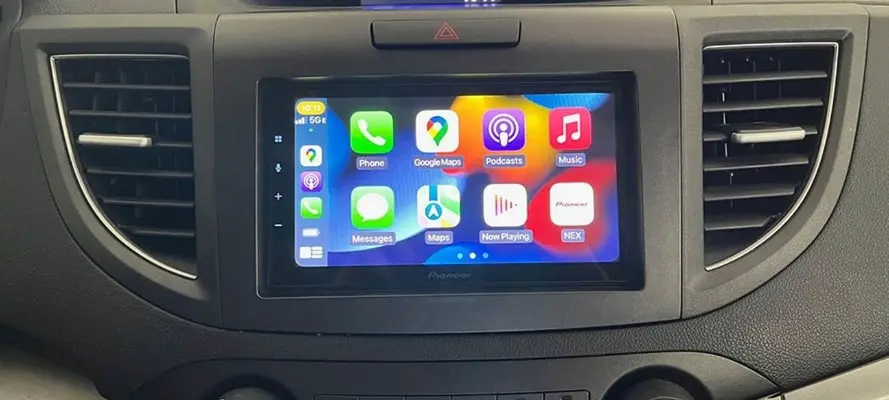
The best double DIN head unit for your car is rarely the most popular one, it is the one built for your specific setup, budget, and daily use. That distinction gets lost fast when every listing leads with the same feature bullets.
We have reviewed 10 of the top-notch double DIN car stereos for 2026 across wireless CarPlay, GPS navigation, sound quality, floating screens, CD/DVD support, and budget tiers, with a clear honest verdict on each.
We weighed each pick’s design, performance, and everyday usability alongside consistent owner feedback to explain what earns it a recommendation and which compromises matter.
If you want the short answer, the Pioneer DMH-W4660NEX is the pick we put first for most drivers, and the sections below explain where each of the other nine is the better call.
Table of Contents
Quick Picks: 10 Best Double DIN Car Stereos
Here is a quick summary of every pick in this guide to help you compare at a glance before reading the full reviews.
1. Pioneer DMH-W4660NEX - Best for Wireless Connection
"Wireless CarPlay and Android Auto in a real double DIN chassis, with Alexa built in, 4V preouts across three pairs and a 3-3/8 inch short chassis depth."
2. Kenwood DMX709S eXcelon - Best for Sound Quality
"The cleanest signal in this guide at 5V across three preout pairs, plus a 13-band EQ, digital time alignment, Hi-Res USB playback and a 2-year warranty."
3. BOSS Audio BVB9358RC - Best Under $100
"Wireless CarPlay and Android Auto plus a backup camera in the box on a 7-inch screen, backed by a 3-year warranty when the unit is bought through Amazon."
4. Pioneer DMH-130BT - Best Under $200
"A 6.8-inch resistive screen with stable Bluetooth, a 13-band EQ, FLAC playback and Alexa through the Pioneer Vozsis app, in a 4-3/8 inch short chassis."
5. Alpine iLX-W670 - Best Under $300
"An ultra-shallow 2.4-inch chassis with wired CarPlay, a 13-band EQ, 6-channel time correction and 4V preouts, with Maestro support on the W670-M variant."
6. JENSEN J1CA7-BUC - Best for Backup Camera
"Certified CarPlay and Android Auto with the BUCAM100J camera in the box, a 1024 x 600 seven-inch screen and 4V preouts, so nothing else needs buying first."
7. Pioneer AVIC-W8600NEX - Best for Built-in GPS Navigation
"Offline HERE maps for the US, Canada and Puerto Rico alongside wireless CarPlay, a disc drive, HD Radio, 4V preouts and iDatalink Maestro compatibility."
8. Pioneer DMH-T450EX - Best Floating Screen
"A 9-inch 1024 x 600 floating display with horizontal, vertical and tilt adjustment, plus a 13-band EQ, FLAC playback and WebLink app projection from USB."
9. JVC KW-V660BT - Best with CD and DVD
"A 6.8-inch capacitive screen with a working disc drive, wired CarPlay and Android Auto, a 13-band EQ with time alignment and dual phone Bluetooth pairing."
10. Kenwood DPX305MBT - Best for Classic and Older Cars
"A mechless double DIN with no touchscreen, a 3-line text display, 2.5V preouts, a 13-band EQ with time alignment and 3-zone variable color illumination."
In-Depth Reviews of the 10 Best Double DIN Head Units
We assessed each double DIN head unit on the details that matter in daily use, including sound control, screen readability, phone connectivity, ease of operation, and installation requirements. Value depends on how well those features serve the driver at the asking price, with strengths and limitations given equal attention.
1. Best for Wireless Connection: Pioneer DMH-W4660NEX 6.8-Inch Receiver

Display | 6.8-inch capacitive |
Resolution | 800 x 480 WVGA |
CarPlay/Android Auto | Wireless and wired |
Preouts | 4V x 3 pairs (6-channel) |
EQ and DSP | 13-band graphic EQ, manual time alignment |
Power | 14W RMS x 4 / 50W x 4 max |
Bluetooth | Yes, with Wi-Fi for wireless CarPlay and Alexa |
Chassis Depth | 3-3/8 inches (7" W x 3-7/8" H) |
The Pioneer DMH-W4660NEX is the best double DIN head unit for wireless CarPlay if you want a real double DIN chassis, solid audio tuning, and cable-free smartphone integration in one package. For a driver who wants a clean dash install without giving up features, it checks the right boxes without asking you to trade one for another.
The chassis is a genuine double DIN, not a single DIN unit behind a larger screen. At 3.375 inches deep, it clears most HVAC ducting and structural bracing behind the dash without needing extra brackets or adapters. It drops into any standard double DIN opening cleanly.
The 6.8-inch capacitive touchscreen runs at 800 x 480, which is the same WVGA panel resolution most competitors use in this bracket, so the display is not where this unit separates itself.
Pioneer's menu layout is easy to navigate. Source switching, EQ access, and Bluetooth pairing all sit within two taps of the homescreen.
Wireless CarPlay and Android Auto connect over Wi-Fi and Bluetooth once your phone is paired. After that, the connection comes back automatically every time you start the car. No cable, no extra steps each time you get in.
Amazon Alexa runs through the unit's Wi-Fi connection rather than through your phone. You can pull up music, weather, and smart home controls directly from the head unit itself. It works whether or not your phone is actively connected.
On the audio side, you get manual time alignment and 4V preouts across all three output pairs. Time alignment lets you set speaker distances per channel, which tightens the stereo image at the listening position.
FLAC and DSD playback via USB handles lossless files natively. iDatalink Maestro compatibility keeps factory steering wheel controls and OEM camera feeds working after the install. It includes two A/V inputs on this chassis, which covers a front or side camera feed alongside the standard backup camera.
A couple of limitations we would mention before you decide. The 4V preouts sit below the 5V in Kenwood's eXcelon line, which matters if you are running a high-powered amplifier and want the cleanest possible signal.
There is no built-in GPS, so navigation depends entirely on your phone. No disc drive either, which is standard for a mechless unit but worth knowing if you are replacing a CD player.
If wireless CarPlay in a genuine double DIN chassis is what you need with solid audio tuning, this is the unit we put at the top of the wireless options.
2. Best for Sound Quality: Kenwood DMX709S eXcelon Double DIN Stereo

Display | 6.8" WVGA capacitive |
Resolution | 800 x 480 |
CarPlay/Android Auto | Wired |
Preouts | 5V x 3 pairs |
EQ and DSP | 13-band + digital time alignment, 3-way crossover, Drive EQ |
Power | 22W RMS / 50W peak x 4 |
Bluetooth | Yes + dual phone pairing |
Chassis Depth | 2-15/16 inches (7.165" W x 4.375" H) |
If you are building around audio quality and want the best double din head unit for sound quality, the Kenwood eXcelon DMX709S is where to start. The eXcelon lineup sits above Kenwood's standard range and uses audiophile-grade internal components that make a measurable difference when the unit is feeding external amplifiers or high-sensitivity speakers.
The most important number here is the preout voltage. At 5 volts across all three pairs, the DMX709S outputs one of the cleanest, strongest signals available in a double DIN receiver. This matters because every amplifier in the chain requires gain to bring the signal up to usable levels.
Higher preout voltage means you run the amp at lower gain to achieve the same output level, which keeps the noise floor quieter and the dynamic range cleaner. If you are pairing this unit with an external amplifier, the 5V output is a solid engineering advantage.
Kenwood's DSP implementation in the eXcelon line is thorough. You get a 13-band graphic equalizer, digital time alignment, and a three-way crossover with high-pass and low-pass filters for the front, rear, and subwoofer channels independently.
The Drive EQ feature boosts the specific frequencies that road noise masks, which keeps detail audible at speed rather than leaving you reaching for the volume knob.
Hi-Res Audio support goes up to 192kHz/24bit via USB, which is well above CD quality. For listeners who store FLAC or WAV files on a USB drive, the DMX709S plays those formats natively without any compression. Kenwood publishes SBC and AAC as the Bluetooth codecs here, so the wireless path is a step below the USB path and the USB input is the one to use for critical listening.
The 6.8-inch capacitive touchscreen is sharp, responsive, and easy to use while driving. Navigation through menus is quick, and the interface layout is clean without unnecessary layers of sub-menus.
Three camera inputs cover front view, rear view, and a third option for a side or trailer camera, which is uncommon at this price and useful in trucks or vehicles that tow frequently.
The 3-inch short chassis is an installation benefit in vehicles with tight dash cavities. Combined with iDatalink Maestro compatibility, the DMX709S integrates well into a wide range of modern vehicle platforms. Kenwood backs the eXcelon line with a 2-year warranty, which is double the standard coverage from most competing brands.
The main downside is wired CarPlay and Android Auto only. Wireless functionality requires an upgrade to the DMX809S. If you have already accepted a cable connection, this is not a daily inconvenience, but it is worth noting if cable-free operation is a priority. There is also no CD or DVD player and no built-in navigation.
For a serious audio build or any setup where signal quality and tuning depth matter, no double DIN head unit at this price matches what the DMX709S delivers. It is the first unit we recommend when sound quality is the deciding factor.
3. Best Under $100: BOSS Audio BVB9358RC 7-Inch Multimedia Receiver
Display | 7-inch capacitive touchscreen |
Resolution | 800 x 480 |
CarPlay/Android Auto | Wireless |
Preouts | 3 pairs (front, rear, sub) |
EQ and DSP | Preset EQ with bass, treble, balance and fader |
Power | 80W x 4 max |
Bluetooth | Yes |
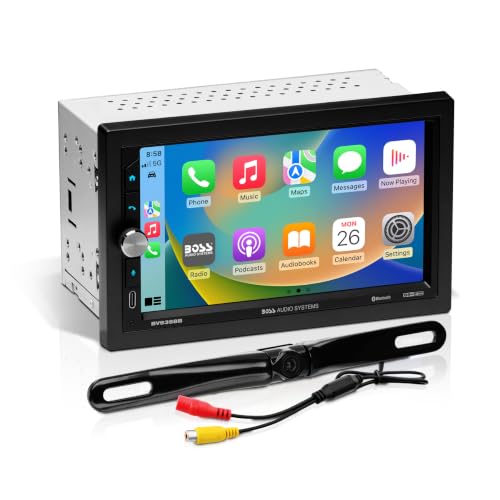
Finding the best low cost double DIN car stereo with wireless CarPlay is harder than it sounds. Most units in this bracket either skip CarPlay entirely or include Android-based interfaces that require firmware maintenance and lack the reliability of a dedicated receiver.
The BOSS Audio BVB9358RC fills that gap by offering wireless Apple CarPlay and Android Auto at a price point where most of the competition is still limited to Bluetooth streaming only.
The 7-inch touchscreen is larger than what you typically see from budget units, which makes it easier to read navigation prompts and media controls at a glance while driving. At 800 x 480 the panel is the lowest-resolution screen in this guide relative to its size, and owners consistently report that it washes out in direct sun, so a west-facing afternoon commute is the situation to think about before buying.
Wireless CarPlay works through the standard Apple protocol and connects automatically once your phone is paired. The experience is not as smooth as what you get from a Pioneer, Kenwood, or Sony at double the price, but it features the core functions reliably. Maps, calls, music streaming, and Siri access all work as expected. For a vehicle that needs a basic upgrade without a large spend, this is a practical solution.
The backup camera is included in the box, which removes an additional purchase from the equation. At this price, having camera hardware bundled is a convenience rather than just a marketing line. The included camera is basic but functional for parking assistance.
BOSS Audio's 3-year platinum warranty provides coverage that most budget brands do not offer. That warranty coverage is worth factoring into the total value of this unit, since budget electronics at this price bracket have a higher variability in component quality.
A couple of things worth knowing before you decide. BOSS publishes 80W x 4 as a maximum rating and does not publish an RMS figure, so the number on the box is not what the internal amplifier produces in clean output.
Preout voltage is not published either, which makes this a poor starting point if you plan to add an external amplifier later. The interface also shows its budget origins in menu navigation speed and responsiveness. The most consistent owner complaint is hands-free call quality, where the supplied microphone picks up enough cabin noise that buyers routinely replace it.
This is not a unit for audiophiles or drivers who care about signal quality. It is for a beater vehicle, a secondary car, or anyone who just needs wireless phone integration and a working backup camera without a larger budget commitment. If someone asks us for the best affordable double DIN car stereo, the BVB9358RC is the first name we'd suggest them.
4. Best Under $200: Pioneer DMH-130BT 6.8-Inch Double DIN Receiver

Display | 6.8-inch resistive touch |
Resolution | 800 x 480 WVGA |
CarPlay/Android Auto | No |
Preouts | 2V x 5-channel |
EQ and DSP | 13-band graphic EQ, high-pass and low-pass crossover, no time alignment |
Power | 14W RMS x 4 / 50W x 4 max |
Bluetooth | Yes, hands-free and audio streaming |
Chassis Depth | 4-3/8 inches (7" W x 3-7/8" H) |
The Pioneer DMH-130BT is a solid pick for drivers who need a clean, reliable head unit without the complexity or cost that CarPlay and Android Auto bring to this price bracket. Pioneer built the DMH-130BT around Bluetooth connectivity as the primary smartphone link, which keeps the interface simpler and the price accessible without sacrificing screen quality or build reliability.
The 6.8-inch resistive touchscreen covers daily use reliably. It requires slightly more deliberate input than a capacitive panel, but Pioneer's touch calibration is consistent and the screen responds accurately under normal operating conditions.
The display supports five color customization options and multiple background image settings, which helps the unit blend with a vehicle's interior rather than looking generic.
Bluetooth performance on the DMH-130BT is consistently stable across reports from verified buyers. Hands-free calling is clear, and audio streaming stays connected without frequent dropout issues common in no-name brands at this tier. Pioneer's Bluetooth implementation is one of the more dependable in the budget segment, and that consistency matters in a unit you will use every day.
Amazon Alexa integration via the Pioneer Vozsis app adds a layer of voice control that partially compensates for the absence of CarPlay and Android Auto. You can access Alexa for music playback, calls, messages, and general commands without taking your eyes off the road. It is not the same as native CarPlay, but it is more than Bluetooth streaming alone provides.
The short chassis depth of 4.375 inches is a practical installation advantage. Pioneer designed this unit to fit in vehicles where longer chassis units conflict with HVAC components or cross-members behind the dash. Combined with Axxess ASWC-1 steering wheel control compatibility, the DMH-130BT installs cleanly in a wide range of older and modern vehicles.
FLAC high-resolution audio playback via USB is included, which allows lossless audio files to play without compression through the internal amp. For the price, this is not a feature every competing unit includes. It features a 13-band graphic EQ, so the tuning limit is not the equalizer itself, it is the absence of time alignment, which leaves you correcting tone without being able to correct speaker distance.
A couple of things worth knowing before you decide. There is no Apple CarPlay or Android Auto on this unit. If smartphone mirroring is a hard requirement, this is not the right pick, and the Pioneer DMH-1770NEX or DMH-2660NEX would be more appropriate alternatives in the same price vicinity.
The 2V preout voltage is also low for any driver planning to add an external amplifier later. And while the Bluetooth is reliable, it does not support advanced codecs like aptX.
As a clean, reliable, daily-driver Bluetooth stereo, the DMH-130BT is our pick for the best double DIN car stereo in the mid budget tier for drivers who do not need CarPlay. It is one of the value picks we recommend when your budget is firm at this level.
5. Best Under $300: Alpine iLX-W670 Digital Multimedia Receiver

Display | 6.75-inch capacitive touch |
Resolution | 800 x 480 WVGA |
CarPlay/Android Auto | Wired |
Preouts | 4V x 3 pairs |
EQ and DSP | 13-band graphic EQ, 6-channel time correction, front, rear and sub crossovers |
Power | 16W RMS x 4 / 50W peak x 4 |
Bluetooth | Yes, hands-free and audio streaming |
Chassis Depth | 2.4 inches (7" W x 3-7/8" H) |
The Alpine iLX-W670 is our go-to recommendation for those who one a stereo under 300 bucks. At 2.4 inches deep, it is among the shallowest double DIN receivers Alpine publishes a depth for, and that measurement solves installation problems that rule out every other unit in this bracket.
Vehicles with compact dashboards, tight HVAC clearances, or older Japanese and European designs often cannot fit the 5 to 6-inch chassis depth of standard head units without modification. The iLX-W670 drops into those spaces without conflict.
The shallow chassis is not the only reason it stands out. Alpine built it with a full audio tuning suite that competes with units well above this price bracket. The 13-band graphic EQ provides standard frequency control, while the 6-channel time alignment lets you set precise speaker distances for front, rear, left, right, and subwoofer channels independently.
Independent crossovers for each output let you roll off frequencies at custom points per channel rather than applying a global crossover setting. That level of tuning depth in this bracket is uncommon and makes it a legitimate option for drivers building around a modest amplifier setup.
The 6.75-inch capacitive touchscreen is responsive, well-calibrated, and clean in layout. Alpine markets this panel as a 7-inch display while the manual specifies 6.75 inches, so treat the smaller figure as the one to measure against.
Menus are logically arranged, and the two-finger swipe navigation for switching sources is intuitive once learned. Display brightness holds up reasonably in daylight and is competitive for the price.
Wired Apple CarPlay and Android Auto perform reliably. The connection is stable and does not depend on Wi-Fi or Bluetooth negotiation, which eliminates the latency and dropout issues that wireless implementations sometimes introduce. For drivers who do not mind the cable, wired CarPlay is often the more consistent experience.
The iLX-W670-M variant adds iDatalink Maestro compatibility, which enables factory steering wheel control retention, OEM camera integration, and vehicle data display in compatible vehicles.
The base iLX-W670 does not carry Maestro support, so the variant you order decides whether factory integration is on the table. This makes it a practical choice for truck owners and drivers of modern vehicles where the factory electronics are interconnected. PowerStack compatibility lets you stack a compatible Alpine amp directly behind the head unit bracket, saving a remote install location entirely.
A couple of things worth knowing before you decide. Wireless CarPlay requires an upgrade to a higher-tier Alpine model. There is no CD or DVD player and no built-in GPS navigation. Anyone who needs offline maps or disc playback should look at the Pioneer AVIC-W8600NEX instead. The 16W RMS x 4 is also lowest internal amplifier rating among the touchscreen picks in this guide, so the factory speakers will sound their best once an external amp is on the 4V preouts.
For a tight dash install with proper audio tuning built in, the iLX-W670 is the double DIN head unit we put ahead of anything else at this price. For more options at this budget, our best car stereos under $300 guide includes the models worth considering.
6. Best for Backup Camera: JENSEN J1CA7-BUC Double DIN Car Stereo

Display | 7-inch touchscreen |
Resolution | 1024 x 600 |
CarPlay/Android Auto | Certified, wired over USB |
Preouts | 4V x 3 pairs (front, rear, sub) |
EQ and DSP | 8-band graphic EQ, 8 presets, time alignment |
Power | 50W x 4 / 22W RMS x 4 |
USB | Rear USB-C |
The JENSEN J1CA7-BUC is built for a specific situation. You want CarPlay, Android Auto, and a backup camera installed as one purchase without hunting separately for compatible camera hardware. JENSEN bundles the BUCAM100J camera in the box, which removes the compatibility guesswork that comes with pairing aftermarket cameras to head units from different manufacturers.
The CarPlay certification matters here. JENSEN uses the term "certified" for a reason, which means the unit has passed Apple's verification process for CarPlay integration rather than relying on an unofficial implementation. This distinction affects connection reliability and long-term compatibility with iOS updates, which is a real concern with cheaper Android-based units that replicate the CarPlay interface without native support.
Android Auto covers the Android side of smartphone integration. Both platforms connect via USB, and the 7-inch touchscreen provides enough display space to use navigation, calls, and media controls comfortably.
At 1024 x 600 it is the sharpest panel of any pick in this guide under the flagship tier, which shows most in map detail and text legibility. The interface is not as polished as Pioneer's or Kenwood's menus, but it covers the core functions without confusion.
Integration is the area we’d verify before buying. JENSEN supports steering wheel controls through a compatible adapter, but it does not list iDatalink Maestro or Metra Axxess integration for this model. That means vehicle compatibility should be confirmed in advance rather than assuming a Maestro module will retain factory controls. This is especially important in trucks, where factory audio and steering wheel control setups can vary significantly by trim.
The included backup camera connects directly to the head unit's dedicated camera input, and the unit automatically switches to the camera feed when the vehicle is placed in reverse. The camera quality is functional rather than premium but serves its purpose when reversing. Here is where we would temper expectations.
Its 4V preouts match the Pioneer and Alpine units in this guide and improve on the 2V outputs found on the JVC and Pioneer DMH-130BT. That gives an external amplifier a cleaner signal to work with, so adding an amp later is a realistic upgrade path rather than an afterthought.
The real ceiling is the equalizer, which is 8-band with 8 presets rather than the 13-band graphic EQ that Kenwood or Alpine give you. The chassis plastics also feel less substantial compared to Pioneer or Sony units in the same range.
That said, the J1CA7-BUC is not competing with eXcelon-level audio hardware. It is competing as the most complete out-of-box upgrade for anyone who needs CarPlay, Android Auto, and a backup camera in one affordable package. On that basis, it delivers well.
7. Best for Built-in GPS Navigation: Pioneer AVIC-W8600NEX

Display | 6.94-inch capacitive |
Resolution | 800 x 480 WVGA |
CarPlay/Android Auto | Wireless and wired |
Preouts | 4V x 3 pairs |
EQ and DSP | 13-band + time alignment |
Power | 14W RMS x 4 / 50W peak x 4 |
Bluetooth | Yes, with Wi-Fi and dual phone connection |
Chassis Depth | 6-1/2 inches (7" W x 3-7/8" H) |
The Pioneer AVIC-W8600NEX is the best double din head unit with navigation for drivers who need reliable offline maps that work independently of their phone's data connection. Unlike phone-dependent navigation through CarPlay or Android Auto, the built-in navigation continues working in areas with poor cell coverage, in underground parking structures, or whenever a data-free map solution is preferred. The pre-loaded HERE maps provide offline navigation coverage across the United States, Canada, and Puerto Rico.
Pioneer's AVIC navigation system is among the most respected in the aftermarket segment. The turn-by-turn guidance includes lane guidance, enhanced junction views, speed limit warnings, and traffic data supplied with the map package. A gyro sensor supplements GPS signal in locations where satellite reception is limited, such as tunnels or dense urban environments, maintaining navigation continuity without signal gaps.
Wireless Apple CarPlay and Android Auto coexist with the built-in navigation, which is the practical advantage of this unit over phone-based nav alone. You can run the onboard maps independently and switch to CarPlay for music, messaging, and calls simultaneously.
The 6.94-inch capacitive touchscreen sits on a motorized mechanism rather than a floating arm, so it folds down flat against the dash and handles both interfaces smoothly without adding height above the DIN opening.
The 4V preouts deliver a strong, clean signal to external amplifiers, and Pioneer includes three pairs covering front, rear, and subwoofer channels. HD Radio is built in rather than requiring an add-on tuner, and iDatalink Maestro compatibility handles the factory-integration side of the installation, helping retain supported OEM features after the head unit swap. Wi-Fi connectivity enables over-the-air firmware updates and additional feature integration through Pioneer's app ecosystem.
The AVIC-W8600NEX also includes a CD and DVD player, which is not common at this tier and adds media flexibility for drivers who still use disc-based content.
The cons are real at this price. Map updates require a microSD card and a download from Pioneer's website, which is less convenient than the automatic updates available in newer factory-integrated systems. The initial setup is also more involved than a standard mechless head unit, since calibrating the navigation, connecting Maestro modules, and configuring dual-source audio takes time to do properly.
The chassis is also 6.5 inches deep, the deepest of anything in this guide, so the dash cavity behind your opening needs measuring before this one is ordered. And the price sits at the higher end of the aftermarket segment, which is appropriate for what it delivers but worth acknowledging.
For anyone who needs offline GPS alongside modern wireless smartphone integration in a single unit, the AVIC-W8600NEX is the one we recommend without hesitation in the aftermarket double DIN space.
8. Best Floating Screen: Pioneer DMH-T450EX Double DIN Receiver

Display | 9-inch capacitive touch, floating |
Resolution | 1024 x 600 |
CarPlay/Android Auto | No, WebLink app projection over USB instead |
Preouts | 2V x 5-channel (front, rear, sub) |
EQ and DSP | 13-band graphic, high-pass and low-pass crossover |
Power | 14W RMS x 4 / 50W peak x 4 |
Bluetooth | Yes, hands-free and audio streaming |
The Pioneer DMH-T450EX is the right option for anyone who wants the largest display available without paying for the flagship-level feature sets of the Pioneer WT series. The 9-inch capacitive floating touchscreen positions itself above the DIN slot on an adjustable mounting arm, which allows it to sit higher in the dash where a display that size is more naturally visible while driving.
The 1024 x 600 resolution is noticeably sharper than the 800 x 480 WVGA standard common in most double DIN units at this price. Text is cleaner, navigation maps render with more detail, and projected phone apps look closer to what you see on the handset itself. The screen supports brightness adjustment and five key color customizations, and Pioneer includes three preset background images for personalizing the homescreen.
Screen adjustability is a practical advantage that does not get enough attention. The floating mount allows horizontal position adjustment, vertical height adjustment, and tilt angle control. This matters in vehicles where the center console sits at an awkward height, or where a standard-position 9-inch screen would obstruct air vents or shifter visibility. Being able to dial in the exact position makes the install work in more vehicle types.
Connectivity needs a closer look on the DMH-T450EX. Apple CarPlay and Android Auto are not supported. Instead, Pioneer uses WebLink for USB-based access to a limited selection of compatible iPhone and Android apps, while Amazon Alexa works through the Pioneer Vozsis app.
WebLink covers navigation, music and video apps inside its own catalogue, and it is a smaller catalogue than the CarPlay and Android Auto libraries. If projected maps and media are all you wanted from a phone connection, WebLink does that job on a 9-inch screen for less than a CarPlay unit of the same size.
The 13-band EQ and USB FLAC playback give the DMH-T450EX a solid audio foundation for the price. Front, rear, and subwoofer RCA preouts also leave room for external amplification, but Pioneer rates them at just 2V. That makes this a better fit for buyers prioritizing the screen and everyday features than for a more ambitious amplified system, where the 4V and 5V models above provide a stronger starting point.
One thing we would flag before you decide. A driver moving up from a factory radio for the sake of CarPlay will not find it here, and the DMH-WT series is where Pioneer puts wireless CarPlay on a large screen. The 9-inch 16:9 screen needs enough clearance around the DIN opening to avoid blocking air vents, climate controls, or frequently used buttons. Check the available space in your dash before buying, especially since the panel’s full outer dimensions are not listed.
If a large display at a reasonable cost is the priority and you do not need native phone projection, the DMH-T450EX is the one we recommend without hesitation.
9. Best with CD and DVD: JVC KW-V660BT Double DIN Head Unit

Display | 6.8-inch capacitive touchscreen |
Resolution | 800 x 480 WVGA |
CarPlay/Android Auto | Wired |
Preouts | 2V x 5-channel (front, rear, sub) |
EQ and DSP | 13-band + digital time alignment, high-pass and low-pass filters |
Power | 22W x 4 full bandwidth / 50W x 4 max |
Bluetooth | Yes + dual phone pairing |
The JVC KW-V660BT is our pick for drivers who are not ready to abandon physical media but want full Apple CarPlay and Android Auto alongside disc playback. JVC managed to put both into the same chassis at a price that undercuts most competing DVD receivers, which makes the V660BT the practical choice.
The combination of disc playback and wired CarPlay in a single double DIN unit is rarer than most drivers expect. Most manufacturers have dropped CD and DVD support from their CarPlay-enabled lines to free up chassis space for shallower designs. JVC's KW-V series keeps the disc slot while adding CarPlay, which serves a specific but loyal segment of drivers who use both.
The 6.8-inch capacitive touchscreen handles CarPlay, DVD menus, and radio controls from the same interface without requiring separate button panels. Interface navigation is clean and JVC's menu layout is one of the more intuitive among mid-range brands. Dual phone Bluetooth pairing allows two phones to stay active simultaneously, which is practical for shared vehicles or drivers who carry both personal and work phones.
The 13-band graphic EQ provides full tonal control across the frequency range, and SiriusXM readiness allows satellite radio with an optional tuner add-on. The backup camera input activates automatically when the vehicle goes into reverse, and JVC's parking guide line overlay helps with distance calibration.
Audio quality from the built-in amplifier at 22W x 4 full bandwidth is competitive for a receiver with a disc mechanism, and it matches the Kenwood eXcelon pick on that figure even though the preout side does not. FLAC file playback via USB covers high-resolution audio from a drive when disc is not in use. The preout configuration supports front, rear, and subwoofer connections for external amplifiers.
The downsides are inherent to having a disc drive. The chassis is deeper than a mechless unit, which requires confirming cavity depth before installation. There is no wireless CarPlay, and the 2V preout voltage limits the headroom available for high-powered external amplifier builds compared to 4V or 5V units.
For disc users who still have a collection of CDs, a car full of children who watch DVDs on road trips, or anyone who prefers physical media as a backup to streaming, the KW-V660BT is the best double DIN DVD car stereo that also handles modern smartphone integration. It is the most balanced option of its kind here and the one we recommend when disc playback is a hard requirement.
10. Best for Classic and Older Cars: Kenwood DPX305MBT Digital Media Receiver

Display | 3-line LCD (no touchscreen) |
Resolution | Not applicable, 420-segment text display |
CarPlay/Android Auto | No |
Preouts | 2.5V x 3 pairs (front, rear, sub) |
EQ and DSP | 13-band + digital time alignment, independent crossovers, Drive EQ |
Power | 22W RMS / 50W peak x 4 |
Bluetooth | Yes (dual phone pairing) |
Color illumination | 3-zone variable color |
The Kenwood DPX305MBT is our pick for classic and older car builds because it delivers modern audio performance and Bluetooth connectivity in a form factor that does not overwhelm a vintage dashboard. The face is a clean, button-and-knob layout with a small 3-line LCD display rather than a large touchscreen, which means it does not look out of place in a 1970s muscle car or a pre-1990s Japanese import.
Classic car owners and restomod builders consistently run into the same problem. Modern head units with 7-inch touchscreens look visually jarring in period dashboards designed around compact radio faces. The DPX305MBT solves that problem. The low-profile face fits within the double DIN opening without dominating the visual space, and the 3-zone variable color illumination allows the backlighting to be set per zone to match the factory gauge cluster lighting rather than clashing with it.
Audio performance inside this modest-looking chassis is solid for the price. The 2.5V preouts handle standard amplifier connections cleanly, which is adequate for a classic car build pairing the unit with a modest external amplifier. They sit below the 5V output of Kenwood's eXcelon line, but for this price point and application the signal quality holds up well.
The 13-band graphic EQ with digital time alignment gives complete frequency and staging control. Time alignment at this price point is not standard, and its inclusion in the DPX305MBT reflects Kenwood's consistent approach to audio tuning across the lineup. Independent crossovers for front, rear and subwoofer channels come with it, which is the same crossover structure Kenwood puts in the eXcelon receiver higher up this guide.
Dual Bluetooth phone pairing means two phones can stay connected simultaneously, and hands-free calling is handled through an external microphone included with the unit. Amazon Alexa support needs a closer look here. The unit is Alexa Ready, with voice access handled through a paired smartphone rather than fully built into the receiver. If hands-free Alexa without relying on your phone is important, this is not the setup to assume will provide it.
The downsides are by design. There is no touchscreen, no Apple CarPlay, and no Android Auto. The DPX305MBT is built around Bluetooth and USB playback, with AM/FM radio as the primary radio source.
For some drivers this is a deal-breaker, but for classic car applications the clean face and low-profile footprint are exactly the point. The limitation that catches people out is the camera input, or rather the absence of one.
There is no rear camera input, so a restomod that needs reversing-camera support will require either a separate display or a different receiver.
For classic and older car builds where the aesthetic integrity of the dash matters as much as the audio performance, the DPX305MBT is the most purpose-fit option in this guide. It is the one we point classic owners to when a modern face is the thing they are trying to avoid.
Fitment and Chassis Depth Across These Picks
These 10 picks do not share the same installation requirements, and dash depth is the first measurement we would check. A receiver can look like the right fit on paper and still create problems if the chassis is too deep for the cavity behind the DIN opening. Measure that space before choosing, then use the three groups below to narrow the options that are realistic for your vehicle.
What To Consider When Choosing a Double DIN Head Unit
The reviews above identify the strongest options. This section focuses on the factors that should decide between them. We have kept it concise so you can compare the essentials quickly, while our How to Choose a Double DIN Head Unit guide goes deeper into each buying factor.
Decide Between Wireless and Wired CarPlay First
Wireless is more convenient but adds cost and occasional latency. Wired is more stable and works across a wider price range. Decide which you actually need before filtering by it. Most drivers who think they need wireless are fine with wired once the cable becomes habit.
Match Preout Voltage to Your Amplifier Plans
2V is entry-level and adequate for stock speaker setups. 4V and 5V deliver a cleaner signal to external amplifiers and keep system noise down. If you plan to add an amplifier, 4V or higher is worth prioritizing from the start.
Measure Your Dash Cavity Before You Buy
Standard units run 5 to 7 inches deep. Shallow-chassis units go as low as 2.4 inches. Measure your dash cavity before buying. This is the step most people skip and regret. If you are unsure where to start, see our guide to identifying your car stereo size.
Choose a Capacitive Screen If the Budget Allows
Capacitive screens respond to a light touch and are visually sharper. Resistive screens require more pressure and feel dated by comparison. Most units above the entry tier use capacitive panels. If budget allows, do not settle for resistive.
Check iDatalink Maestro Support Against Your Vehicle
Maestro is essential if you want to keep factory steering wheel controls, OEM cameras, or vehicle data displays working after the install. Not all units support it, and not all vehicles need it. Support can also vary by variant rather than by model, as the Alpine iLX-W670 and iLX-W670-M show. Check your vehicle before assuming either way.
Look for Time Alignment, Not Just an EQ
A 13-band EQ with time alignment gives you real control over how your system sounds. Without time alignment, you are limited to basic frequency adjustments that do not account for speaker placement in the cabin. It matters most in amplified builds.
Skip the Disc Drive Unless You Still Use One
Mechless units are shallower, boot faster, and cover the needs of most drivers in 2026. A disc player is worth the deeper chassis only if physical media is still a regular part of how you listen.
Set Your Budget Tier Before You Compare Features
Price changes what matters. Entry-level receivers focus on Bluetooth, basic touchscreen functions, and occasional wireless CarPlay support. Move up a tier and you generally gain a better display, stronger build quality, and more dependable connectivity. Higher-priced models start to justify the extra cost with deeper audio tuning, stronger preamp sections, and more installation flexibility. At the top end, features such as wireless smartphone integration, built-in navigation, and higher-grade hardware account for much of the premium.
If you have not settled on the radio format yet, our single DIN vs double DIN comparison explains the fit, screen, and feature differences worth considering before you set a budget.
Frequently Asked Questions
What is the best double DIN head unit for the money?
The Alpine iLX-W670 is our pick in this category. In its budget tier, it covers wired CarPlay, an ultra-shallow chassis, and a tuning suite most units at this price skip entirely. For a sound-quality focused build, the Kenwood DMX709S eXcelon is the stronger call with 5V preouts and Hi-Res audio support.
Do I need wireless CarPlay, or will wired work?
Wired is fine for most drivers. The connection is more stable and the price is lower. Wireless makes sense if you find plugging in a cable every drive genuinely inconvenient. Both deliver the same CarPlay experience once connected.
What is the best shallow mount double DIN head unit?
The Alpine iLX-W670 at 2.4 inches deep is the shallow mount pick in this guide. The Kenwood DMX709S eXcelon follows at 2-15/16 inches and adds 5V preouts if the build is amplified. Both fit openings where a standard 5 to 7-inch chassis will not clear the ductwork behind the dash.
What is the best double DIN head unit for subs?
The Kenwood DMX709S eXcelon is the one to start with for a subwoofer build. It gives you a dedicated 5V subwoofer preout pair, a three-way crossover with independent high-pass and low-pass filters, and digital time alignment to keep the sub integrated with the front stage. The Pioneer AVIC-W8600NEX and the Alpine iLX-W670 are the 4V alternatives.
Can I install a double DIN head unit myself?
Yes. Most installs are manageable at home with a wiring harness adapter and a vehicle-specific dash kit. If your vehicle has a CAN-bus system, you will likely need an iDatalink Maestro module too. We would check the touchscreen car stereo installation guide before starting.
What is the difference between a capacitive and resistive touchscreen?
Capacitive screens are faster, more responsive, and visually sharper. Resistive screens require physical pressure and feel dated by comparison. Above the entry tier, most units use capacitive panels. For the full breakdown, find our capacitive vs resistive touchscreen guide.
What brand makes the best double DIN car stereo?
Pioneer, Kenwood, Alpine, Sony, and JVC all make reliable units. Pioneer leads on navigation and floating screens. Kenwood eXcelon leads on audio tuning depth. Alpine leads on shallow chassis and sound-quality builds. Sony hits a strong mid-range value point. JVC is the best call if DVD playback alongside CarPlay is a requirement.
What is iDatalink Maestro and do I need it?
iDatalink Maestro is a module that lets an aftermarket head unit communicate with your vehicle's factory systems. It keeps steering wheel audio controls, OEM cameras, and vehicle data displays working after the swap. You need it in most post-2010 vehicles where factory electronics are interconnected. Not every head unit supports it, so confirm compatibility before buying.
How do I know what double DIN head unit fits my car?
Measure the opening in your dash. A 4-inch tall and 7-inch wide slot confirms a double DIN opening. Also measure the cavity depth behind it before buying.
Is Apple CarPlay better than Android Auto?
Both mirror your phone's interface on the head unit screen and work the same way in practice. CarPlay is for iPhone. Android Auto is for Android. Match the platform you already use daily. For a side-by-side comparison, see our Apple CarPlay vs Android Auto Guide.
What is the best double DIN head unit for trucks?
The Pioneer AVIC-W8600NEX and Kenwood DMX709S eXcelon are the two we point to first. Both support iDatalink Maestro for steering wheel control retention in Ford, GM, and Ram platforms. The AVIC adds offline GPS, which is a practical bonus for work trucks in areas with patchy cell coverage.
Final Verdict: Which One Should You Choose?
We picked every unit in this guide for a reason, and finding the best double DIN head unit for your car depends on how you actually use it, not which model has the longest spec list. The Pioneer DMH-W4660NEX is the overall pick for most drivers, because wireless CarPlay in a true double DIN chassis with 4V preouts and a 3-3/8 inch depth covers more vehicles and more use cases than anything else here.
For audio quality and amplifier builds, the Kenwood DMX709S eXcelon leads with 5V preouts and Hi-Res audio support.
On a budget, the BOSS BVB9358RC covers wireless CarPlay in the entry tier, the Pioneer DMH-130BT is the reliable Bluetooth pick a tier up, and the Alpine iLX-W670 is the go-to above that for tight dash installs. The JENSEN J1CA7-BUC handles the backup camera bundle out of the box.
The Pioneer AVIC-W8600NEX is the only choice here if offline GPS is a hard requirement. The Pioneer DMH-T450EX gives you the largest screen in a standard install as long as you do not need CarPlay with it. The JVC KW-V660BT is the practical call for disc users who still want CarPlay. And the Kenwood DPX305MBT is built specifically for classic and older car owners who want modern audio without a modern face.
Before you buy, confirm your dash size, measure the cavity depth, and match the unit to your daily use. Across the picks we have researched, a well-matched mid-range unit will always outperform a flagship in the wrong vehicle.
Explore More From Our Double DIN Coverage
- Related: How to choose a double DIN head unit
- Related: Single DIN vs double DIN car stereo compared
- See Also: Best car stereo with GPS navigation
- See Also: Best floating screen car stereos
- See Also: Best car stereos with a backup camera included
- Read Also: How to identify your car stereo slot size
- Read Also: How to install a touchscreen car stereo
Working with a single DIN slot instead? We have covered the best single DIN head units across every budget and use case.