
Back-over crashes happen at walking pace, in driveways and parking lots, and almost always because the driver could not see something low sitting behind the bumper. A rear camera closes that gap. It only helps, though, if the screen feeding it is one you actually want looking back at you for the rest of the drive.
So which deserves more of your budget, the camera or the head unit it plugs into?
Both, and that tension is what makes shopping for the best car stereo with backup camera harder than it looks. Some receivers include the camera and cut corners on the audio section. Others hand you 4-volt preouts and 6-channel time correction, then leave the camera as a separate line item. We worked through manufacturer specifications and owner reports for all 10 models below and held each one to the same checks, covering what the camera input actually does, how much detail the screen resolves, what the preamp outputs can feed, and how deep the chassis sits behind your dash opening.
Our overall pick is the ATOTO A5LG2A7T-S01, because it is the only unit here that runs an open Android system, projects wireless CarPlay, and ships with the camera already in the box. Your dash and your amp plans decide the rest, and you're in the right place to sort out which of these 10 belongs in your car.
Table of Contents
Quick Picks Among the Best Car Stereos with Backup Camera
Each line below names the one thing we would buy that model for. Nine of the 10 include a camera, and we flag the exception where it appears.
1. Best Overall: ATOTO A5LG2A7T-S01 7-inch Double DIN Car Stereo
Open Android, wireless CarPlay and the camera in one box, plus a 24-band DSP no closed-system pick here matches, though the glossy panel throws reflections.
2. Best for Sound Quality: Alpine iLX-W670-M Double DIN Car Stereo
Three 4V preouts, 6-channel time correction and a 2.4-inch chassis make this our tuning pick, but the camera is the one part Alpine leaves out of the box.
3. Best Certified CarPlay: JENSEN J1CA7-BUC Double DIN Car Stereo
Certified CarPlay, a 1024 x 600 capacitive panel and a camera in the box, backed by four years of coverage once you register within 60 days of buying.
4. Best Bundle: SJoyBring W021 QLED 7-inch Double DIN Car Stereo
Head unit, 170-degree backup camera and a dash cam in one purchase, with four RCA channels and two separate subwoofer outputs behind a 1280 x 720 QLED panel.
5. Best Budget: PLZ 7-inch Wireless Double DIN Car Stereo
The least costly route here into wireless CarPlay with a camera included, dual sub outputs and a 10-band EQ, though PLZ states plainly that it carries no Wi-Fi hotspot.
6. Best for Factory Integration: KENWOOD DMX5710S 6.8-inch Receiver
One of two picks here that keeps factory gauges alive through iDatalink Maestro, and the only one of that pair adding wireless CarPlay on a 3-3/8-inch chassis.
7. Best Wireless CarPlay Under $200: BOSS Audio BE920WCPA-C Car Stereo
Wireless CarPlay, 4V preouts, two camera inputs and five years of warranty, with camera and GPS antenna supplied, though preset curves stand in for real EQ bands.
8. Best Floating with Certified CarPlay: Jensen J1CA10FL-BUC Stereo
A 10.1-inch floating panel that mounts in single or double DIN openings, with certified wireless CarPlay, three 4V preouts and the camera already included.
9. Best Floating with Built-In GPS: ATOTO A5LG110PT QLED Head Unit
Its own GNSS receiver and offline Android maps hold the route when phone signal drops, behind a 1280 x 800 floating QLED panel with 4V RCA outputs and 24-band EQ.
10. Best No-Installation Setup: HAUXIY Q9S 9-inch Portable Screen
Runs off the 12-volt socket with nothing cut or unplugged, adding wireless CarPlay, a 4K dash cam and a 1080p rear camera to any dash in roughly ten minutes.
Compare All 10 Car Stereos with Backup Camera
The fastest way to narrow this list is the camera column, then the preout column. Everything else follows from those two.
Pick | Best For | Screen | Power | Preouts | Check Price |
|---|---|---|---|---|---|
1. ATOTO A5LG2A7T-S01 | Best Overall | 7 in, 1280 x 720 IPS/QLED | 24W x 4 RMS; 45W x 4 max | 1 sub out, 4.1 ch; voltage not published | |
2. Alpine iLX-W670-M | Best for sound quality | 6.75 in, 800 x 480 | 16W x 4 RMS | 3 pairs (front, rear, sub), 4V | |
3. JENSEN J1CA7-BUC | Best for Certified CarPlay | 7 in, 1024 x 600 capacitive | 60W x 4 peak; RMS not published | 3 pairs (front, rear, sub), 4V | |
4. SJoyBring W021 | Best for backup camera & dash cam combo | 7 in, 1280 x 720 QLED | 240W max (60W x 4); RMS not published | 4-channel RCA plus 2 subwoofer outs | |
5. PLZ 7-inch | Best budget | 7 in, 1024 x 600 IPS | 240W max; RMS not published | 4-channel RCA plus 2 subwoofer outs | |
6. KENWOOD DMX5710S | Best for Factory Integration | 6.8 in, 1024 x 600 capacitive | 22W x 4 RMS; 50W x 4 max | 2 pairs plus sub out, 2.5V | |
7. BOSS BE920WCPA-C | Best for Wireless CarPlay at low cost | 7 in, 1024 x 600 capacitive | 20W x 4 RMS; 85W x 4 peak | 5-channel (front, rear, mono sub), 4V | |
8. Jensen J1CA10FL-BUC | Best for Certified CarPlay | 10.1 in capacitive floating; resolution not published | 60W x 4 peak; RMS not published | 3 pairs (front, rear, sub), 4V | |
9. ATOTO A5LG110PT | Best for Built-In Navigation | 10.1 in, 1280 x 800 QLED floating | 24W x 4 RMS; 45W x 4 max | 4V RCA, front, rear and sub | |
10. HAUXIY Q9S | Best for no-install reverse camera | 9 in portable touchscreen | No internal amplifier | None; audio leaves by Bluetooth, FM or AUX |
Reviews In-Depth of the Best Car Stereos with Backup Camera
The 10 reviews below run in our ranked order and apply the same five checks to every model. Where a unit is merely adequate at something, we say that rather than dress it up, since a receiver that included a camera to hit a price will usually show the saving somewhere else.
1. Best Overall: ATOTO A5LG2A7T-S01 7-inch Double DIN Car Stereo
Running a full Android system behind wireless CarPlay is what earns the A5LG2A7T-S01 our best overall pick, because it is the only stereo here that still shows a map and plays music when your phone stays in your pocket.

Power | 24W x 4 RMS; 45W x 4 max |
Display | 7 in, 1280 x 720 IPS/QLED |
Preouts | 1 subwoofer output, 4.1-channel; voltage not published |
EQ and Tuning | 24-band EQ, 9 presets, DSP time correction, HPF/LPF |
Smartphone | Wired and wireless Apple CarPlay and Android Auto, phone mirroring |
Camera | Rear camera included; RCA input |
Radio and Media | FM/AM, microSD and USB to 128GB each, Wi-Fi hotspot on 2.4 and 5GHz, Bluetooth and USB tethering |
Fit | Double DIN |
The ATOTO A5LG2A7T-S01 suits the driver who wants the best car stereo with backup camera without handing over control of what runs on the screen. It sits on ATOTO's A5 Lite platform, a quad-core Cortex-A53 at 1.3GHz with 2GB of RAM and 32GB of storage, and it runs a real Android install rather than a locked media interface. Google Play is open, so a music app, a tire pressure monitor and Waze all install straight to the head unit. That is why it ranks first here. Every other pick needs a phone awake and paired before the screen does much beyond radio.
Offline mapping follows from the same design. Map data stores on the unit and routes with no network at all, which earns its keep on a forest road or inside a parking structure where a phone loses its fix. Bring a hotspot, Bluetooth tether or USB tether back and live traffic returns with it.
When you would rather hand the screen to your phone, CarPlay runs wired or wireless, and Android Auto does the same. That means the phone can sit in a pocket or on a charging pad for the whole drive instead of tethered to the dash by a cable.
The camera ships with this SKU, wires to the RCA input, and the display cuts to it the moment reverse engages. Owners fitting it to vans and work trucks report the automatic switch behaving as it should. Across 7 inches, the 1280 x 720 panel resolves roughly twice the pixels of the 800 x 480 Alpine further down this list, and at reversing distance that gap is the difference between seeing a curb edge and guessing where it ends.
Audio gets more attention than the price suggests. ATOTO publishes 24 watts RMS per channel against a 45-watt peak, enough to keep factory speakers clean at commuting volume without pretending to drive a subwoofer. The DSP carries a 24-band EQ with 9 presets, finer resolution than the 13-band curves on the Alpine and Kenwood picks and well past the preset-only BOSS. A narrow cut near 200Hz pulls out the door-panel boom that thin sedan doors add, and it does that without dulling the notes on either side. Time correction then delays the nearer speakers so vocals sit centered in front of you rather than hanging off the driver's door card.
A single subwoofer output runs in a 4.1 arrangement, so a powered sub can join on day one without a second head unit purchase later. What ATOTO does not publish anywhere we could find is preout voltage, and its own comparison chart lists 4V RCA against the S8 and X10 series while leaving that field empty for the A5L. We would plan on setting amp gain a little higher here than on the 4-volt Jensen and BOSS units, and watching for hiss on quiet passages.
Two things deserve a look before you order. Owners describe the screen as glossy, with cabin reflections landing on it in direct sun, and a matte protector is the usual answer. The second is speed. A5 Lite hardware handles one job at a time well and starts to stutter with a music app, Google Maps and Android Auto all live together, and a few owners report Android Auto failing to load until the unit reboots. Neither is a deal breaker at this money, and both are real.
ATOTO covers the unit for 12 months, adds 180 days once you register it, and pushes firmware over the air.
What we found is two systems sharing one dash slot. If you want a stereo that works with a phone and without one, this is the model we would install first. For how the opening in your dash decides which chassis you can use, see our single DIN and double DIN comparison.
Offline mapping follows from the same design. Map data stores on the unit and routes with no network at all, which earns its keep on a forest road or inside a parking structure where a phone loses its fix. Bring a hotspot, Bluetooth tether or USB tether back and live traffic returns with it.
When you would rather hand the screen to your phone, CarPlay runs wired or wireless, and Android Auto does the same. That means the phone can sit in a pocket or on a charging pad for the whole drive instead of tethered to the dash by a cable.
The camera ships with this SKU, wires to the RCA input, and the display cuts to it the moment reverse engages. Owners fitting it to vans and work trucks report the automatic switch behaving as it should. Across 7 inches, the 1280 x 720 panel resolves roughly twice the pixels of the 800 x 480 Alpine further down this list, and at reversing distance that gap is the difference between seeing a curb edge and guessing where it ends.
Audio gets more attention than the price suggests. ATOTO publishes 24 watts RMS per channel against a 45-watt peak, enough to keep factory speakers clean at commuting volume without pretending to drive a subwoofer. The DSP carries a 24-band EQ with 9 presets, finer resolution than the 13-band curves on the Alpine and Kenwood picks and well past the preset-only BOSS. A narrow cut near 200Hz pulls out the door-panel boom that thin sedan doors add, and it does that without dulling the notes on either side. Time correction then delays the nearer speakers so vocals sit centered in front of you rather than hanging off the driver's door card.
A single subwoofer output runs in a 4.1 arrangement, so a powered sub can join on day one without a second head unit purchase later. What ATOTO does not publish anywhere we could find is preout voltage, and its own comparison chart lists 4V RCA against the S8 and X10 series while leaving that field empty for the A5L. We would plan on setting amp gain a little higher here than on the 4-volt Jensen and BOSS units, and watching for hiss on quiet passages.
Two things deserve a look before you order. Owners describe the screen as glossy, with cabin reflections landing on it in direct sun, and a matte protector is the usual answer. The second is speed. A5 Lite hardware handles one job at a time well and starts to stutter with a music app, Google Maps and Android Auto all live together, and a few owners report Android Auto failing to load until the unit reboots. Neither is a deal breaker at this money, and both are real.
ATOTO covers the unit for 12 months, adds 180 days once you register it, and pushes firmware over the air.
What we found is two systems sharing one dash slot. If you want a stereo that works with a phone and without one, this is the model we would install first. For how the opening in your dash decides which chassis you can use, see our single DIN and double DIN comparison.
2. Best for Sound Quality: Alpine iLX-W670-M Double DIN Car Stereo
Three pairs of 4-volt preouts and 6-channel time correction sit behind a chassis just 2.4 inches deep, and that pairing is why the iLX-W670-M takes our sound quality pick in dashes that fit almost nothing else.
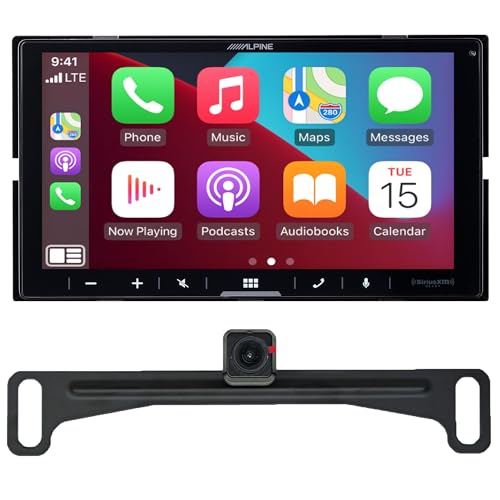
Power | 16W x 4 RMS |
Display | 6.75 in, 800 x 480 |
Preouts | 3 pairs (front, rear, sub), 4V, crossover on each |
EQ and Tuning | 13-band graphic EQ, 6-channel time correction, Sound Boost menu |
Smartphone | Wired Apple CarPlay and Android Auto |
Camera | 1 camera input; camera sold separately |
Radio and Media | AM/FM, SiriusXM-Ready, 1 USB, 1 AUX, AAC/FLAC/MP3/WMA audio |
Fit | Double DIN, 2.4 in mounting depth, iDatalink Maestro compatible, SWC through 3.5mm adapter |
Alpine built the iLX-W670-M around a problem most receivers ignore. The chassis behind the faceplate is 2.4 inches deep, less than a third of what Kenwood asks for and shallower than anything else here. In a midsize truck, a Wrangler or an older import where HVAC ducting crowds the back of the opening, that measurement decides whether the install happens at all.
The shallow chassis then does a second job. Alpine's PowerStack design lets a KTA-200M or KTA-450 amplifier bolt straight to the back of the receiver, so a four-channel amp claims no extra space anywhere else in the vehicle. That counts here, because the internal amp is the weakest published figure in this guide at 16 watts RMS per channel, six under the Kenwood and eight under the ATOTO. On factory speakers at moderate volume it holds up. Past that point the preouts carry the system, and Alpine clearly designed it to work that way.
Those preouts are the reason this is our sound quality pick. Three pairs run at 4 volts into front, rear and subwoofer amps, and each output carries its own crossover, so door speakers can be high-passed the moment a sub takes over the bottom octaves. A 4-volt signal lets an amplifier's gain sit nearer the quiet end of its travel, and lower gain is what keeps alternator whine and hiss out of your tweeters on a quiet passage.
Tuning runs deeper than anything else in this guide. Six-channel time correction delays each speaker on its own, which pulls the vocal image off the driver's door card and centers it on your seat. The 13-band graphic EQ then works on specific problems instead of broad tone, and the Sound Boost menu adds separate bass and mid-bass controls for drivers who want more weight without redrawing the whole curve. Run Alpine's PrismaLink enclosures and Lighting Link drives their lighting from the same screen.
The camera is where this pick asks something back. Alpine provides one dedicated input that accepts a rear or front view, and nothing to plug into it. Every unit here except the Kenwood ships a camera in the box, so add one to the order, and we'd check that the model you pick matches the composite RCA input. What you get in exchange is control over camera quality, since a decent aftermarket camera will outperform the bundled units on the budget picks below.
Two limits deserve a read before you buy. The panel measures 6.75 inches at 800 x 480, the lowest resolution in this guide, and a reversing image on a low-resolution screen gives up edge detail that the 1280 x 720 ATOTO holds onto. CarPlay and Android Auto are wired only, so the cable lives in the car permanently, which some drivers prefer for connection stability and others find tiresome.
Factory integration improved with this version. iDatalink Maestro compatibility keeps steering wheel controls and, depending on the vehicle, factory data readouts working through a separate module, putting it alongside the Kenwood as one of two picks here that can do that. A 3.5mm jack takes an ordinary steering wheel control adapter if you skip Maestro entirely.
Our research points to the iLX-W670-M whenever the dash is shallow and amplifiers are already on the list. Buy the camera separately, wire the preouts to real amps, and this is the best aftermarket car stereo with backup camera support for a driver chasing sound quality first. For what those extra volts do at the amp end, read how preamp voltage affects amp gain.
3. Best Certified CarPlay: JENSEN J1CA7-BUC Double DIN Car Stereo
Plenty of budget screens print the CarPlay logo on the carton, and the J1CA7-BUC is one of the few here that carries Apple's own certification, ships the camera alongside it, and covers both for four years.

Power | 240W peak (60W x 4) MOSFET; RMS not published |
Display | 7 in, 1024 x 600 capacitive, angle adjusts and locks |
Preouts | 3 pairs (front, rear, sub), 4V |
EQ and Tuning | 8-band graphic EQ, 8 presets, time alignment |
Smartphone | Wired Apple CarPlay and Android Auto, push-to-talk key |
Camera | Rear camera included; composite RCA input |
Radio and Media | AM/FM with 30 presets (18 FM, 12 AM), rear USB at 1.5A, rear RCA A/V input, MP3 and FLAC |
Fit | Double DIN (4 x 7 in opening), SWC adapter required |
Certification is the quiet difference here. Jensen builds the J1CA7-BUC as a certified Apple CarPlay head unit with backup camera, which means the implementation passed Apple's own validation instead of approximating the interface. On inexpensive screens that skip that step, CarPlay tends to drop mid-drive or mirror the phone rather than running the real thing, and owners usually find out after the install. Both CarPlay and Android Auto run wired only on this model, launching the moment a compatible phone reaches the rear USB port, so plan on a cable living in the car.
The panel backs the software up. At 1024 x 600 across 7 inches of capacitive glass, it takes the light touch you expect from a phone rather than the firm press an 800 x 480 resistive screen needs, and it holds more detail than the Alpine above once a camera feed fills it. What we liked is that Jensen lets you angle the screen and then lock that angle with the installation screws, so a tall truck dash or a low opening can be aimed at the driver once and left alone. Nothing else in this guide fixes its viewing angle that way.
The camera arrives with this SKU and wires into the composite RCA input at the back, switching the display automatically when you shift into reverse. Jensen also sells the same camera as a standalone accessory, so a replacement three years from now costs no more than a generic unit would.
For amplifiers, three preout pairs run at 4 volts into front, rear and subwoofer channels, matching Alpine's published voltage and doubling the 2-volt outputs common at this money. Gain knobs can then sit low, which is where most amplifiers contribute the least noise of their own. Jensen publishes no crossover on those outputs, so filtering falls to the amplifiers themselves, and any competent four-channel amp handles that without complaint.
Tuning is where this receiver gives ground. Eight graphic EQ bands is the shallowest multi-band control here, below the 13 on the Alpine and Kenwood and a third of the ATOTO's 24. Broad tone shaping works fine. A narrow door resonance does not, because eight bands are too wide to isolate one. Time alignment is the compensation, and it is unusual at this price, delaying each speaker so the stage settles on your seat instead of the nearest door.
Power appears as a peak figure only, 240 watts across four channels at 60 watts each, with no RMS rating anywhere on Jensen's page. We read a peak-only listing as a sign the internal amp suits factory speakers and nothing larger, which puts the weight of any real build back on those preouts.
The daily details are handled well. A push-to-talk key reaches Siri or Google Assistant over the Bluetooth link without opening CarPlay first, which is quicker at a red light than tapping through a screen. The external microphone ships in the box, and mounting it on the visor puts it far closer to your mouth than a faceplate mic manages. Bluetooth covers hands-free calling, streaming and phonebook sync, the tuner stores 30 stations across 18 FM and 12 AM presets, and a rear RCA A/V input accepts a second source while the USB port charges at 1.5 amps.
Warranty closes the argument. Jensen covers the receiver for two years and stretches that to four when you register within 60 days, second only to the five years BOSS lists further down and four times what ATOTO gives you. Steering wheel controls need an adapter, as they do on every pick in this guide.
We recommend the J1CA7-BUC to a driver who wants CarPlay behaving exactly as it does in a new car, with the camera already sorted and no appetite for deep EQ work. For more options at this screen size, see our double DIN head unit rankings.
4. Best Bundle: SJoyBring W021 QLED 7-inch Double DIN Car Stereo
Buying a head unit, a reversing camera and a dash cam separately means three orders and three wiring sessions, and the W021 folds all of it into one box behind a 1280 x 720 QLED panel.

Power | 240W max (60W x 4); RMS not published |
Display | 7 in, 1280 x 720 QLED |
Preouts | 4-channel RCA plus 2 separate subwoofer outputs; voltage not published |
EQ and Tuning | Built-in DSP with 10-band EQ |
Smartphone | Wireless and wired Apple CarPlay and Android Auto, MirrorLink for iOS and Android |
Camera | 170-degree waterproof night-vision rear camera and a dash cam included; front and rear inputs |
Radio and Media | AM/FM, USB and SD playback, Bluetooth 5.3 with its own module and antenna, video output, remote in box |
Fit | Double DIN, 3.66 in deep |
Most drivers shopping for a 2 din car stereo with backup camera end up buying a dash cam within the year anyway, and that second purchase means pulling the A-pillar trim a second time. SJoyBring ships both cameras with the W021, so one install run handles the rear feed, the forward recording and the head unit together. The rear camera is waterproof with night vision and a 170-degree field, wide enough to pick up a car crossing behind you in a parking aisle rather than only what sits directly astern.
The audio outputs are the part that separates this from the other bundle-style picks. Four RCA channels cover front and rear amplifiers, and then two separate subwoofer outputs sit alongside them. Almost every receiver in this guide gives you one sub output, which forces a Y-splitter if you run two mono amps, and a splitter both halves the signal and adds a junction where noise can enter. Two discrete outputs skip that entirely, so a pair of sealed 10s can each take their own amp.
The DSP behind them carries a 10-band EQ, midway between the 8 bands on the Jensen above and the 13 on the Alpine. It handles broad shaping and moderate problem-solving, though a listing for an earlier revision of this model shows a 16-band count, so confirm the EQ depth on the exact SKU you order before you count on it.
Screen quality is a real strength. The 7-inch QLED runs 1280 x 720, tied with the ATOTO for the sharpest 7-inch panel here, and that resolution shows a painted parking line or a low wheel stop as a defined edge rather than a soft band. SJoyBring also supports 1920 x 1080 video playback, so a USB movie for passengers looks right on the same screen.
Bluetooth deserves a mention because SJoyBring did something unusual with it. Instead of leaning on the main board's integrated radio, the W021 uses a separate Bluetooth 5.3 module with its own antenna, paired with a noise-cancelling microphone. Owners report steadier pairing and fewer mid-drive dropouts than they saw on cheaper units, which is the single most common complaint about budget CarPlay screens. Wireless CarPlay and Android Auto both run, and MirrorLink covers older phones on either platform.
Controls stay physical where it counts. A rotating volume knob and hard buttons sit below the screen, so volume and source changes happen by feel without a glance down. A remote ships in the box, which the Alpine and Kenwood picks leave out.
What we noted on the other side of the ledger is how little SJoyBring publishes. There is no RMS rating, only a 240-watt peak figure, and no preout voltage at all. We would treat the internal amp as a factory-speaker amp and set external gain conservatively until you hear where the noise floor sits. SJoyBring is also a young brand next to Kenwood and Alpine, so long-term reliability data is thin and firmware support is harder to predict.
Our research puts the W021 first whenever the shopping list already includes a dash cam. You give up published specifications and brand history, and you get a sharp screen, two sub outputs and three devices for one install. If you are weighing which phone platform to build around, our look at how CarPlay and Android Auto differ day to day is worth a read first.
5. Best Budget: PLZ 7-inch Wireless Double DIN Car Stereo
Four RCA channels, two subwoofer outputs, a 10-band EQ and a 1080p camera in the carton, at the lowest price in this guide.
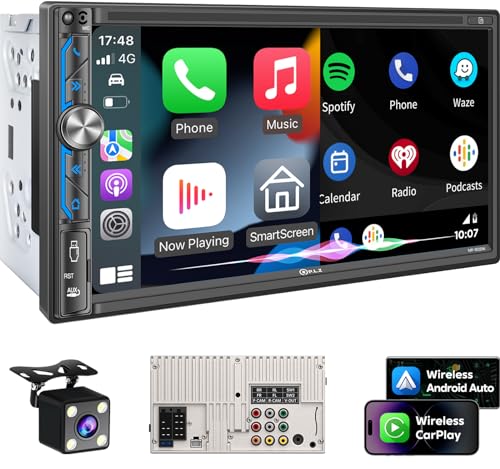
Power | 240W max; RMS not published |
Display | 7 in, 1024 x 600 IPS capacitive |
Preouts | 4-channel RCA plus 2 subwoofer outputs; voltage not published |
EQ and Tuning | Built-in DSP with 10-band EQ |
Smartphone | Wireless Apple CarPlay and Android Auto, wired MirrorLink |
Camera | 1080p night-vision rear camera included; front and rear inputs |
Radio and Media | AM/FM, USB, TF card, AUX, Bluetooth 5.3 with its own module and antenna, no Wi-Fi hotspot |
Fit | Double DIN, 2.7 lb unit weight, SWC through an interface (not included) |
Budget receivers usually protect the screen size and cut the output stage, since buyers see inches and never see RCA jacks. PLZ went the other way with the MP-902W. Four RCA channels and two separate subwoofer outputs sit on the back of the least expensive unit in this guide, the same arrangement the SJoyBring above carries for more money, and more output flexibility than the Kenwood offers for several times the price. If you already own a four-channel amp and a mono amp, this is the cheapest way here to feed both properly.
The camera comes with it, rated 1080p with night vision, and the display cuts to the rear view on its own when reverse engages. A second input takes a front camera, which earns its place on anything long enough that the nose disappears over a parking block.
Wireless CarPlay and Android Auto are the headline at this money, and they work the way they do on the pricier picks, with the phone staying in a pocket. Wired MirrorLink covers older handsets on both platforms.
PLZ prints a warning on its own listing that the unit has no Wi-Fi hotspot function, and the practical effect is narrower than that sounds. Wireless CarPlay still connects, because the phone and the head unit build a direct link between themselves. What disappears is any ability to share a connection with other devices, and there is no onboard app store here that would want one. Compare that with the two ATOTO picks, which run Android and need a connection of their own to be useful at all.
The screen is where the price shows. A 1024 x 600 IPS panel is a step below the 1280 x 720 QLED units from SJoyBring and ATOTO, and a reversing image loses some edge definition as a result. It is the same resolution Kenwood and Jensen use on their 6.8 and 7-inch panels, though, so this is mid-pack rather than the weak link buyers expect at the bottom of a price range. Touch response is capacitive, so it takes a light tap rather than a press.
Bluetooth follows the same approach SJoyBring took, with a dedicated 5.3 module and an external antenna instead of an integrated radio sharing board space. Owners report quick pairing and stable calls, which is the single most common failure point on inexpensive touchscreens.
Tuning sits mid-range and we would not oversell it. A built-in DSP drives a 10-band EQ, enough to shape tone and pull back a boomy region, short of the 24-band resolution on the ATOTO picks. Steering wheel controls work through an interface that PLZ does not include, the same caveat that applies to every unit in this guide.
What PLZ publishes about power is a 240-watt maximum and nothing else. No RMS figure, no preout voltage. We treat both silences the same way, assuming the internal amp is built for factory speakers and setting amp gain low until the noise floor tells you otherwise.
This is the pick we would hand to someone adding a touch screen car stereo with backup camera to an older commuter without touching the rest of the system. You get wireless projection, a camera and real output flexibility, and you give up published specifications and screen sharpness to get there. For more at this end of the range, see the stereos we rank under $150.
6. Best for Factory Integration: KENWOOD DMX5710S 6.8-inch Receiver
If your truck still shows tire pressure and climate settings on the factory radio, the DMX5710S can bring those readouts onto its own screen through iDatalink Maestro, and that is what earns it our factory integration pick.
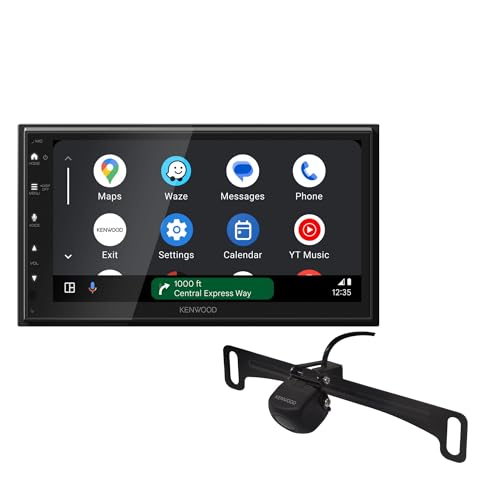
Power | 22W x 4 RMS full bandwidth at under 1% THD; 50W x 4 max |
Display | 6.8 in, 1024 x 600 capacitive TN panel |
Preouts | 2 pairs plus subwoofer output, 2.5V into 10k ohm, 100 ohm impedance |
EQ and Tuning | 13-band EQ, digital time alignment, high and low pass filters |
Smartphone | Wired and wireless Apple CarPlay and Android Auto, wireless mirroring both platforms |
Camera | Rear input with parking guidelines; receiver ships without a camera |
Radio and Media | AM/FM, SiriusXM-Ready, rear USB at 2.1A, rear RCA video out, Bluetooth 5.0, 24-bit DAC, FLAC and WAV |
Fit | Double DIN short chassis, 178 x 100 x 85.7 mm (7 x 3-15/16 x 3-3/8 in) |
The DMX5710S is the pick for a driver who wants an aftermarket screen without losing what the factory radio already did. iDatalink Maestro readiness is the mechanism. Add the module and the receiver keeps steering wheel controls live and, depending on the vehicle, puts factory data such as tire pressure and climate status onto the new display. The Alpine above can do the same thing, but it projects your phone over a cable only, so this is the one to choose when you want factory data and wireless CarPlay in the same dash.
The camera side is thought through in a way the bundle picks are not. Kenwood draws parking guidelines over the rear feed, the only receiver here that lists them, and those lines are what turn a wide rear image into a usable judgement of distance. The receiver itself ships without a camera, though the listing we link pairs it with Kenwood's own CMOS-230LP universal camera, which sidesteps the compatibility guesswork of buying blind.
Power is published the way it should be. Kenwood rates 22 watts per channel across the full band at under 1% distortion, and that qualifier is the part to read. ATOTO's 24-watt figure looks higher on paper, and it comes with no stated bandwidth or distortion condition, so the two numbers are not describing the same thing. Between published ratings in this guide, we would take Kenwood's 22 qualified watts over an unqualified 24 every time.
The chassis measures 85.7mm behind the faceplate, which is 3-3/8 inches and the shallowest true double DIN body here outside the Alpine's 2.4-inch mounting depth. That leaves room for a wiring harness in the kind of dash where ducting sits close behind the opening.
Where the DMX5710S gives ground is output voltage. Two preout pairs plus a subwoofer output all run at 2.5 volts, the lowest published figure in this guide. Against the 4 volts on the Jensen, Alpine and BOSS picks, an amplifier here needs its gain turned further up to reach the same output, and higher gain is where alternator whine and hiss start to appear in quiet passages. For a single powered subwoofer it hardly registers. For a front, rear and sub build, we would look at the 4-volt picks first.
One connectivity detail deserves attention before you commit. Kenwood specifies the Wi-Fi radio as 802.11 a/n/ac operating in the 5GHz band only, with no 2.4GHz support listed. Wireless CarPlay and Android Auto rely on that radio, so an older phone limited to 2.4GHz will need the USB cable. Both platforms run wired as well, and wireless mirroring covers iPhone and Android outside the projection interfaces.
Audio handling is quietly strong. A 24-bit DAC decodes FLAC, WAV, AAC and OGG from the rear USB port, which charges at 2.1 amps, the highest charge rate of any pick here. A 13-band EQ and digital time alignment cover tuning, and Kenwood publishes a 75dB USB signal-to-noise figure and 93dB dynamic range, numbers none of the budget picks disclose at all.
The panel is the one place we would temper expectations. At 1024 x 600 it matches the Jensen and PLZ screens, but Kenwood specifies a TN panel rather than IPS, so colours shift more when a passenger views it from the side.
We would put the DMX5710S in any vehicle where the factory head unit is doing more than playing music. Buy the Maestro module, plan on a modest amp at most, and it earns its place. Kenwood's wider range is covered in every Kenwood model we track.
7. Best Wireless CarPlay Under $200: BOSS Audio BE920WCPA-C Car Stereo
Wireless CarPlay, two camera inputs and 4-volt preouts normally push a receiver past what the Kenwood costs, and the BE920WCPA-C carries all three well below it with the camera and a GPS antenna already in the carton.
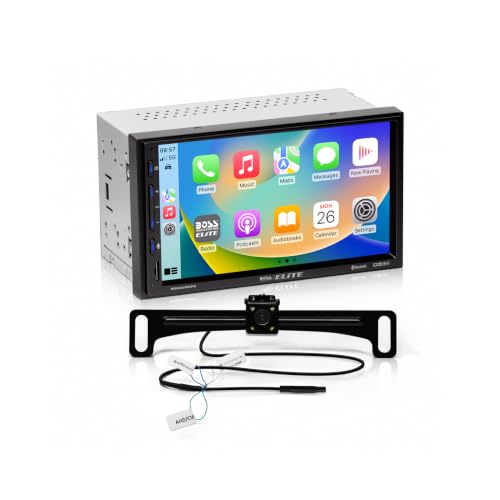
Power | 20W x 4 RMS; 85W x 4 peak (340W total) |
Display | 7 in, 1024 x 600 capacitive (some retail listings show 800 x 480) |
Preouts | 5-channel (front, rear, mono sub), 4V |
EQ and Tuning | Preset EQ curves plus balance and fader; band count not published |
Smartphone | Wired and wireless Apple CarPlay and Android Auto, push-to-talk key |
Camera | Rear camera included; front and rear inputs |
Radio and Media | AM/FM with RDS/RBDS, switchable US and EU tuner, 2 rear USB at 1.5A, front microSD, rear A/V in, FLAC to 192kHz/24-bit |
Fit | Double DIN, external mic and GPS antenna supplied, parking brake wire required, SWC adapter required |
Put the BE920WCPA-C next to the Kenwood and the value case writes itself. Both run wireless CarPlay and Android Auto. Both take a rear camera. Only the BOSS gives you 4-volt preamp outputs, a second camera input, a camera in the box and five years of warranty, and it does that at a fraction of the Kenwood's price. Those 4 volts are the part worth dwelling on, since they let an amplifier reach full output with its gain set low, and low gain is what keeps the noise floor down once the engine is running.
The output arrangement is five channels rather than three pairs. Front and rear stereo outputs cover a four-channel amplifier, and a mono subwoofer output feeds a bass amp on its own. That covers a full build without a splitter anywhere in the chain.
Both camera inputs earn their keep on a larger vehicle. The rear feed switches automatically in reverse, and a front camera input helps when the nose of a lifted truck hides a parking block or the lip of a steep driveway. BOSS also supplies the parts that usually cost extra later, with an external microphone on a 9.5-foot lead that reaches a visor mount and a GPS antenna on a 59-inch cable, which gives the head unit a position fix of its own rather than relying on a phone struggling for signal between tall buildings.
Media support is better than the price band suggests. Two rear USB ports each charge at 1.5 amps, one dedicated to phone projection and one to storage, and a front microSD slot handles a card. FLAC plays at up to 192kHz and 24-bit, so a hi-res library does not need converting before it goes in the car. If you are shopping the same bracket, our sub-$200 stereo picks cover what else competes here.
Tuning is the compromise and we will not soften it. BOSS publishes preset EQ curves with balance and fader, and no graphic band count anywhere. Every other receiver in this guide gives you at least 8 bands to work with, and several give you 13 or more. You can pick a curve you like. You cannot cut a 250Hz door resonance out of it.
Internal power sits at 20 watts RMS per channel against an 85-watt peak, second lowest among the picks that publish an RMS figure. On factory speakers at commuting volume that is fine, and the 4-volt preouts are clearly where BOSS expects the system to grow.
One install step catches people out. This receiver needs its parking brake wire connected and set before video playback and some settings become available, which is a wiring job rather than a plug-and-play connection. Budget an extra 20 minutes for it and read the harness diagram first.
We should flag a documentation conflict too. The owner's manual lists the panel at 1024 x 600, while several retail listings show 800 x 480 for the same model. We use the manual's figure in the table above and would confirm it with the seller before ordering if screen sharpness is decisive for you.
Our research points to the BE920WCPA-C for a driver who wants wireless CarPlay, a camera and amp-ready outputs without Kenwood or Alpine money, and who sets tone once and leaves it there. If you expect to tune, the preset-only EQ will wear thin quickly. For the rest of the brand's range, see how BOSS models stack up across the price ladder.
8. Best Floating with Certified CarPlay: Jensen J1CA10FL-BUC Stereo
What happens when a certified wireless CarPlay receiver stops caring whether your dash opening is single DIN or double DIN? You get the J1CA10FL-BUC and a 10.1-inch floating panel that mounts in either one.
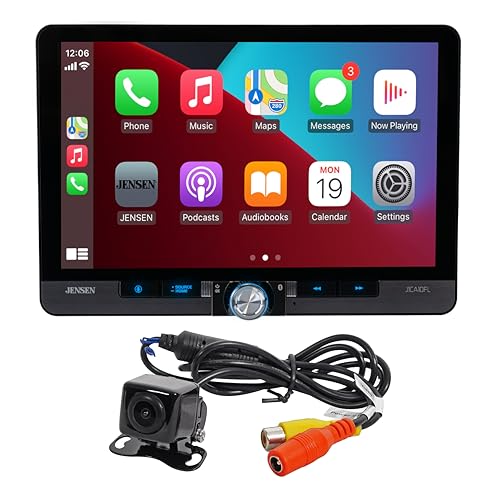
Power | 240W peak (60W x 4) MOSFET; RMS not published |
Display | 10.1 in capacitive floating, multi-axis adjustment; resolution not published |
Preouts | 3 pairs (front, rear, sub), 4V, with subwoofer gain control |
EQ and Tuning | 10-band EQ, 7 presets, subwoofer crossover at off, 50, 80, 120 or 160Hz |
Smartphone | Wired and wireless Apple CarPlay and Android Auto, push-to-talk key |
Camera | Rear camera included (BUCAM100J); front and rear inputs |
Radio and Media | AM/FM with 30 presets (18 FM, 12 AM), rear USB at 2.1A, rear A/V in, MP3, WMA and FLAC, 6 illumination colours |
Fit | Single DIN or double DIN through the supplied dash adapter, SWC adapter required |
Most 10-inch floating screens are built for a single DIN chassis and stop there, which leaves owners of newer cars with a 4-inch opening to fill. Jensen supplies a dash mount adapter that lets the J1CA10FL-BUC drop into either size, so the same receiver suits a 1990s pickup and a 2015 sedan. That flexibility is the reason it carries our floating pick, and Jensen publishes a printable sizing guide so you can check clearance in front of the dash before the box arrives.
Phone projection moves forward from the 7-inch Jensen above. CarPlay and Android Auto both run wireless as well as wired here, still on Jensen's certified implementation, so the phone can stay in a pocket and the screen still behaves the way it does in a new car. A push-to-talk key reaches Siri or Google Assistant over Bluetooth without opening the projection interface first.
Camera coverage improves too. The BUCAM100J ships in the box and wires to the rear input, and this model adds the front camera input the J1CA7 lacks. On a long-nose truck or a van, that second feed is the difference between creeping toward a wall and knowing where the bumper sits.
The audio section is where the extra screen inches come with real substance. Three preout pairs run at 4 volts into front, rear and subwoofer amps, and Jensen adds two controls the 7-inch model has no equivalent for. A subwoofer gain control sets bass level from the touchscreen, which saves crawling under a seat to reach an amplifier's knob every time a passenger complains. A built-in subwoofer crossover switches between 50, 80, 120 and 160Hz or off, so deep bass can be kept out of the door speakers from the head unit itself. That means an inexpensive mono amplifier without its own filter still works properly in this system.
The EQ counts 10 bands with 7 presets, two more bands than the J1CA7 offers, which gives you finer control over a peaky midrange.
One thing does disappear on the way up, and it surprised us. Jensen lists time alignment in the J1CA7's audio processing and does not list it here. If centring the stage on the driver's seat is important to you, the smaller Jensen actually does more, and the Alpine does considerably more with six channels of it.
Two published gaps are worth knowing. Jensen never states the panel resolution for this model, so you cannot compare it on paper against the 1280 x 800 ATOTO floating screen below, and power appears as a 240-watt peak with no RMS rating behind it. We read that combination the same way we read it on the 7-inch Jensen, treating the internal amp as speaker-level power and the preouts as the real path forward.
Jensen's support page also lists a firmware release for this receiver that improved touchscreen response time, set the rear camera view default to off and added a time sync option. That tells you two things at once. Units built before the update felt slow under a finger, and the platform is still being maintained. Check the software version under Settings and About after the install, then run the update from a FAT32 USB drive if it is older.
We would choose the J1CA10FL-BUC for a driver who wants a big certified CarPlay screen, a camera already included and four years of coverage, and who cares more about crossover control than stage placement. For how the other big-screen options compare, see every floating screen model we compare.
9. Best Floating with Built-In GPS: ATOTO A5LG110PT QLED Head Unit
Drive into a canyon and watch a phone map freeze, then watch the A5LG110PT keep routing from its own GNSS receiver and offline Android maps on a 1280 x 800 floating screen.
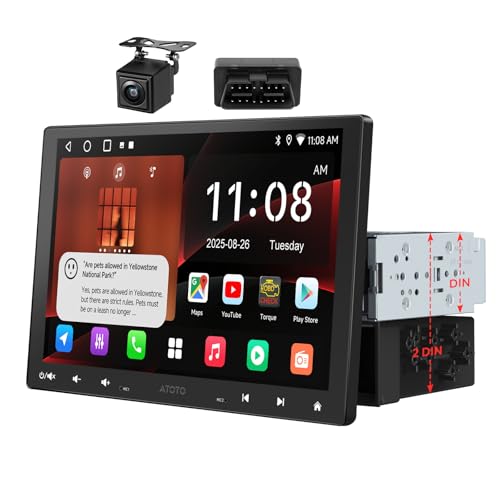
Power | 24W x 4 RMS; 45W x 4 max |
Display | 10.1 in, 1280 x 800 QLED floating, FlexView adjustment |
Preouts | 4V RCA, front, rear and subwoofer |
EQ and Tuning | 24-band EQ, 9 presets, DSP time correction, HPF/LPF |
Smartphone | Wired and wireless Apple CarPlay and Android Auto, MirrorLink, split screen |
Camera | Rear camera included on the S01; front and rear inputs |
Radio and Media | FM/AM, HDMI in and out, Wi-Fi hotspot on 2.4 and 5GHz, Bluetooth and USB tethering, microSD and USB to 128GB |
Fit | Single DIN chassis with double DIN conversion kit, physical buttons and volume knob |
Navigation is the reason this model sits apart from the other floating pick. The A5LG110PT carries a receiver that locks onto GPS, GLONASS, Galileo and BeiDou satellites, and it stores Android map data on the unit, so a route continues when cell coverage stops. The BOSS earlier also ships a GPS antenna, and the difference is that BOSS has no maps of its own, so routing still comes from your phone. Here, both halves live in the dash. Anyone driving forest service roads, rural highways or multi-level parking structures will feel that on the first trip.
The panel is the sharpest in this guide. A 1280 x 800 QLED across 10.1 inches carries about 1.02 million pixels against 614,000 on the 1024 x 600 screens from Kenwood, Jensen and PLZ. On a reversing feed that resolution shows the seam where a curb meets asphalt rather than a soft grey band, and the FlexView mount lets you angle the panel toward the driver's eyeline instead of the centre of the windscreen.
Outputs improve on the 7-inch ATOTO in one specific way we appreciate. ATOTO publishes 4 volts on the RCA outputs here, where the A5LG2A7T leaves that field empty, and it runs front, rear and subwoofer feeds. That published figure lets you set amplifier gain low with confidence rather than by ear, and it puts this model level with the Alpine, Jensen and BOSS picks on signal voltage.
Tuning carries over from our best overall pick, with a 24-band EQ, 9 presets, time correction and separate high and low pass filters. Twenty-four bands is the finest resolution here, and it lets you notch a single resonant frequency out of a plastic door card without flattening the octave around it.
Installation is unusually flexible. The chassis is single DIN and a conversion kit for double DIN openings comes in the box, so the same unit suits an older truck with a 2-inch slot or a modern car with a 4-inch one. ATOTO also keeps physical buttons and a rotary volume knob below the screen, which is rare on a 10-inch floating unit and means volume changes happen without looking down. Dual HDMI is the other surprise, with an input for a streaming stick when the car is parked and an output for a rear-seat monitor.
The honest limits sit underneath all of it. This is the same A5 Lite platform as our best overall pick, an MT8163 with 2GB of RAM and 32GB of storage, and a larger screen does not make that processor faster. Owners report the same stutter when several apps run at once, so treat it as a unit that does one thing well at a time. There is no parking monitor or emergency video lock either, features ATOTO reserves for its S8 and X10 ranges, so this will not record while the car sits.
Availability is the last thing we would check. ATOTO's own store listed the camera-equipped S01 as backordered while we were researching, and variants differ in storage, with some carrying 2GB and 16GB rather than 32GB. Confirm the exact SKU before you order.
What we found is the strongest screen and the only real offline navigation in this guide, sitting on modest processing hardware. If maps without signal are the point, this is the model to buy. For other options built around onboard maps, see the stereos we rank for built-in navigation.
10. Best No-Installation Setup: HAUXIY Q9S 9-inch Portable Screen
No dash kit, no wiring harness, no trim panel pulled off, and the Q9S still puts wireless CarPlay and a reversing camera in front of you.
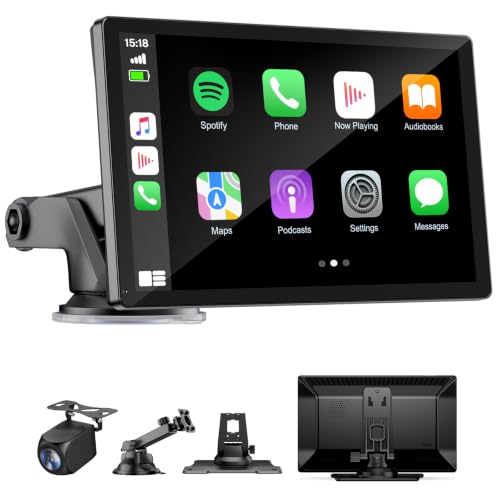
Power | No internal amplifier; audio leaves by Bluetooth, FM, AUX or the built-in speaker |
Display | 9 in portable touchscreen; resolution not published |
Preouts | None; 3.5mm AUX output only |
EQ and Tuning | Not published |
Smartphone | Wireless Apple CarPlay and Android Auto, mirror link for iOS and Android, Bluetooth 5.0 |
Camera | 1080p waterproof night-vision rear camera and a 4K front dash cam included |
Radio and Media | FM transmitter, AUX out, built-in speaker, 64GB TF card supplied, loop recording, G-sensor, parking monitor, OTA updates |
Fit | No installation; 12-volt socket power, two mounting bases, 350cm power cord, 700cm camera lead |
Some cars rule out a head unit before the conversation starts. A lease agreement forbids modification, a classic dash would lose its character with a modern screen cut into it, or the factory radio handles climate and vehicle settings that would vanish with it. The Q9S answers all three by sitting on top of the dash rather than inside it, drawing power from the 12-volt socket through a 350cm cord and mounting on one of two supplied bases.
Setup takes roughly ten minutes if you skip the camera, and the camera is the only part that asks for tools. Its 700cm lead runs to the back of the vehicle and taps the reverse light's positive wire, which is what triggers the automatic switch to the rear view. That is one wire in the whole install, against a full harness on every other pick in this guide.
Recording is the second reason to want it. A 4K front camera runs loop recording, and a G-sensor locks the clip automatically when it detects an impact, so the footage from a collision survives instead of being overwritten on the next lap of the loop. A parking monitor captures short clips on vibration with the engine off. HAUXIY also supplies a 64GB TF card, which most dash cams leave you to buy separately.
The rear camera is rated 1080p with night vision and a waterproof housing. Owners rate daytime footage well and give night performance mixed marks, so treat it as a parking aid rather than evidence-grade recording after dark.
Wireless CarPlay and Android Auto both run without a cable, mirror link covers older phones on either platform, and OTA updates arrive over Wi-Fi.
Audio is where you need to think before buying, and we will be blunt about it. This unit has no amplifier, no preamp outputs and no EQ. It cannot improve your car's sound by a single decibel. What it does is hand audio to your existing system four ways, through Bluetooth to a compatible factory radio, through a 120cm AUX cable, through an FM transmitter, or out of its own small speaker. Bluetooth and AUX both sound fine for daily listening. The FM transmitter is the weak link and owners say so repeatedly, describing thin sound and interference in built-up areas, so we would only reach for FM in a car with no Bluetooth and no auxiliary input.
If your dash will take a receiver, almost anything above this will do more for your sound, and even our entry-level picks include real preamp outputs. Our single DIN receivers we recommend cover the narrow-opening cars that owners often assume cannot be upgraded.
One caution on support. HAUXIY is a young brand with a short record, and while the stated cover is a one-year replacement plus lifetime technical assistance, we have no multi-year owner data to judge how that plays out.
We would put the Q9S in a leased car, a weekend classic or a vehicle you will hand back, where a reversing camera and CarPlay are the goal and the factory stereo stays exactly where it is. Judged as a car stereo with backup camera it is the weakest here. Judged as the only option for a dash you cannot touch, nothing else on this list competes.
Factors to Consider Before Buying
Eight decisions about your car and your habits settle which of these 10 belongs in it, and brand sits well down that list. Work through them in order, because each one narrows the field before the next gets complicated.
Settle the Format Before the Features
Eight decisions about your car and your habits settle which of these 10 belongs in it, and brand sits well down that list. Work through them in order, because each one narrows the field before the next gets complicated.
Settle the Format Before the Features
Your dash decides this before any spec does. If your opening is a standard 4-inch double DIN slot and the trim above it is tight, an in-dash unit like the ATOTO A5LG2A7T-S01, the Jensen J1CA7-BUC or the Kenwood is the shape that fits. If the area in front of the dash is open and you want a bigger picture when reversing, a floating panel gives you 10 inches on a chassis that still tucks into a narrow slot. If you cannot modify the car at all, that rules out both and leaves the portable route.
Settle this first and half the shortlist disappears on its own.
Start With Whether the Camera Is Included
This one saves you money or costs you flexibility, and which way it falls depends on how fussy you are about image quality. A bundled camera means one purchase, one wiring run and guaranteed compatibility with the composite input, which is why seven of our 10 picks ship one.
Buying separately, as the Alpine and Kenwood require, lets you choose resolution, lens angle and mounting style to suit the vehicle. A license plate camera suits a sedan, a bumper-mount fits a truck, and neither comes bundled with anything. If your car is unusual or you want a wide lens on a long vehicle, treat the separate purchase as an advantage rather than a cost.
Measure the Opening and What Sits Behind It
Depth is the measurement most buyers skip and the one that stops installs. Reach behind your factory radio and check what sits there, since HVAC ducting and structural bracing often leave less than 4 inches of usable space.
The Alpine's 2.4-inch mounting depth and the Kenwood's 3-3/8-inch chassis are built for exactly that problem. If you are fitting a floating screen, measure forward as well, because a 10-inch panel needs clearance in front of the trim and has to miss your vents, your shifter and your hazard switch through its whole adjustment range.
Let Your Amplifier Plans Set the Voltage You Need
If you will never add an amplifier, skip this and buy on screen and camera alone. If amps are on your list, even years out, preout voltage shapes how clean that system will sound.
Higher voltage lets you set an amplifier's gain lower, and lower gain means less hiss and less alternator whine reaching your tweeters. Four volts, as on the Alpine, both Jensens, the BOSS and the ATOTO A5LG110PT, comfortably feeds a front, rear and sub build. The Kenwood's 2.5 volts handles a single powered subwoofer well and asks more of a full amp rack. Where a brand publishes nothing at all, plan on running gain higher and listening carefully at low volume.
Judge the Screen by What You See in Reverse
You will look at this screen most often while backing out of a parking space, so judge it for that job rather than for album art. A curb, a post or a child's scooter sits a few feet behind the bumper, and the finer the panel, the more clearly its edge separates from the asphalt.
Among our picks, 1280 x 800 on the ATOTO floating unit and 1280 x 720 on the 7-inch ATOTO and SJoyBring resolve that edge best. The 1024 x 600 screens on the Kenwood, Jensen and PLZ are perfectly usable. The Alpine's 800 x 480 is the softest here, which is the trade for its shallow chassis and its tuning depth.
Decide If the Cable Stays in the Car
This is a habit question more than a technical one. Wireless CarPlay means your phone stays in a pocket or on a charging pad and the screen wakes on its own, which suits short trips with frequent stops.
A wired connection is more stable and charges the phone at the same time, which suits long drives and older phones with tired batteries. The Alpine and the 7-inch Jensen are wired only, so the cable lives in the car permanently. The ATOTO picks, the Kenwood, the BOSS, the 10-inch Jensen, the SJoyBring and the PLZ all run wireless. One Kenwood detail is worth checking if you keep an older handset, since its Wi-Fi radio is listed for the 5GHz band only.
Protect What Your Factory Radio Already Does
On anything built after roughly 2010, the radio you are replacing may be doing more than playing music. Steering wheel buttons, chimes, climate readouts and vehicle settings can all route through it, and losing them is a poor trade for a bigger screen.
Every pick here needs an adapter to keep steering wheel controls working, which is a small extra purchase rather than a barrier. For the deeper functions, iDatalink Maestro is the path, and only the Kenwood and the Alpine support it among these 10. Check your vehicle against the Maestro compatibility list before committing, since coverage varies by model and year.
Read the Warranty Before the Spec List
Coverage tells you what a brand expects to happen, and it varies more here than any single specification. BOSS lists five years in the US, Jensen gives two and extends to four if you register within 60 days, and ATOTO covers 12 months plus 180 days on registration.
SJoyBring, PLZ and HAUXIY publish little or nothing, which is worth factoring in alongside their prices rather than treating as an afterthought. Where a brand is young, thin long-term owner data compounds the same risk.
Frequently Asked Questions
These are the questions readers send us most often about this particular purchase, rather than about car stereos in general.
Do all of these car stereos come with a backup camera?
Seven of the 10 ship one in the box. The Alpine iLX-W670-M and the Kenwood DMX5710S provide a camera input and leave the camera to you, though the Kenwood listing linked here is sold as a bundle with Kenwood's CMOS-230LP. Always check the exact SKU, since several brands sell the same receiver with and without a camera under model codes that differ by two or three characters.
Can I get a single din car stereo with backup camera?
Yes, through a floating screen design. A floating unit puts a large panel in front of a narrow chassis, so the body slides into a 2-inch single DIN slot while the screen sits proud of the dash. Both the Jensen J1CA10FL-BUC and the ATOTO A5LG110PT mount that way and include a double DIN adapter for cars with the larger opening.
Will any aftermarket backup camera work with any head unit?
Usually, provided both sides use the standard composite RCA video connection that every receiver in this guide accepts. The camera also needs a 12-volt trigger, normally taken from the reverse light's positive wire, so the screen knows when to switch. Check the receiver's settings for a mirror-image option too, since a camera mounted without it shows left and right reversed.
Which of these is the best double din head unit with backup camera for sound quality?
We would take the Alpine iLX-W670-M. Three 4-volt preouts with a crossover on each, a 13-band graphic EQ and six channels of time correction give you more control over the final result than anything else here, and the 2.4-inch chassis leaves room to mount an Alpine Power Pack amplifier directly behind it. The camera is a separate purchase, and that is the price of the rest.
Do I need built-in navigation, or is my phone enough?
For most drivers a phone is enough, since CarPlay and Android Auto both put live maps and traffic on the screen. Onboard navigation earns its place when coverage is unreliable, because a phone map stops redrawing once data drops. Of these picks, only the two ATOTO units store maps on the head unit, and the A5LG110PT adds its own multi-constellation satellite receiver, which is why we rank it as the best double din car stereo with backup camera and navigation in this group.
Why does the camera only appear when I shift into reverse?
That is how the trigger wire is designed to behave. The camera feed is switched by 12 volts arriving from the reverse circuit, so the display returns to music or maps as soon as you select drive. Several receivers here allow a manual camera view from the menu, which helps when hitching a trailer, and units with a second input can show a front camera on demand.
Is a flip out car stereo with navigation and backup camera better than a floating screen?
Neither wins outright, and the trim above your dash opening usually decides it. A floating panel gives you the largest screen and the simplest mounting, while a motorized flip-out hides behind the dash when parked, which suits drivers who leave a car on the street. We chose floating designs for this guide because they suit camera use better, with no motor travel to clear and no delay before the picture appears. If the hidden option appeals, see our motorized flip-out screens compared and our look at floating and flip-out panels side by side.
Our Final Verdict
The best car stereo with backup camera for most drivers is the ATOTO A5LG2A7T-S01, since it ships the camera, projects wireless CarPlay, and still runs its own apps and offline maps on the days your phone stays in your pocket.
Change the situation and our answer changes with it. Chasing sound quality in a dash that fits almost nothing, the Alpine iLX-W670-M gives you 4-volt preouts and six channels of time correction behind a 2.4-inch chassis, and you buy the camera yourself. Wanting CarPlay to behave exactly as it does in a new car, the JENSEN J1CA7-BUC carries Apple's certification and four years of cover once you register it.
The remaining seven sort by what your car asks for.
- SJoyBring W021 when a dash cam is already on the list, our Best Bundle
- PLZ 7-inch when the budget is fixed and you still want two subwoofer outputs, our Best Budget
- KENWOOD DMX5710S when factory gauges and steering controls have to survive the swap, our Best for Factory Integration
- BOSS BE920WCPA-C when wireless CarPlay, two camera inputs and 4-volt outputs all have to come cheaply, our Best Wireless CarPlay Under $200
- Jensen J1CA10FL-BUC when a 10-inch certified CarPlay panel has to fit either DIN opening, our Best Floating with Certified CarPlay
- ATOTO A5LG110PT when routing has to continue after the signal drops, our Best Floating with Built-In Navigation
- HAUXIY Q9S when the dash cannot be touched at all, our Best No-Installation Setup
Before you order anything, spend ten minutes with a tape measure behind your factory radio. That single number rules out more of this list than any specification on the page, and once you have it, the right pick here tends to choose itself.
Explore More
- Double DIN Head Units Ranked
- Single DIN Head Units Explored
- Floating Screen Car Stereos
- Flip Out Car Stereos Ranked
- GPS Navigation Car Stereos
- Single DIN Versus Double DIN
- Top Car Stereo Brands
- Kenwood Car Stereos Compared
- BOSS Car Stereos Reviewed
- Budget Car Stereos Under $150
- Car Stereos Under $200
- Car Stereos Under $300
- Car Stereos Under $400
- Car Stereos Under $500