
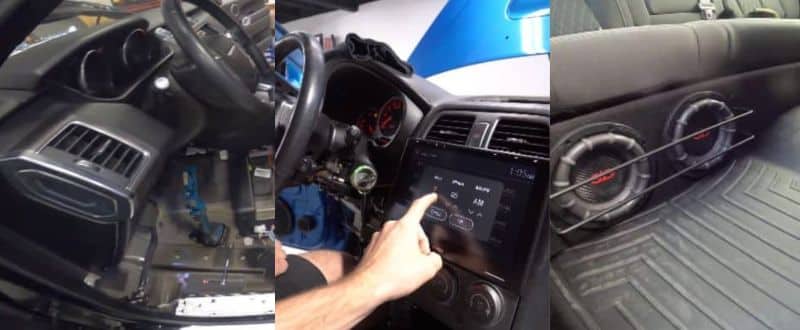
The three types of car audio systems are OEM, aftermarket and custom. An OEM system is the stereo, speakers and any factory amplifier the carmaker fitted on the assembly line. An aftermarket system replaces or adds to those parts with equipment from audio brands such as Pioneer, Kenwood, JL Audio or Rockford Fosgate. A custom system goes further, with enclosures, panels or tuning built for one particular vehicle. Power is the figure that separates them most. An aftermarket head unit's built-in amplifier usually makes about 14 to 22 watts RMS per channel, factory radios sit in a similar or lower range, and a separate amplifier typically adds 50 watts RMS or more per channel. This guide is for drivers deciding how much of the factory system to keep before buying a first upgrade.
Table of Contents
3 Types of Car Audio Systems Explained
Each of the types of car audio systems below describes who built the equipment and how far it was adapted to the car. Sound quality is a separate question, since a well-tuned factory system can outperform a careless aftermarket install.
1. OEM (Factory) Car Audio System
An OEM car audio system is the audio equipment installed by the vehicle manufacturer. OEM stands for Original Equipment Manufacturer, and you'll also see it called the factory or stock system. It normally includes the head unit or infotainment screen, door and dash speakers, the wiring harness and, on higher trims, a separate factory amplifier.
The sound quality can vary considerably. Base models might have a very basic sound system, while high-end trims or models may feature premium branded audio systems, such as Bose, Bang & Olufsen, or Harman Kardon.

Premium OEM systems usually run a dedicated amplifier with equalization tuned to that cabin, and some drive their speakers at 2 ohms instead of the usual 4 ohms. That tuning explains why a simple speaker swap in a premium system can leave it sounding thinner than before.
Modern factory head units also handle more than audio. Climate controls, vehicle settings, parking sensors, warning chimes and the backup camera often run through the same screen, so removing it can take those functions with it.
Pros
- Fits the dash and wiring exactly, with no adapters
- Keeps steering wheel controls, chimes and
- vehicle settings working
- Stays inside the vehicle's factory warranty
- Premium trims arrive with an amplifier and
- cabin tuning already in place
Cons
- Base systems run every speaker from the radio's low built-in power
- Thin paper-cone factory speakers lose clarity at higher volume
- Few tuning controls beyond bass, treble, balance and fade
- Integrated screens are hard or impossible to replace in many newer cars
Best for: drivers who listen at moderate volume and value full vehicle integration over extra output.
2. Aftermarket Car Audio System
An aftermarket car audio system uses equipment made by audio companies instead of the carmaker, installed after the vehicle leaves the factory. It can be a single part, such as new front speakers, or a complete replacement of everything from the head unit to the subwoofer. Each part in that chain is covered in every car audio component and what it does.
Partial Aftermarket Upgrade
A partial aftermarket upgrade keeps the factory head unit and adds aftermarket speakers, an amplifier or a subwoofer behind it. Factory radios rarely have RCA outputs, so the added amplifier takes its signal through a line output converter or a DSP with speaker-level inputs. A line output converter (LOC) is a small module that turns the radio's speaker signal into the low-voltage RCA signal an amplifier expects.

This route keeps the factory screen and controls intact, which is why we recommend it for newer cars whose radio is tied into vehicle settings. The walkthrough on adding a subwoofer to a factory radio covers the signal and turn-on connections it needs.
Full Aftermarket Replacement
A full aftermarket replacement swaps the head unit for an aftermarket receiver and builds the rest of the system around it. Aftermarket receivers add features many factory radios lack, such as Apple CarPlay, Android Auto, a 13-band EQ and 4 or 5 volt RCA pre-outs for external amplifiers. Our comparison of factory and aftermarket head units weighs what you gain against what you give up.
Keeping steering wheel controls, the backup camera and vehicle settings usually takes an integration module, and what iDatalink Maestro retains varies by vehicle. Dash fit is the other early check. Single DIN and double DIN openings differ in height, and some floating-screen receivers need extra depth, so measure your dash opening before shopping.
Pros
- More power and better speakers than most base factory systems
- Wider tuning control, from multi-band EQ to time alignment on many receivers
- Upgrades can be staged one part at a time
- Many parts can move to your next car
Cons
- Vehicle integration often needs extra interfaces and harnesses
- Poorly matched parts can make the system louder but less clear
- Higher-power builds may need electrical upgrades
- Installation work adds to the parts cost
Best for: drivers who want more volume, clarity or bass than the factory system gives, or who want phone integration in an older car.
3. Custom Car Audio System
A custom car audio system is built around one specific vehicle, with parts fabricated or adapted to fit it instead of bolting into factory locations. Typical custom work includes fiberglass subwoofer enclosures shaped to a trunk corner, A-pillar pods that aim tweeters at the listener, amplifier racks and hidden install panels, usually finished with a full DSP tune.
Custom builds tend to chase one of two goals. Sound quality (SQ) builds aim for accurate tone and a stable stereo image in front of the driver. Sound pressure level (SPL) builds aim for maximum loudness, measured in decibels inside the cabin, and often run several thousand watts RMS on subwoofers alone.
Custom does not guarantee better sound. Speaker placement and tuning still decide how the system behaves, and poor fabrication can create rattles or block access to vehicle equipment. For a daily driver, our preference is to keep the spare tire, jack and service panels reachable even when the install is hidden.

High-power custom systems often draw more current than the factory charging system can supply, which leads to cable, alternator and battery upgrades. The guide on whether you need a second battery explains where extra storage helps and where it doesn't.
Pros
- Speaker positions and enclosures can be designed around the cabin
- Uses space that factory and off-the-shelf parts leave empty
- Allows the highest level of tuning accuracy or output
- The finished look can be fully hidden or fully on show
Cons
- The most labor-intensive and expensive of the three approaches
- Fabrication quality varies widely between shops
- Hard to reverse when selling the car
- Can take cargo space and block the spare tire
Best for: enthusiasts chasing a specific sound or loudness target, and vehicles where standard parts will not fit.
OEM vs Aftermarket vs Custom: How the Types Compare
The biggest differences between car audio system types show up in available power and in how much of the car changes during the install. A base OEM radio and an aftermarket receiver both rely on a small built-in amplifier, so adding a separate amplifier is usually the step that changes output the most.
Feature | OEM (Factory) | Aftermarket | Custom |
|---|---|---|---|
Who builds it | Vehicle maker | Audio brands, fitted later | Installer or owner, for one car |
Power per channel | Radio's built-in amp, or a factory amp on premium trims | About 14 to 22 W RMS from a receiver, 50 W RMS or more with an amp | Sized to the build, often hundreds of watts RMS for subwoofers |
Tuning control | Bass, treble, balance, fixed factory EQ | Multi-band EQ, crossovers, often time alignment | Full DSP tuning for every speaker |
Vehicle integration | Complete | Needs a harness or interface | Designed case by case |
Install time | None | A few hours for most parts | Days to weeks |
Reversibility | Not applicable | Usually reversible | Often permanent |
Relative cost | Included with the car | Low to moderate | Highest |
Which Type of Car Audio System Fits Your Goal?
The right type of car audio system depends on what your current setup cannot do. Start with the one problem you can name, then choose the smallest change that fixes it. For most first upgrades, we'd keep a working head unit and spend on speakers and amplification first.
Weak bass is the most common complaint, and a powered subwoofer connected to the factory radio fixes it without touching the dash. Missing phone features point to a head unit replacement, as long as the car's radio is not also its climate control screen. Distortion at higher volume usually means the speakers need cleaner power, so new speakers and a 4-channel amplifier belong together. A system that resets or dims the headlights on bass notes needs electrical attention before any new equipment, and the symptoms of an underpowered system help confirm it.
Goal | Practical starting point | Check before buying |
|---|---|---|
Keep familiar controls | Retain the factory radio | Available integration interface |
Add low bass | Powered subwoofer, or amplifier and subwoofer | Signal input and enclosure space |
Add phone navigation | Replace a compatible head unit | Dash fit and retained vehicle features |
Clearer sound at volume | Speakers plus a 4-channel amplifier | Speaker size, mounting depth, amp input |
Precise tuning or competition | Custom build with DSP | Electrical capacity and service access |
What Should You Check Before Changing a Factory System?
Check your exact trim's factory audio package before buying anything, because a harness made for the base system may not work on the amplified version of the same car. Speaker grille badges, the window sticker or the vehicle's build sheet will show whether a premium system is fitted.
A factory amplifier needs a decision early. Keeping it means the new parts must work with its signal and its turn-on lead, and a missing turn-on signal can leave a powered system silent. Some factory amplifiers also send only part of the frequency range to each speaker, which a DSP can recombine before an aftermarket amplifier.
Disconnect the negative battery terminal before unplugging a factory radio or amplifier. Many dashboards hold the passenger airbag or its wiring near the radio, and yellow connectors or yellow-sleeved harnesses mark airbag circuits that should never be probed or unplugged with the battery connected.
Space and power come next. A trunk-mounted amplifier and subwoofer must leave the spare tire reachable, and every added amplifier needs its own fused power cable from the battery. The steps for estimating amplifier current draw set that fuse rating, while the fuse formats used in audio wiring decide which holder suits the job.
Warranty worries stop many first upgrades, though an aftermarket installation does not void the whole vehicle warranty on its own in the United States. Under the Magnuson-Moss Warranty Act, a dealer can deny a repair only when the aftermarket part or its installation caused the failure, as the FTC's guidance on auto warranties explains. Labor can shift the budget as much as the parts, so compare what professional installation costs before approving a full replacement.
Questions people usually ask (FAQ)
How many types of car audio systems are there?
There are three main types of car audio systems, OEM, aftermarket and custom. Many cars run a mix of these car audio types, such as a factory radio with an aftermarket amplifier and subwoofer, which is still treated as an aftermarket upgrade.
Is an aftermarket car audio system better than OEM?
An aftermarket system is usually louder and more adjustable than a base OEM system, because it adds power and tuning a factory radio lacks. Against a premium factory system the gap is smaller, and a careless install can sound worse than the stock setup.
Are aftermarket and custom the same thing?
Aftermarket describes equipment made outside the vehicle's original factory system. Custom describes work adapted to a particular installation, so one build can fit both descriptions.
Can you keep the factory stereo and still upgrade?
Yes. A line output converter or a DSP with speaker-level inputs lets an amplifier, new speakers and a subwoofer run from the factory head unit, so the dash, screen and steering wheel controls stay exactly as they were.
Explore More