
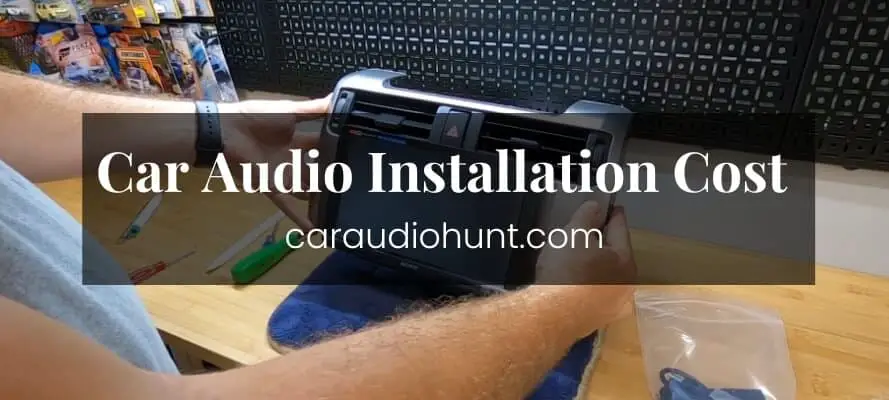
How much does a car audio installation cost? The labor depends on the job, and the equipment price is separate unless the quote says otherwise. A standard radio swap usually needs less labor than adding an amplifier with a new power cable. Factory amplifier integration or custom fabrication can change the scope before the first panel is removed.
As a published comparison, touchscreen radio installation is about 1.5 times standard deck installation at Best Buy. A 4-channel amplifier installation is about 2.5 times the standard deck service. Those are service comparisons, not complete-system totals. For drivers budgeting an upgrade, the useful number is the written installed total for the exact vehicle, including required adapters and any tuning. Service benchmarks help compare labor only after required hardware is identified.
Table of Contents
What are useful installation labor benchmarks?
Published service prices provide a labor reference, while a vehicle-specific quote establishes the amount for the actual job. Best Buy's car electronics installation services list separate standard rates for the following work.
Service | Published regular price | Scope to confirm before booking |
|---|---|---|
Standard in-dash deck installation | $99.99 | Dash kit and wiring hardware |
Touchscreen stereo installation | $149.99 | Vehicle interface and retained features |
Standard speaker installation | $99.99 | Number of speakers covered and adapters |
Component speaker installation | $149.99 | Tweeter mounting and crossover placement |
2-channel or mono amplifier installation | $199.99 | Power kit and audio integration |
4-channel amplifier installation | $249.99 | Speaker wiring and tuning scope |
The component-speaker service is roughly 1.5 times the standard-speaker service, while mono amplifier labor is about twice the standard-deck labor. These comparisons do not establish a national average or include equipment simply because it is needed for the work.
A service name can hide a different scope from one shop to another. For speaker work, we recommend asking how many locations the quoted service covers instead of assuming a per-speaker or whole-car price.
Which parts add to the installed total?
Vehicle-specific installation hardware adds to the total even when the radio or speakers are already purchased. Factory functions can require a harness or data interface during a head unit change. A dash kit and an antenna adapter may add further hardware to that job.
A factory-amplified vehicle may require an amplifier-retention interface or a deliberate bypass. The Maestro interface and retained feature explanation helps identify what needs confirming for a compatible radio and vehicle combination.
Amplifier installation also needs a protected power feed and a suitable signal connection. An existing cable kit is useful only if its cable and protection suit the new equipment. The amplifier power feed fuse selection explains why a larger fuse is not a substitute for the right wiring.
A parts quote should distinguish equipment that is necessary from optional additions. The essential and optional car audio parts explain which functions may already be built into the radio or amplifier.
Which vehicle details change the labor?
The exact trim and factory audio package can change installation work within the same model year. Keeping a factory amplifier, camera or warning chimes may require an interface and programming beyond mounting a new radio.
Some vehicles are more difficult to work on. Cars with tight dashboards or luxury trims can require more labor and time.
Speaker mounting work can also differ between front and rear doors. Separate tweeters need an approved location and cable routing. A custom subwoofer enclosure adds fabrication that a ready-made enclosure does not require.
A low labor quote needs to cover the features that must remain. A written list of retained functions is our preference before comparing installers for a daily driver.
An electrical upgrade cannot be approved by a universal 1,000 W RMS threshold. Charging capacity available after the vehicle's own loads, along with voltage behavior and wiring condition, decides whether more work is needed. The alternator upgrade planning explanation owns that decision.
How do you request a comparable quote?
A comparable quote names the vehicle, equipment and completion standard. Have the model year and trim, factory audio option and exact proposed product models ready. A phone photo of the current dash can help the installer identify the starting system.
1. Specify the upgrade goal so the quote does not include a full replacement for a single missing feature.
2. List the factory functions to retain so the required interface work is included.
3. Request an itemized installed total so equipment and labor can be compared separately.
4. Confirm the tuning service so gain and crossover setup are not confused with detailed DSP adjustment.
5. Confirm the workmanship warranty so the remedy for an installation fault is written down.
The written total should identify tax and any required installation materials. It should also state whether trim removal, equipment mounting and programming are included. Ask whether a changed scope needs approval before extra work starts.
A second quote can be useful when the scope is unclear. For that comparison, we favor giving both shops the same equipment list and retained-feature requirements.
A reader still choosing the amount of work should compare the different car audio system approaches before requesting a complete-system price. A bass-only addition may keep the working radio and speakers.
When does DIY installation make sense?
DIY installation can reduce paid labor when you have the tools and experience for the specific vehicle. Mistakes can add repair work and replacement parts to the bill.
DIY work is a more reasonable option when the vehicle has clear instructions and the correct adapters are available. Add the cost of missing tools and your time before treating the saved labor as the entire saving.
Removing trim near an airbag needs the vehicle's safety instructions. Do not unplug safety-system connectors or work around a live battery terminal to reduce shop labor. A partial DIY cable run should be agreed with the installer first, because the shop may need to inspect or redo it.
Factory amplifier integration and unfamiliar electrical work can make professional help the better value. For that situation, our recommendation is to agree on the completed job rather than divide responsibility across unfinished stages.
Questions people usually ask (FAQ)
How much does a car audio installation cost for a full system?
A full-system price needs a defined equipment list and installation scope. Car audio installation cost rises when the work adds new cable routes, factory-system integration or custom fabrication, so separate service prices should not be treated as one complete-build quote.
Does buying equipment include installation?
Equipment includes installation only when the offer explicitly says so and the vehicle qualifies. Confirm hardware exclusions and any extra interface work before purchase.
Is tuning included in amplifier installation?
Basic gain and filter setup may be included, while detailed DSP calibration may be quoted separately. Ask the installer to name the adjustments and verification covered.
Explore More