
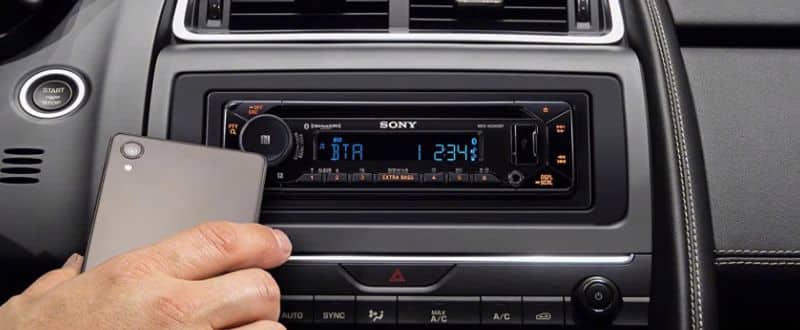
A single DIN opening is only about 2 inches tall, but that small space can still accommodate serious audio tuning, hands-free control, and even a large CarPlay display. The challenge is knowing which format actually makes sense for your dash. The best single DIN head unit might be a traditional screenless receiver, a CD receiver, a floating-screen stereo, or a flip-out model, depending on what you need from the installation.
We researched current models using manufacturer specifications and owner feedback, then put each one in the context of real-world car-audio needs. We held all 10 picks to one standard, weighing preout voltage, tuning depth, chassis depth, and screen fit the same way for an entry deck as for a premium flip-out. After weighing those factors across the current head unit lineup, we chose the Kenwood Excelon KMM-X705 as our best overall pick for most dashes.
Whether you want 5-volt preouts for an amp build, a CD slot for a disc collection, or a 10-inch screen in an older truck, you're in the right place to find the best single DIN car stereo for it.
Table of Contents
Quick Picks: 10 Best Single DIN Head Units
1. Best Overall: Kenwood Excelon KMM-X705
Three 5V preout pairs and HD Radio in a 3-15/16-inch chassis make this the deck we'd build any amplified single DIN system around, today or after the amps arrive.
2. Best for Sound Tuning: Pioneer MVH-S522BS
Its 13-band EQ opens to 31 bands in Smart Sync, the most EQ control of any screenless pick here, with sub phase control and 3-way crossovers for amp builds.
3. Best Value: JVC KD-X380BTS
Three 4V preout pairs and built-in Alexa in a 100mm chassis at entry money, the most amp-ready screenless deck per dollar in this guide, plus a direct subwoofer mode.
4. Best Under $100: Sony DSX-A415BT
EXTRA BASS and NFC tap-to-pair give factory speakers a quick lift from a short chassis, while 2V preouts cap how far you can expand if amps join the plan later.
5. Best-Sounding CD Receiver: Kenwood Excelon KDC-X705
The only CD receiver here with three 5V preout pairs, backed by HD Radio and a 97dB disc signal-to-noise rating, a clean disc source for amplified builds.
6. Best Value CD Receiver: JVC KD-T920BTS
T920BTS Alexa and five-phone Streaming DJ make this our road-trip CD deck, and K2 processing restores treble on older discs for less than the Kenwood Excelon KDC-X705.
7. Best Big-Screen Floating: Sony XAV-AX8500
A 10.1-inch 1280 x 720 floating screen with wireless CarPlay and 5V preouts, plus the sharpest display and deepest factory integration of any pick in this guide.
8. Best Budget Floating: BOSS BVCP9700A-CFL
The least expensive way into floating 7-inch CarPlay in this guide, with a backup camera in the box and three preout pairs for the amps you add later.
9. Best Premium Flip-Out: Pioneer AVH-3500NEX
DVD playback and wired CarPlay share one motorized 7-inch screen here, with Auto EQ and three 4V preouts at the top of our price range, just above the 10.1-inch Sony.
10. Best Wireless CarPlay Flip-Out: Power Acoustik CA1-77W
Wireless CarPlay on a 1024 x 600 motorized screen with an onboard GPS receiver, though the brand lacks Pioneer's long head unit record, so long-term owner data is thin.
How We Chose These Single DIN Head Units
Every pick here passed the same 5 checks, applied the same way to a screenless deck as to a 10.1-inch floating display. We drew on manufacturer specs and real owner reports, and we ranked each unit on what its numbers change inside a real car.
- Preout voltage and count: Three pairs at 4V or 5V let you add front, rear, and sub amps without pushing amp gain into hiss. A single 2V or 2.5V pair limits you to one add-on.
- Tuning depth: We counted EQ bands, checked for time alignment and crossover modes, and noted app-based tools such as Pioneer's 31-band Smart Sync.
- Fit: Chassis depth decides whether a unit clears a shallow dash, and screen placement decides whether a floating or flip-out panel clears your vents and shifter.
- Integration: We checked for HD Radio, SiriusXM readiness, Alexa, dual-phone Bluetooth, steering wheel control support, and whether CarPlay runs wired or wireless.
- Availability: Each pick was listed new at a major retailer during our research, and we dropped models that only turned up refurbished.
Compare Our Top Single DIN Head Units Side-by-Side
We’ve compared the key specs for all 10 picks in the table below.
Pick | Type | RMS Power | Preouts | EQ | Screen | Check Price |
|---|---|---|---|---|---|---|
1. Kenwood Excelon KMM-X705 | Screenless | 22W x 4 | 3 pairs, 5V | 13-band | None | |
2. Pioneer MVH-S522BS | Screenless | 14W x 4 | 3 pairs, 4V | 13-band (31 in app) | None | |
3. JVC KD-X380BTS | Screenless | 22W x 4 | 3 pairs, 4V | 13-band | None | |
4. Sony DSX-A415BT | Screenless | 20W x 4 | 2 pairs, 2V | 10-band | None | |
5. Kenwood Excelon KDC-X705 | CD | 22W x 4 | 3 pairs, 5V | 13-band | None | |
6. JVC KD-T920BTS | CD | 22W x 4 | 2 pairs, 2.5V | 13-band | None | |
7. Sony XAV-AX8500 | Floating | 20W x 4 | 3 pairs, 5V | 14-band | 10.1 in, 1280 x 720 | |
8. BOSS BVCP9700A-CFL | Floating | 22W x 4 | 3 pairs | Presets only | 7 in, 800 x 480 | |
9. Pioneer AVH-3500NEX | Flip-out | 14W x 4 | 3 pairs, 4V | 13-band | 7 in, 800 x 480 | |
10. Power Acoustik CA1-77W | Flip-out | 20W x 4 | 3 pairs, 4V | 16-band | 7 in, 1024 x 600 |
4 Best Standard Single DIN Digital Media Receivers
These 4 keep the classic 2-inch face with no touchscreen, which leaves more of the budget for preouts and tuning. All 4 are mech-less, with chassis depths between roughly 3.85 and 4 inches, so they suit dashes where a CD receiver won't fit.
1. Best Overall: Kenwood Excelon KMM-X705 Digital Media Receiver
Three pairs of 5-volt preouts inside a chassis just 3-15/16 inches deep make the KMM-X705 our best overall pick, since the same deck that lifts your stock speakers today can anchor a fully amplified system later.

Power | 22W x 4 ; 50W x 4 max |
Preouts | 3 pairs (front, rear, sub), 5V |
EQ | 13-band (62.5Hz to 16kHz, ±9dB) |
Display | 255-segment, 1.5-line LCD |
Smartphone | No CarPlay or Android Auto Kenwood Remote app |
Media | Front and rear USB, front AUX |
Chassis Depth | 3-15/16 in (100mm) |
The Kenwood Excelon KMM-X705 is aimed at the driver who wants the best single DIN head unit for sound quality and has no use for a screen. It rates all three preout pairs at 5,000mV into a 10k-ohm load. Only the KDC-X705 and Sony's XAV-AX8500 match that level in this guide.
That voltage is the reason we ranked it first. A 5V signal lets an external amp run its gain lower than a 2V deck would require, and lower gain means less alternator whine and hiss reaching your tweeters. Each output carries its own crossover, so a 4-channel amp for the doors and a mono amp for a sub can be added one at a time.
Tuning is just as complete. Digital time alignment delays the nearer speakers so vocals center on your seat instead of the driver's door panel.
Drive EQ then lifts the frequencies that tire and wind noise mask at highway speed. That helps most in trucks and older sedans with thin sound deadening.
If factory speakers are staying for now, the internal amp is tied for the strongest published full-band figure among our screenless picks. That's clean enough for daily listening, but it won't drive a subwoofer, so the preouts remain the real upgrade path.
The chassis is short, which suits the kind of dash where a full-depth CD unit fights for space behind the opening.
Radio gets more attention here than on most decks. Built-in HD Radio pulls digital FM at a 75dB stereo signal-to-noise figure with no subscription, and SiriusXM is ready once you add Kenwood's tuner.
Alexa answers a spoken wake word through the Alexa app on your phone. Kenwood Music Mix keeps five phones connected, so passengers can take turns queuing tracks. The two USB ports let one charge at 1.5 amps while the other plays FLAC files up to 96kHz/24-bit.
The weaknesses are mostly about age. Bluetooth 4.2 is dated next to the 5.0 radio in the Power Acoustik further down. The display shows 1.5 lines of text, which makes scrolling a large USB library by artist slow. There's also no CD slot, a need the KDC-X705 covers.
What we liked most is how little the KMM-X705 asks you to change later. Buy it for Bluetooth and HD Radio today, and it's still the right source unit the day the amps arrive. Want to check more Excelon and standard models? Check our Kenwood car stereo roundup.
2. Best for Sound Tuning: Pioneer MVH-S522BS Digital Media Receiver
Why stop at 13 EQ bands when the MVH-S522BS opens 31 of them in Pioneer's Smart Sync app, the finest frequency control of any screenless deck in this guide?

Power | 14W RMS x 4; 22W x 4 continuous; 50W x 4 max |
Preouts | 3 pairs (front, rear, sub), 4V |
EQ | 13-band (31-band with Smart Sync) |
Display | segment LCD |
Bluetooth | dual phone |
Radio | AM/FM (18 FM, 6 AM presets) |
Chassis Depth | about 3.85 in |
Compared with the Kenwood above, the Pioneer MVH-S522BS gives up HD Radio and 1V of preout voltage in exchange for far deeper EQ control. Pioneer puts a 13-band graphic EQ on the deck, and the Smart Sync app expands it to 31 bands, close to one band per third of an octave across the audible range.
That resolution reaches problems a 13-band curve can't isolate. A door-panel resonance near 315Hz, or a harsh windshield reflection around 4kHz, can be cut narrowly in the app without dulling the notes on either side.
For bass builds, we consider this the best single DIN head unit for subs in the middle of our price range. Three 4V preout pairs feed front, rear, and sub amps. Sub phase control lets you flip polarity when a trunk-mounted sub cancels against the door woofers somewhere between 60 and 80Hz, which often recovers more bass than turning the sub level up.
Switch the crossover from Standard to Network mode and the outputs divide into high-pass, band-pass, and low-pass sections. That's how you run a 3-way active system with separate tweeter, midbass, and sub amps, and no other screenless pick here offers that split.
A 24-bit DAC handles hi-res FLAC and WAV files from the front USB port, which also charges your phone at 1.5 amps. The rotary volume knob sits where your hand expects it, so a volume change never needs a glance away from the road.
The weak spot is internal power. Pioneer rates the built-in amp at 14 watts RMS per channel under CTA-2006, the lowest published figure among our 4 screenless picks. Factory speakers stay clean at moderate volume but flatten out on the highway, so we see this deck as a source for amplifiers first.
Alexa only works through the Smart Sync app on a paired phone, so voice control disappears whenever the app is closed. There's no HD Radio tuner either, although SiriusXM is ready with the add-on tuner, and Bluetooth holds two phones at once from a memory of five.
This single DIN head unit is suitable for owners who will actually open the app and tune. If you'd rather set bass and treble once and leave them alone, the Kenwood and JVC decks ask less of you.
Our research points to the MVH-S522BS whenever a subwoofer or active 3-way system is already on the build list. Pioneer's other single and double DIN options are ranked in our Pioneer head unit roundup.
3. Best Value: JVC KD-X380BTS Digital Media Receiver
If your budget covers an entry-level Bluetooth deck but your plans include a 4-channel amp and a subwoofer, the KD-X380BTS is the entry-priced pick here with three 4-volt preout pairs ready for both.

Power | 22W RMS x 4; 50W x 4 max |
Preouts | 3 pairs (front, rear, sub), 4V |
EQ | 13-band (11 presets) |
Display | 2-line VA LCD |
Smartphone | no CarPlay or Android Auto |
Bluetooth | 4.2, HFP 1.7.1 |
Radio | AM/FM, SiriusXM-ready, no HD Radio |
Chassis Depth | 3-15/16 in (100mm); 4.215 |
The JVC KD-X380BTS pairs Bluetooth convenience with three 4V preout pairs, matching the amplifier connections of the Pioneer MVH-S522BS. Those separate front, rear, and subwoofer outputs make it our best value single DIN car stereo for drivers who want a straightforward upgrade today and room to add amplifiers later.
Those outputs are the heart of the purchase. Front, rear, and sub pairs each run at 4V, twice the starting signal of the 2V outputs on the Sony DSX-A415BT, so an amplifier's gain knob can stay nearer its quiet end. High- and low-pass filters keep deep bass out of small door speakers once a subwoofer takes over the bottom octaves.
If a full amp rack isn't in this year's budget, Subwoofer Direct mode offers a middle step. The internal amp switches to 50 watts max on each front channel plus a third 50-watt channel for a sub. That lets a modest passive subwoofer run without a separate amplifier.
What we liked is how much tuning JVC fits in at this price. Digital time alignment calculates a delay for each speaker from its type and its distance to your seat. Sound Lift raises the apparent height of low-mounted door speakers toward the dash, which suits sedans with woofers down by your ankles.
The internal amp holds 22 watts per channel across the full band at under 1% distortion, the same rating as the Kenwood KMM-X705. Factory speakers stay clean at commuting volume, so the deck doesn't give up daily listening quality to reach its price.
Alexa sits behind a dedicated key on the faceplate. With the Alexa app running on your phone, one press handles a spoken request for the morning weather, a parking timer, or the next audiobook chapter.
Bluetooth 4.2 keeps two phones connected full-time. JVC's Streaming DJ lets up to five devices stay paired, so passengers can take turns sending songs from the back seat.
iPhone owners get a shortcut too. Plug the phone into the front USB port once and the deck completes Bluetooth pairing on its own.
JVC lists the chassis at 3-15/16 inches (100mm) deep, the same figure Kenwood gives the KMM-X705, while Crutchfield's own measurement comes in at 4.215 inches. It clears the same tight dashes in older trucks and compact imports.
The limitations are about extras more than performance. There's no HD Radio tuner, so broadcast listeners who want digital FM should step up to the Kenwood. JVC's warranty runs one year against Kenwood's two, and the RM-RK52 remote is an optional purchase, where Sony includes one with the DSX-A415BT.
The KD-X380BTS is the best single DIN car stereo for the money when your plans include amplifiers but your budget doesn't yet. You get the output stage of a pricier deck on day one and grow into it. For JVC's other receivers, including its HD Radio models, see the JVC receivers we rank highest.
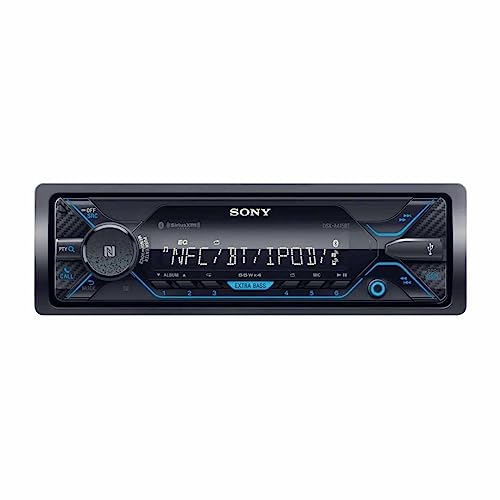
4. Best for Factory Speakers: Sony DSX-A415BT Single DIN Car Stereo Receiver
One NFC tap to pair your phone and one button for EXTRA BASS, and a car still running factory speakers has everything it needs from its next head unit.
Power | 20W RMS x 4; 55W x 4 max |
Preouts | 2 pairs (rear, sub), 2V |
EQ | 10-band EQ with app control |
Display | LCD, blue key illumination |
Bluetooth | 3.0 |
Radio | AM/FM (18 FM, 12 AM presets) |
Chassis Depth | about 4 inch |
Not every upgrade needs a preout voltage chart. The Sony DSX-A415BT is the best budget single DIN head unit in this guide for drivers who want Bluetooth, USB playback, and more low end from the speakers the car came with, and who plan to stop there.
Pairing on Android phones takes one step. Tap the phone against the volume knob and NFC completes the Bluetooth link, which saves time in a family car where two or three drivers connect through the week. iPhones pair through the usual settings menu, since Apple doesn't open NFC pairing to car stereos.
EXTRA BASS is the feature we'd lean on first. Its two levels lift the low end within a range that factory 6.5-inch paper cones can handle at moderate volume. Sony rates the internal amp at 20 watts RMS per channel under CTA-2006, while retail listings show 17 watts, and either figure keeps daily listening clean on stock speakers.
The 10-band EQ can be adjusted from a phone app, which is easier than scrolling through menus on the faceplate. It also lets you pull back any upper-bass boom that the boost exaggerates in thin doors.
Installation is simple in most older dashes. Sony lists 102mm of depth behind the opening (about 4 inches), within a few millimeters of the Kenwood KMM-X705 and well short of every CD unit here.
The sub output connects directly to a powered subwoofer, with a low-pass filter set at 80, 100, or 120Hz, which covers the most common first add-on. A 4-channel amp for the doors is a different story. The 2V rear preouts force that amp's gain higher to reach full output, and higher gain invites hiss.
Sony includes the RM-X231 card remote in the box, a small extra that the Kenwood, Pioneer, and JVC decks above sell separately. Passengers can skip tracks without reaching across the console.
The age of the design shows in its wireless hardware. Bluetooth 3.0 is the oldest version in this guide, two generations behind the Power Acoustik's 5.0 and older than the 4.2 radio in the Kenwood and JVC decks.
Calls run through a microphone built into the faceplate instead of a visor-mounted mic. That puts it farther from your mouth, which can let more road noise into a highway call.
We'd point you here only if an amplifier isn't in your future. For that buyer, the DSX-A415BT covers streaming, calls, and a clear bass lift at the entry end of our price range, which is why it carries our Best for Factory Speakers tag. Sony's wider range is covered in our Sony car stereo picks.
2 Best Single DIN CD Receivers
Both of these load discs through the faceplate, so plan on an opening about 6 inches deep behind the dash. We picked one for amplified sound-quality builds and one for voice control and shared cars. DVD playback lives in the flip-out section, where the AVH-3500NEX handles it.
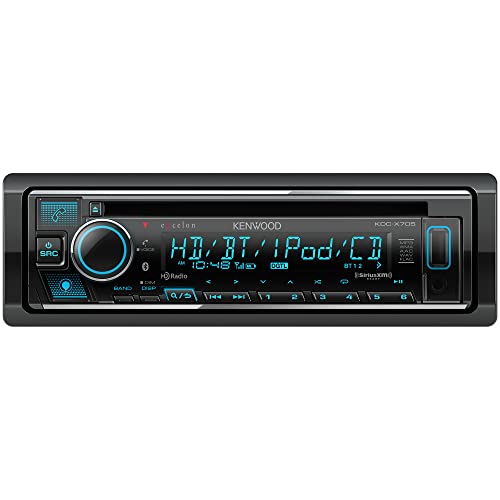
5. Best-Sounding CD Receiver: Kenwood Excelon KDC-X705 Single DIN
While most CD receivers treat the disc drive as the headline, the KDC-X705 treats it as one clean source feeding three 5-volt preout pairs, which is why it carries our Best-Sounding CD Receiver pick.
Power | 22W RMS x 4; 50W x 4 max |
Preouts | 3 pairs (front, rear, sub), 5V |
EQ | 13-band |
Display | 1.5-line LCD |
Bluetooth | 4.2 |
Radio | HD Radio built in |
Chassis Depth | 6-1/8 in (155.5mm) |
If your music still lives on discs and your system includes, or will include, external amps, this is the best sounding single DIN car stereo with a CD slot we found. The Kenwood Excelon KDC-X705 shares its audio section with the KMM-X705 above, so the choice between them turns on the disc drive and about 2 inches of chassis depth.
The transport uses 8x oversampling, and Kenwood features a 97dB signal-to-noise ratio and 0.01% total harmonic distortion at 1kHz for disc playback. That S/N figure sits within 1dB of the same deck's USB input, which tells you the CD path isn't the weak link in the chain.
The amp side is where disc players usually cut corners, and this one doesn't. All three preout pairs deliver 5V, so the gain controls on a 4-channel amp and a mono amp can sit near the low end of their range, where most amplifiers add the least noise. One CD receiver can then anchor a full front, rear, and sub build.
Tuning matches the mech-less Excelon band for band. Digital time alignment places the stage at the driver's seat instead of splitting it between doors. Drive EQ raises the frequencies that road noise buries past highway speed.
HD Radio is built in, which none of the other disc-playing units in this guide list. Digital FM stations come through with a 75dB stereo S/N rating and no subscription.
Alexa and Kenwood Music Mix carry over from the KMM-X705 too. Voice control and five-phone streaming don't require giving up the disc slot.
The costs are physical. At 155.5mm (6-1/8 inches) deep, the chassis needs a full CD-depth opening, 55mm more than the KMM-X705. USB sits on the front panel only, so a charging cable hangs across the dash instead of routing to the glovebox.
It's also the priciest screenless deck here, a modest premium over the mech-less Excelon. If you never play discs, that money is better spent on the KMM-X705.
Among the CD receivers we researched, this was the only one pairing 5V outputs with HD Radio, and that combination earns the KDC-X705 its place. If you plan to amplify a disc-based system, start here. For more on what those 5 volts do, read how preamp voltage affects amp gain.
6. Best Value CD Receiver: JVC KD-T920BTS Single DIN Car Stereo
Compressed tracks and older CDs lose the top octave of treble, and the KD-T920BTS answers that with K2 processing that upsamples 44.1kHz disc audio to 192kHz, the feature that makes it our value pick for disc collectors.

Power | 22W RMS x 4; 50W x 4 max |
Preouts | 2 pairs (front, rear/sub), 2.5V |
EQ | 13-band |
Display | 2-line VA LCD |
Bluetooth | 4.2 |
Radio | AM/FM |
Chassis Depth | 6-3/16 in (156mm) |
Picture a road-trip crew with five phones, a stack of CDs in the door pockets, and a driver who'd rather talk to the dash than press buttons. That's the buyer for the JVC KD-T920BTS, and it covers all three for less than the Excelon.
K2 does more work on a disc player than anywhere else. JVC says the processing expands 44.1kHz CD data to 192kHz and recreates the treble above 20kHz that CD formatting cuts off, so older discs and MP3-era burns sound less closed-in at the top.
JVC Streaming DJ keeps up to five Bluetooth devices connected while two phones stay linked full-time for calls. Anyone in the car can queue the next track without re-pairing, which turns a long drive into a shared playlist.
Alexa is built in and responds through the dedicated faceplate key once your phone runs the Alexa app, so you get voice control without buying a separate device. It can play Amazon Music, iHeartRadio, TuneIn, Audible, SiriusXM, and Pandora by voice, along with weather and local news.
Bluetooth Hands-Free Profile 1.7 improves voice quality and noise reduction on calls, a practical gain in a loud cabin compared with older HFP versions.
For amplifiers, a front preout pair joins a rear/sub pair. A 4-channel amp can take front and rear signals, or an amp can run the front speakers while a powered sub takes the second pair.
Two-zone lighting lets you set the buttons and accent strip separately, with 32,768 colors per zone. That makes it simple to match a dash with mixed amber and red instrument lighting.
The ceiling is output voltage. Both preout pairs run at 2.5V, half the Kenwood KDC-X705's 5V, so larger amp builds need higher gain settings and more attention to noise. HD Radio is absent too.
Depth stays close to the Excelon's, since JVC lists the chassis at 6-3/16 inches (156mm).
Stock is the last thing to check. The KD-T925BTS sibling shares its core features if your preferred store runs dry.
Taken together, this is the CD receiver we'd hand to a family or a road-trip regular before the Excelon.
2 Best Floating Screen Single DIN Head Units
A floating unit mounts a large touchscreen in front of a standard 1-DIN chassis. If you want the best single DIN touchscreen head unit with the biggest possible display, the floating unit is the right type. Measure the space in front of the dash as well as the opening, since the panel sits proud of the trim.
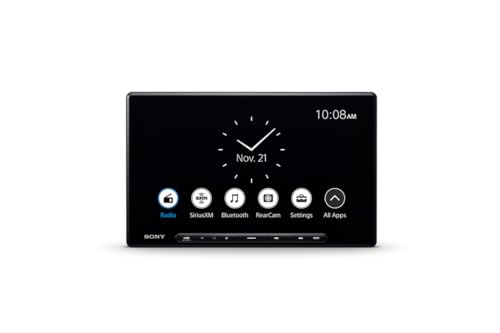
7. Best Big-Screen Floating: Sony XAV-AX8500 Floating Stereo
Next to the BOSS floating unit below, the XAV-AX8500 costs roughly four times as much, and a 1280 x 720 screen, cable-free CarPlay, and 5-volt preouts are where that difference goes.
Power | 22W RMS x 4; 55W x 4 max |
Preouts | 3 pairs (front, rear, sub), 5V |
EQ | 14-band EQ |
Display | 10.1 in floating capacitive, 1280 x 720 |
Smartphone | wireless Apple CarPlay, wired and wireless Android Auto |
Radio | AM/FM (18 FM, 12 AM presets) |
The Sony XAV-AX8500 is the pick if you want the best single DIN Apple CarPlay head unit and your dash has room for a 10.1-inch panel. It carries the largest and sharpest screen in this guide.
Resolution is the first upgrade you'll notice. At 1280 x 720, the panel holds about 2.4 times the pixels of the 800 x 480 BOSS screen, so street names and album art stay crisp at a glance. Sony bonds the LCD directly to the glass touch layer, a gapless design that cuts the internal reflections that wash out ordinary screens in afternoon sun.
Size brings a fit question with it. The panel measures about 10.6 by 6.6 inches, so it needs open space in front of the dash that many compact cars don't have. Sony's 4-way installation adjustment and updated tilt and swivel joint help you clear vents and angle the screen toward the driver, but measure first.
CarPlay connects over Wi-Fi, and Android Auto runs wired or wireless, so your phone can stay in a pocket or on a charging pad for the whole drive. Sony also supplies a GPS antenna in the box to support navigation alongside that wireless link.
The catch is that CarPlay has no wired fallback on this model. If an iPhone's wireless link drops, the rear USB-C port still charges it at up to 3 amps, but plugging in won't start CarPlay. Android users keep both connection options.
The audio section is where the premium goes for anyone planning an amplified build. Three preout pairs run at 5V, matching the Kenwood Excelon decks. A 24-bit/192kHz DSP drives the 14-band EQ.
What we liked most is the time alignment, which adjusts in 1cm steps across five channels (four speakers plus the sub). That lets you shift the stage by less than half an inch at a time, which helps when the driver's seat sits much closer to one door than the other.
Bluetooth streaming supports LDAC as well as AAC, so compatible Android phones send music at higher bitrates than the standard SBC codec when you're not in Android Auto. iPhones stream over AAC.
For newer vehicles, iDatalink Maestro RR and RR2 compatibility keeps factory features such as steering wheel controls and, depending on the car, vehicle information displays. Three camera inputs, each with its own trigger, cover a rear camera, a front camera, and a third view such as a trailer hitch.
Sony backs all of this with a 3-year warranty, three times the coverage on the Pioneer picks. What the unit lacks is HD Radio, so broadcast-heavy listeners should add the SiriusXM tuner or look at the Kenwood decks.
Based on our research, the XAV-AX8500 is the floating screen we'd choose for a truck or SUV with a tall center stack and an amp build on the way. It sits near the top of our price range, just under the Pioneer flip-out. It earns that spot with the best display and the only iDatalink Maestro support among our picks. Want to see more options? See our Top 7 floating screen stereo picks.
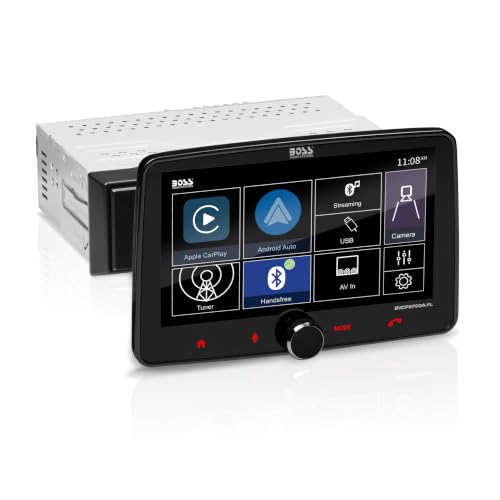
8. Best Budget Floating: BOSS BVCP9700A-CFL Single DIN Stereo
Put a 7-inch floating CarPlay screen and a backup camera into a single DIN dash for less than any other touchscreen in this guide costs, and the BVCP9700A-CFL is the unit that does it.
Power | 22W x 4 RMS; 85W x 4 max (340W total) |
Preouts | 3 pairs (front, rear, sub) |
EQ | preset EQ curves |
Display | 7 in floating touchscreen, 800 x 480 |
Smartphone | wired Apple CarPlay and Android Auto |
Radio | AM/FM |
At the entry end of this guide's touchscreens, the BOSS BVCP9700A-CFL includes the part most budget buyers end up adding anyway, a backup camera. It also costs roughly a quarter of what the Sony above does.
That camera is what separates the CFL from the plain FL version. It wires to the rear input and switches on automatically in reverse, which helps most in a pickup or older SUV that never had a factory camera.
A second input accepts a front camera, useful for judging a tight parking spot or the lip of a steep driveway.
The 7-inch screen floats above the dash on a single DIN chassis, and its angle adjusts so the panel faces the driver instead of the passenger seat. In a truck with a tall dash, a few degrees of tilt also keeps midday glare off the glass.
CarPlay and Android Auto run over a wired USB connection according to BOSS dealer listings, with Siri or Google Assistant handling calls, messages, and maps by voice. An external microphone ships in the box, and mounting it on the visor puts it much closer to your mouth than a faceplate mic.
For system growth, BOSS includes front, rear, and sub preamp outputs. BOSS doesn't publish the preout voltage, so we'd plan on running amp gain a bit higher than with the 5V Sony, but three pairs still allow a full amp build over time.
The output is 22W RMS per channel, while the 85-watt figure per channel is a peak rating. Treat the internal amp as suited to factory speakers.
The compromises are evident on the screen and in the tuning menu. An 800 x 480 panel on a 7-inch display looks soft for small map text, and it trails both the 1280 x 720 Sony and the 1024 x 600 Power Acoustik. The EQ offers preset curves plus balance and fader, and it lacks the 14-band control the Sony provides.
USB placement is the daily annoyance. The only port sits on the rear of the chassis, so you'll route an extension cable to the glovebox or console during install to keep wired CarPlay usable.
If warranty coverage matters, buy through Amazon, since BOSS ties its 3-year coverage to purchases in its listing and other sellers may offer different terms.
What we found is a unit that handles the basics of floating-screen CarPlay at a price the name brands don't approach, with a camera included. It's the right call when the budget is fixed and a camera is on the list.
2 Best Flip-Out Screen Single DIN Head Units
A flip-out unit hides a motorized 7-inch screen inside the chassis and extends it at startup, so the dash looks stock when the car is parked. It's the best single DIN head unit with a screen for dashes where trim above the opening blocks a floating panel. Check that the screen's arc clears your shifter and hazard switch before you order.
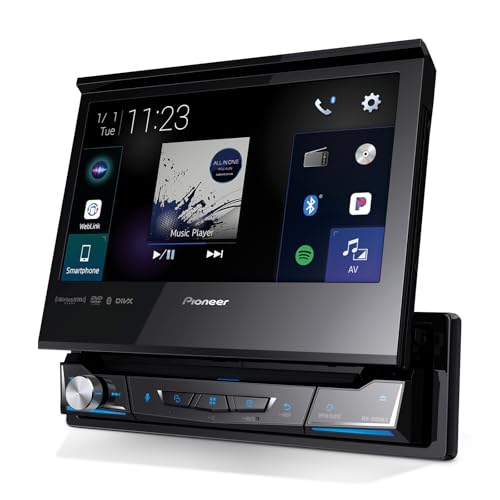
9. Best Premium Flip-Out: Pioneer AVH-3500NEX DVD Receiver
Only one flip-out in this guide still plays DVDs alongside wired CarPlay and three 4-volt preout pairs, and Pioneer's motorized 7-inch AVH-3500NEX is that unit.
Power | 14W RMS x 4; 22W x 4 continuous; 50W x 4 max |
Preouts | 3 pairs (front, rear, sub), 4V |
EQ | 13-band |
Display | 7 in motorized, 16:9, 800 x 480 |
Smartphone | wired CarPlay and Android Auto |
Radio | AM/FM (18 FM, 6 AM presets) |
Chassis Depth | 6.985 inches |
The Pioneer AVH-3500NEX is the single DIN DVD car stereo for a driver who never gave up on discs but wants CarPlay anyway. It reads DVDs, CDs, and DivX discs, and among the flip-out units we researched, it was the only DVD player that also runs CarPlay and Android Auto. That makes it our choice for the best single DIN DVD player with phone mirroring.
The motorized 7-inch 16:9 screen folds out at startup and retracts when you park, keeping the panel out of view from anyone looking in through the windows. Pioneer lists it as an 800 x 480 resistive panel, so it needs a firmer press than the capacitive glass on the Sony and Power Acoustik screens and shows less detail than either.
Wired CarPlay and Android Auto run through the rear USB port, and Pioneer's WebLink adds support for select apps outside those two platforms.
Tuning is the strongest part of the package. Auto EQ measures your cabin through Pioneer's optional CD-MC20 microphone and sets a correction curve on its own, a real shortcut, since manual time alignment asks you to measure speaker distances with a tape.
Three preout pairs run at 4V, and the crossover switches between standard and 3-way network modes, the same active topology as the MVH-S522BS. Internal power is modest at 14 watts RMS per channel under CTA-2006, so the preouts do the heavy lifting in any serious build.
Safety and passenger features round it out. The dedicated backup camera input displays parking assist lines, and an RCA video output can feed a rear-seat monitor for DVD playback on long trips. A remote control ships in the box, Alexa works through Pioneer's Vozsis app, and Bluetooth holds two phones from a memory of five.
The drawbacks start with price. Pioneer's own store lists it at the top of our price range, a little above even the 10.1-inch Sony. CarPlay and Android Auto are wired only, so the cable stays in the car. Plan on a deep opening too, since the chassis is at just under 7 inches.
The platform also dates to 2019, when it replaced the AVH-3400NEX. That age shows most in the missing wireless phone projection, a feature the much cheaper Power Acoustik includes.
We found one clear use case for the AVH-3500NEX. If DVDs are still part of your car and you want Pioneer's tuning depth behind a hidden screen, nothing we researched matches it directly.
If you stream everything should skip it, since the Power Acoustik below costs a fraction as much and adds wireless CarPlay. For every motorized option we track, see our full flip-out stereo rankings.
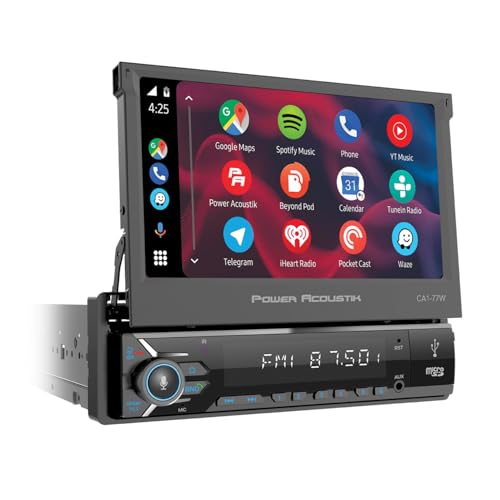
10. Best Wireless CarPlay Flip-Out: Power Acoustik CA1-77W Stereo
Because CarPlay and Android Auto connect wirelessly on the CA1-77W, the 7-inch motorized screen can fold away at shutdown with no USB cable trailing out of the dash.
Power | 20W x 4 RMS; 300W max |
Preouts | 3 pairs (front, rear, sub), 4V |
EQ | 16-band (±12dB) with presets |
Display | 7 in motorized, 1024 x 600 capacitive |
Smartphone | wireless CarPlay & Android Auto |
Bluetooth | 5.0 (HFP, PBAP, AVRCP, A2DP) |
Radio | AM/FM with RBDS |
Wireless projection changes how a flip-out works day to day. Your phone links to CarPlay or Android Auto over the air when the unit powers up, so the screen extends and maps appear with nothing to plug in. That also spares the USB port the cable strain a motorized screen can cause.
The Power Acoustik CA1-77W is the best single DIN car stereo for iPhone owners who want cable-free CarPlay without paying for the Sony XAV-AX8500, and Android phones get the same wireless link.
The panel is the sharpest flip-out screen in this guide. At 1024 x 600 on a 7-inch capacitive display, map labels and album art look cleaner than on the 800 x 480 BOSS, though the 1280 x 720 Sony XAV-AX8500 is sharper still.
Four tilt positions let you set the viewing angle once, and last-position memory returns the screen to that spot every time it deploys.
An onboard GPS receiver is rare at this price. The head unit fixes its position through its own antenna, which helps the map dot stay accurate when your phone's GPS lock is weak on dense downtown streets. That makes it the best single DIN GPS head unit in this guide, although route guidance still comes from the map app on your phone.
Tuning goes wider than most picks here. The 16-band EQ offers ±12dB of boost or cut per band, three more bands than the Pioneer AVH-3500NEX. High- and low-pass crossovers apply to the 4V RCA outputs for front, rear, and sub amps.
Camera support covers both ends of the vehicle. Separate inputs accept a rear backup camera and a front-view camera, useful on a lifted truck with a blind nose. Power Acoustik is also compatible with OEM steering wheel interface modules.
The output is 20W RMS per channel, alongside a 300-watt maximum figure for its Class A/B amp. We'd plan on an external amp for anything past factory speakers.
The brand dates to 1983 but has a shorter record in premium head units than Pioneer or Sony. Long-term owner feedback on this model is thinner as a result.
Media playback is limited too. Power Acoustik lists MP3 and WMA audio from USB or microSD with no mention of FLAC, so a lossless library would need converting first. Video plays up to 720p in MP4 or WMV.
We recommend the CA1-77W to drivers who value wireless CarPlay over disc playback or brand heritage in a single DIN dash, and it costs well under a third of the Pioneer flip-out.
How to Choose the Right Single DIN Head Unit
Four facts about your car and your listening habits decide which of our 10 single DIN stereo fits, and brand sits well down that list. Settle the type first, then check depth, outputs, and tuning before comparing extras. The steps below apply whether you're buying the best single DIN head unit for a daily commuter or a weekend project car.
Pick Your Single DIN Type First
Your dash and your music habits settle this before specs do. If there's no room in front of the dash and you stream everything, a screenless receiver like the Kenwood KMM-X705 or Pioneer MVH-S522BS fits. If CDs still ride in your door pockets, keep a disc slot with the KDC-X705 or KD-T920BTS.
If you want a map on the dash and the area above the opening is clear, a floating unit such as the Sony XAV-AX8500 gives you the largest screen. If trim above the opening blocks a floating panel, or you'd rather the screen disappear when parked, a flip-out like the Pioneer AVH-3500NEX or Power Acoustik CA1-77W suits you better.
Measure Chassis Depth and Dash Clearance
Depth decides whether a unit fits behind your opening, and it's the measurement most buyers skip. If your dash is shallow or crowded with HVAC ducting, a mech-less deck around 4 inches deep, like the 100mm Kenwood KMM-X705, leaves the wiring harness room behind it. CD receivers such as the KDC-X705 need about 6-1/8 inches.
For floating units, measure the space in front of the dash too, since the Sony XAV-AX8500's panel alone measures about 10.6 by 6.6 inches. Flip-out screens need a clear arc above the opening through their full travel.
Match Preout Voltage to Your Amp Plans
If you'll ever add an amplifier, the Preout Voltage shapes how clean that system sounds. Higher preout voltage lets you set amp gain lower, and lower gain means less hiss and alternator whine.
Three pairs at 4V or 5V, as on the Kenwood, Pioneer, JVC KD-X380BTS, and Sony XAV-AX8500 picks, support separate front, rear, and sub amps.
The 2V pairs on the DSX-A415BT and the 2.5V pairs on the KD-T920BTS still handle a powered subwoofer. A full multi-amp build will push those amps harder.
Decide How Much Tuning You Need
More EQ bands let you fix specific problems in your cabin instead of reshaping the whole sound. If you run upgraded speakers or plan to, look for at least 13 bands plus time alignment, which every Kenwood, JVC, and Pioneer pick here includes. The MVH-S522BS reaches 31 bands through its app, and the AVH-3500NEX adds Auto EQ with an optional microphone.
If factory speakers are staying and you'll never touch a crossover, a 10-band EQ with a bass boost, like the one on the Sony DSX-A415BT, covers your needs.
Choose Your Smartphone Link
Decide first whether you want your phone's apps on a screen or only its audio in the speakers. If audio and calls are enough, any single DIN Bluetooth head unit in this guide works, and dual-phone pairing on the Kenwood, JVC, and Pioneer decks helps in shared cars.
If you want maps and messages on the dash, you'll need a floating or flip-out unit. Wired CarPlay on the BOSS and Pioneer screens is the most stable link, while wireless CarPlay on the Sony XAV-AX8500 and Power Acoustik skips the cable in exchange for occasional connection lag. Our look at wired and wireless CarPlay explains the difference.
Check Radio and Voice Extras
If you still listen to local stations, HD Radio gives you digital FM and AM with no subscription, and only the two Kenwood Excelon decks here build it in. That makes them the best single DIN radio picks for drivers who spend most of their time on broadcast. SiriusXM needs an add-on tuner and a subscription on every ready model.
For voice control, Alexa is built into both Kenwood decks and both JVC decks, while the Pioneer picks route it through their apps. If you prefer Siri or Google Assistant, the CarPlay units hand voice commands straight to your phone.
Compare RMS Power, Not Peak
Peak ratings describe short bursts, while RMS tells you what an amp sustains through a full song, so RMS is the number to compare. Across these picks, published RMS ranges from 14 watts on the two Pioneer units to 22 watts on the Kenwood and JVC decks. You'll hear that gap only at higher volume.
If a listing shows only a peak figure, as with the BOSS and Power Acoustik, assume the internal amp suits factory speakers and plan on an external amp for anything more.
Keep Steering Wheel Controls and Factory Features
If your car has audio buttons on the wheel, you'll need an interface adapter to keep them working, since every pick we recommend has steering wheel control support with the module sold separately. BOSS, for example, recommends the Metra ASWC-1 for its floating unit. If you drive a newer vehicle with factory screens or chimes, the Sony XAV-AX8500's iDatalink Maestro RR/RR2 support is the only factory-integration path among these picks.
Check for a factory amplifier and backup camera too, since some vehicles route audio through an OEM amp that the new deck must feed or bypass. If you want a camera added at the same time, our head units with backup camera inputs roundup lists more options, and our step-by-step single DIN install guide walks through harnesses and adapters.
Set Your Budget Tier
Your budget decides how far up these tiers you go, but each step buys something specific. At the entry level, the Sony DSX-A415BT covers Bluetooth and bass for stock speakers, and the JVC KD-X380BTS adds three 4V preouts and Alexa for a little more. One step up, the Pioneer MVH-S522BS adds app-based tuning, the JVC KD-T920BTS adds a CD slot, and the BOSS adds a CarPlay screen.
The Kenwood Excelon decks and the Power Acoustik flip-out sit in the middle. The Sony XAV-AX8500 and Pioneer AVH-3500NEX share the top of the range, each several times the price of the entry decks.
Frequently Asked Questions
Will a single DIN head unit fit my car?
Most cars with a 2-inch-tall factory radio accept one, but the opening is only part of the fit. Check the depth behind the dash, whether a dash kit is required, and whether a factory amplifier or steering wheel controls need an adapter. A retailer's vehicle fit tool confirms all three for your exact model.
What's the difference between single DIN and double DIN?
A single DIN opening measures about 7 by 2 inches, and a double DIN is the same width at about 4 inches tall. Double DIN units fit larger fixed screens, while single DIN units reach similar screen sizes through floating or flip-out designs. Our single DIN and double DIN comparison explains fit and feature differences.
Can I get Apple CarPlay in a single DIN dash?
Yes, through a floating or flip-out unit. Single-DIN receivers can support Apple CarPlay with either wired or wireless connectivity, depending on the unit. Floating-screen models typically pair a larger display with the single-DIN chassis, while flip-out designs use a retractable screen. Screenless receivers cannot run CarPlay.
Is a CD player still worth it in 2026?
Yes, if you still play CDs regularly. A CD receiver gives you physical-disc playback alongside features like Bluetooth and hands-free calling, while some models also offer higher-voltage preamp outputs for external amplifiers. If all your music comes from your phone, a mech-less receiver is shallower and has one less moving part to wear out.
What preout voltage do I need for an amplifier?
For a multi-amp system, look for at least 4V, and 5V gives the most headroom. Higher voltage lets you run amp gain lower, which reduces noise. A 2V or 2.5V output works fine for a single powered subwoofer or a small amp.
Floating screen or flip-out: which is better?
We'd choose a floating unit if the area above your opening is clear, since you get a bigger screen, up to 10.1 inches on the Sony. A flip-out makes more sense if trim blocks a floating panel or you want the screen hidden when parked. Our look at floating and flip-out screens compared goes deeper.
Do I need a steering wheel control adapter?
Yes, in almost every car with factory audio buttons. The adapter translates your vehicle's control signals for the new receiver, and it has to match both the car and the head unit brand. Metra's ASWC-1 is one common universal option.
Can I install a single DIN head unit myself?
Yes, with a vehicle-specific dash kit and a wiring harness adapter, which together avoid cutting factory wires. Floating and flip-out units take more care, since screen clearance and USB routing add steps. If your car has a factory amplifier or data-bus steering controls, a professional install saves hours of troubleshooting.
What is the most powerful single DIN head unit?
Based on RMS output, we’d put the Kenwood Excelon KMM-X705, KDC-X705, JVC KD-X380BTS, and KD-T920BTS at the top of this group. Each is rated at 22 watts RMS per channel, compared with 20 watts for the Sony DSX-A415BT and 14 watts CTA-2006 for the Pioneer models. We give RMS output more weight than advertised peak wattage because it better represents the continuous power a head unit can deliver. That’s why we don’t rank the larger peak-power figures listed for the BOSS and Power Acoustik models directly against these RMS ratings.
Which single DIN head unit works best with Android phones?
The Sony XAV-AX8500 is our pick for Android phones, since it runs Android Auto wired or wireless and streams Bluetooth audio over LDAC. The Power Acoustik CA1-77W runs Android Auto wirelessly, while the BOSS BVCP9700A-CFL and Pioneer AVH-3500NEX run it over a cable. None of our picks runs the full Android operating system that some off-brand units sold as Android head units use.
Our Final Verdict
The best single DIN head unit for most drivers is the Kenwood Excelon KMM-X705, since its 5V preouts, HD Radio, and 100mm chassis serve a stock system today and an amplified one later.
If you want the most tuning control, the Pioneer MVH-S522BS is Best for Sound Tuning with 31 app bands and 3-way crossovers. Budget buyers who want room for amps later should look at the JVC KD-X380BTS, and drivers staying on factory speakers will be well served by the Sony DSX-A415BT.
For discs, the Kenwood KDC-X705 is our best-sounding CD receiver here, while the JVC KD-T920BTS brings Alexa and five-phone streaming for less. If you are a screen lover, you can choose:
- Sony XAV-AX8500 for the biggest, sharpest floating display with wireless CarPlay
- BOSS BVCP9700A-CFL for floating CarPlay on a budget
- Pioneer AVH-3500NEX for DVD playback on a flip-out
- Power Acoustik CA1-77W for wireless CarPlay on a flip-out
Measure your dash depth, decide whether a screen belongs there, and you'll find a top single DIN head unit on our list that fits both your car and the way you listen.
Explore More