
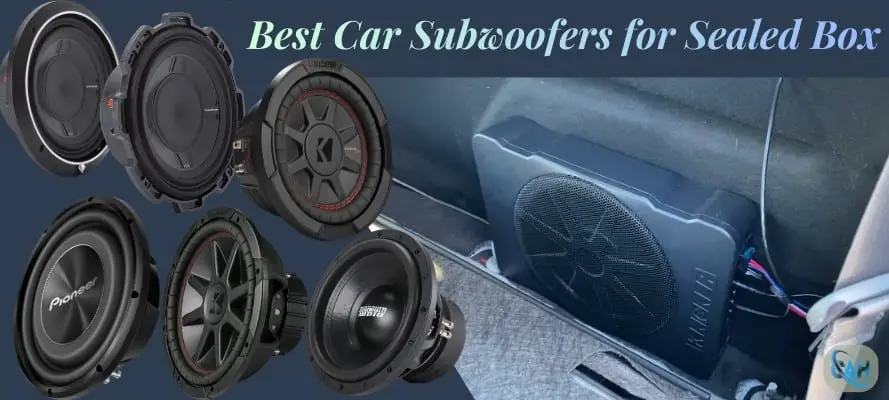
If you are trying to choose the best car subwoofer for sealed box setups, this guide is built to make that decision easier. We selected these picks based on sealed-box performance, your listening style, available space, and how much power you can realistically run. Every figure below comes from the manufacturer's own product page, cross-checked against retail listings where a spec was not published, with owner reports used for how these drivers behave once they are actually installed.
Sealed enclosures are a smart choice if you want tight, controlled bass and consistent results when the driver and box are matched correctly.
In this article, we cover driver-only sealed subwoofers for custom enclosures and compact powered sealed options for buyers who want easier installation without giving up the controlled bass response sealed boxes are known for. If you want the short answer, the Rockford Fosgate P3SD4-10 is our overall pick for a driver-only build, and the KICKER 46HS10 Hideaway is the one we point powered buyers toward. Let's begin with the top picks if you want a quick sealed-box shortlist before reading the full reviews.
Quick Picks - Best Car Subwoofers for Sealed Boxes
1. Best Overall: Rockford Fosgate P3SD4-10 Punch
"Shallow 10 inch driver that delivers tight, musical bass from a small sealed box, and it fits trucks, coupes and daily drivers that are short on depth."
2. Best for High-Power System: Sundown Audio SA-12 Classic
"Built for serious sealed power, with the motor strength and excursion to stay dense and controlled when you feed it clean wattage from a real mono block."
3. Best Daily-Driver Pick: Kicker 43CVR122 CompVR
"Well-rounded 12 inch sub for everyday sealed setups, with punchy bass, honest power ratings and a sealed box range that most mid-sized trunks can take."
4. Best OEM-Friendly: Pioneer TS-A3000LS4
"Slim shallow 12 inch driver that fits tight spots while giving a factory system a smoother, deeper foundation, and it runs happily on a modest mono amp."
5. Best Compact Sealed Pick: KICKER 48CWRT674 CompRT
"Tiny 6.75 inch driver that makes real sealed bass possible inside doors, rear side panels and ultra-tight installs, without overwhelming a small cabin."
6. Best Shallow-Mount Power: Skar Audio VD-10 D4
"Shallow 10 inch driver that handles 500W RMS at just 4.41 inches of mounting depth, so you keep real headroom where a full-depth sub will not fit at all."
7. Best for Sound Quality: Dayton Audio RSS315HO-44
"Low-distortion reference driver for sealed builds where you care about bass texture and tonal accuracy far more than badge recognition or sheer output."
8. Best Under-Seat Powered: JBL BassPro SL2
"Underseat sealed powered sub that adds tasteful, tight bass to a factory system without eating trunk space, and it needs under three inches of clearance."
9. Best Quick-Install Pick: KICKER 46HS10 Hideaway
"Slim sealed powered unit with 180W RMS on board, built to slide into cramped spaces and deliver clean, controlled bass with far less wiring hassle to plan."
Sealed Subwoofer Comparison and Fitment
Pick | RMS power | Depth or height needed | Sealed volume | Best suited to | Check Price |
|---|---|---|---|---|---|
1. Rockford Fosgate P3SD4-10 | 300W | 3.50 in | 0.4–1.0 ft³ | Trucks, coupes and compact cars | |
2. Sundown Audio SA-12 Classic | 1000W | 6.5 in | 1.0 ft³ | High-power trunk builds with supporting electrical | |
3. Kicker 43CVR122 CompVR | 400W | 6-1/4 in | 1.0–4.6 ft³ | Mid-sized trunks on an affordable mono block | |
4. Pioneer TS-A3000LS4 | 400W | 3-1/2 in | 0.5–1.0 ft³ | Behind seats, spare tire wells, OEM-style builds | |
5. KICKER 48CWRT674 CompRT | 150W | 2-3/4 in | 0.18–0.75 ft³ | Doors, rear side panels, stealth installs | |
6. Skar Audio VD-10 D4 | 500W | 4.41 in | 0.65 ft³ | Trunk corners and depth-limited builds wanting headroom | |
7. Dayton Audio RSS315HO-44 | 700W | 5.75 in | 0.49 ft³ | Active front-stage systems tuned for sound quality | |
8. JBL BassPro SL2 | 125W | 2-13/16 in | Built-in sealed enclosure | Under front seats in compact cars and trucks | |
9. KICKER 46HS10 Hideaway | 180W | 3-1/8 in | Built-in sealed enclosure | Under or behind seats, factory or aftermarket head units |
Where these figures come from: Every number in this table is taken from the manufacturer's own published specifications, checked against current retail listings where a manufacturer page omitted a figure. Where a manufacturer's claim and what owners consistently report do not agree, we say so inside the review rather than smoothing it over in the table.
7 Best Driver-Only Car Subs for Sealed Enclosures (Reviews)
These are the driver-only subs we keep coming back to for sealed use. These are best suited if you are planning your own sealed enclosure or having a custom box built around your vehicle. Let's start with our best overall pick.
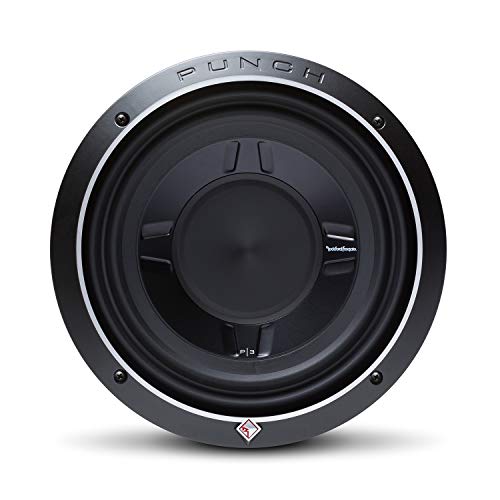
1. Best Overall: Rockford Fosgate P3SD4-10 Punch Shallow Subwoofer
RMS power | Peak power | Type | Sensitivity | Frequency Response | Mounting Depth | Sealed Volume |
|---|---|---|---|---|---|---|
300W | 600W | 10" dual 4-ohm shallow sub | 83 dB at 1w/1m | 45–250 Hz | 3.50 in | 0.4–1.0 ft³, 0.5 ft³ optimum |
The Rockford Fosgate P3SD4-10 Punch is one we would look at first if you are trying to combine tight sealed-box bass with limited mounting depth. It is part of Rockford's P3 shallow series, so the motor and basket are built to fit where a full-depth 10-inch subwoofer simply will not fit.
With a 300W RMS rating and a shallow 3.5-inch mounting depth, this driver makes a lot of sense in trucks, coupes, and compact cars where seat clearance and enclosure depth matter. Rockford's sealed recommendations keep the box in a manageable range, and that 0.4 to 1.0 cubic foot window is exactly where the sub is built to perform best.
In a sealed enclosure around 0.5 cubic feet, the volume Rockford lists as optimum, the P3SD4-10 produces a clean, punchy low end that feels like a real upgrade over factory audio. The bass is tighter and more controlled than many ported prefab setups, and you can hear that control in the way kick drums and bass guitar lines stop and start without dragging.
The shallow design also does not come at the expense of durability. The P3S uses an anodized aluminum cone with an M-roll Santoprene surround to maintain stiffness and linearity. The motor structure and voice coil cooling are tuned for the kind of daily use most drivers put their systems through, from steady commuting to weekend drives and the occasional volume spike when a favorite track comes on.
You still need to treat it like a proper subwoofer. It is not built for extreme SPL use, and it is not trying to replace a large ported 12-inch subwoofer on heavy power. If you push it outside its intended role, it will remind you that this is a shallow 10-inch driver designed for tight spaces. Run it within its comfort zone, though, and it delivers sealed bass that is controlled, musical, and clearly more satisfying than stock.
If your vehicle does not have room for a large enclosure, but you still want the best car subwoofer for sealed box use in a compact install, the P3SD4-10 is a very sensible pick. For us, this is the kind of sub that makes the most sense when space is tight and you care more about clean, usable bass than chasing maximum output. Just keep your expectations realistic. It is not an SPL monster, and it will not dig as deep as a larger 12-inch subwoofer. Set the gains properly and use it for tight, musical bass rather than chasing sheer output, and it rewards that approach.
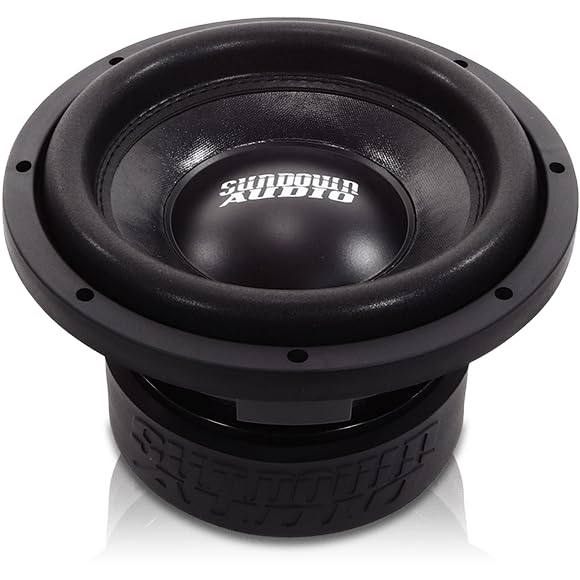
2. Best for High-Power System: Sundown Audio SA-12 Classic Subwoofer
RMS power | Peak power | Type | Sensitivity | Frequency Response | Mounting Depth | Sealed Volume |
|---|---|---|---|---|---|---|
1000W | 2000W | 12" dual 2-ohm or dual 4-ohm sub | 83.2 dB D2, 84.2 dB D4, at 1w/1m | Sub-bass focused,Fs 33.7 Hz | 6.5 in | 1.0 ft³ |
The Sundown Audio SA-12 Classic is not in the same lane as shallow daily subs. It is the kind of subwoofer you choose when you want a high-power sealed system with serious motor strength and control, not a lightweight woofer running on deck power.
Sundown now rates the SA Classic 12 at 1000W RMS with 19 mm of one-way excursion, up from the 750W figure the model carried for years, which is why plenty of listings still show the older number. The SA-12 Classic is built to handle sealed-box pressure and longer listening sessions at higher output levels. In a sealed box around 1.0 cubic foot, it produces a dense, controlled bass foundation that stays composed when you turn things up.
Sundown has a strong reputation for building drivers with solid mechanical control and heat handling, and owner reports from sealed builds consistently describe the same thing. Bass notes carry real weight, but they stay defined instead of turning bloated. When the music gets busy, the SA-12 Classic holds itself together well.
Because this driver is clearly aimed at higher-power systems, it comes with certain expectations. To get the best from it, you will want a mono amplifier that can honestly deliver in the 1000W RMS range at the correct impedance, along with wiring, battery health, and alternator support that match that demand. Running it on a small, low-powered amp and clipping the signal will not show what this sub can really do.
At the same time, it does not need a giant ported box to prove itself. One or two SA-12 Classics in proper sealed enclosures can make a car feel full, controlled, and powerful without chasing the absolute last dB. For many listeners, and especially those who care about the sound quality of a subwoofer in a sealed box, this balance of control and strength is exactly what they want.
If your goal is the best 12 inch subwoofer for sealed enclosure for a high-power build that stays controlled at volume, the SA-12 Classic is an excellent fit. What stands out to us is how comfortably it handles output in a sealed setup without losing bass definition. It does expect proper support, though. If your mono block and electrical system are not up to the task, you are paying for headroom you will never use.
3. Best Daily-Driver Pick: Kicker 43CVR122 CompVR Car Audio Subwoofer

Sensitivity | Type | RMS power | Peak power | Frequency Response | Mounting Depth | Sealed Volume |
|---|---|---|---|---|---|---|
86.9 dB | 12" Dual 2-Ohm Sub | 400W | 800W | 25–500Hz | Around 6.25" | Around 1.0–4.6 ft³ |
The Kicker CompVR 43CVR122 shows up in a lot of daily builds for a reason. It lands in a practical range where it is easy to power, reasonably priced, and well suited to sealed enclosures without demanding extreme amplifier power or box space.
Rated for 400W RMS, the CompVR pairs well with a wide range of affordable mono blocks. In a sealed box around 1.0–1.75 cubic feet (depending on your vehicle and the response you want), it delivers a punchy, full-bodied low end that works well for most mainstream genres. You do not need an oversized trunk or a complicated build to get good results from it.
The CompVR cone and surround are built for daily use while staying predictable. It has a slightly more energetic, punch-forward sound, which many listeners actually prefer in a daily system. Drums and bass lines keep their shape and impact, and the sub fits well with the kind of upgraded front-stage speakers many daily drivers already use.
This is not a purist sound-quality driver like the Dayton Audio Reference line, and it does not try to be. Instead, it focuses on strong, enjoyable bass that still sounds good in real-world systems, even when the rest of the setup is not perfect. That is the pattern we see across owner builds, and it is exactly why it remains such a practical choice for buyers who want better low end without turning the project into a full rebuild.
If you are building a sealed system around a single 12-inch subwoofer and want something that simply works, with honest power handling and a friendly sealed-box range, the CompVR 43CVR122 is a very solid daily-driver option. It will not match the refinement of a pure SQ subwoofer, and larger sealed boxes can still take up meaningful trunk space, but within realistic daily limits it is an easy sub to own and tune.
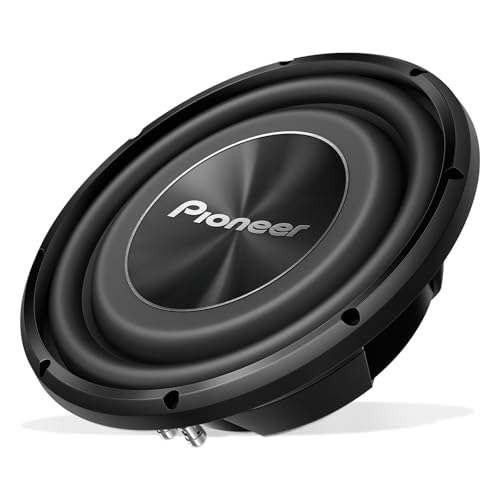
4. Best OEM-Friendly: Pioneer TS-A3000LS4 Shallow Mount Subwoofer
RMS power | Peak power | Type | Sensitivity | Frequency Response | Mounting Depth | Sealed Volume |
|---|---|---|---|---|---|---|
400W | 1500W | 12" single 4-ohm shallow sub | 88 dB at 1W/1m | 20–1000 Hz | 3-1/2 in | 0.5–1.0 ft³, 0.8 ft³ optimum |
The Pioneer TS-A3000LS4 is an appealing choice if you want to keep your system close to an OEM look and feel while still adding real sealed-box bass. As a shallow 12" model, it fits where full-depth 12s cannot, yet it retains enough cone area and excursion to make a meaningful difference.
With an RMS rating around 400W and a shallow mounting depth, this driver works well in low-profile sealed enclosures behind seats, in spare tire wells, or along the back of the trunk. Pioneer's recommended sealed volume runs 0.5 to 1.0 cubic feet with 0.8 as the optimum, so the box does not have to take over your cargo space just to perform well.
In sealed use, the TS-A3000LS4 delivers a smooth, forgiving sound rather than an exaggerated one. It fills in the low end, gives kick drums a more convincing punch, and supports vocals and instruments without constantly pulling attention to itself. We rate that balance highly for OEM-plus builds where the goal is better bass without changing the overall character of the system.
Because this is a single 4-ohm voice coil rather than a dual, your wiring options are simpler than on most picks here, and 88 dB sensitivity means it does not need much to get going. A properly built sealed enclosure, a correctly set subsonic filter, and a clean 300–400W of power will keep it in its comfort zone. If you try to run it like a competition woofer, you will reach its limits quickly.
For drivers who want an OEM-friendly sealed subwoofer without major modifications, this Pioneer shallow-mount model is the one we would recommend. Just keep in mind that it is not built for extreme output, and like most shallow designs, it rewards careful box design and sensible power more than aggressive, competition-style use.
5. Best Compact Sealed Pick: KICKER 48CWRT674 CompRT 6.75" Subwoofer

RMS power | Peak power | Type | Sensitivity | Frequency Response | Mounting Depth | Sealed Volume |
|---|---|---|---|---|---|---|
150W | 300W | 6.75" dual 4-ohm shallow sub | 82.6 dB at 1w/1m | 30–500 Hz | 2-3/4 in | 0.18–0.75 ft³ |
The KICKER 48CWRT674 CompRT is an unusual subwoofer choice, and that is exactly why it makes sense in a sealed-box guide. As a 6.75-inch dual-coil sub built for compact applications, it gives you a way to add low-frequency support in places where a traditional 10-inch or 12-inch subwoofer simply will not fit.
This driver works in very small sealed enclosures within doors, rear side cavities, or custom side panels. With 150W RMS, it is not meant to shake neighborhoods. Its role is much more practical than that. It is there to fill in the lower part of the frequency range in smaller vehicles or stealth-style installs.
In the right sealed enclosure, the CompRT 6.75-inch gives you a usable bass foundation for what it is. It will not replace a full dedicated sub stage, but it does smooth out the low end in a way that makes the system feel fuller. I like that it solves a real space problem without pretending to be something bigger than it is. In smaller hatchbacks, city cars, or vehicles where you simply cannot give up trunk space, that can be the right answer.
Because output is naturally limited by cone size, this driver makes more sense as part of a balanced system than as the main event. When paired with good 6.5-inch components or 6.5-inch coaxials up front and a modest amplifier, it fits into the overall tuning nicely and helps the system sound more complete.
If your goal is a stealthy low-frequency upgrade without using a large enclosure, the CompRT 6.75-inch gives you a path that many other subs cannot. For me, its value is not about chasing big output. It is about adding real bass in a vehicle where space rules out a normal subwoofer install. Its drawbacks are tied to its size: output is limited, and you need to integrate it carefully with your midbass drivers so it supports the system instead of trying to carry the entire low end by itself.
6. Best Shallow-Mount Power: Skar Audio VD-10 D4 Car Audio Subwoofer
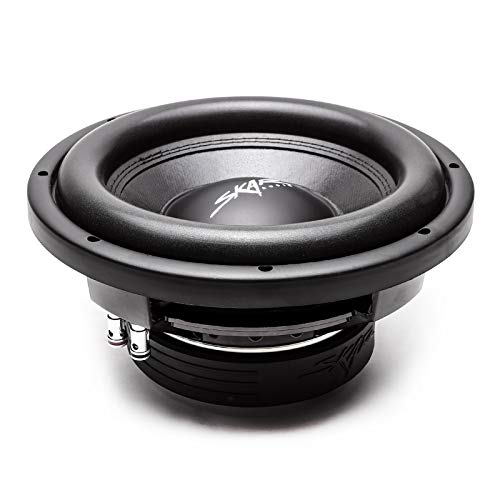
RMS power | Peak power | Type | Sensitivity | Frequency Response | Mounting Depth | Sealed Volume |
|---|---|---|---|---|---|---|
500W | 800W | 10" dual 4-ohm shallow sub | 85.1 dB | 30–350 Hz | 4.41 in | 0.6–0.85 ft³ |
We covered the Skar Audio VD-10 D4 earlier in the ported guide, but it fits sealed setups surprisingly well too. With 500W RMS handling at a 4.41-inch mounting depth, it carries more power per inch of depth than anything else in this guide, and that is the whole reason it earns its place here.
In the 0.65 cubic foot sealed box Skar publishes for it, the VD-10 D4 gives you a nice mix of control and output. It is compact enough to fit into trunk corners and other tight spaces, but still capable enough to handle realistic daily power without feeling strained when the setup is dialed in properly.
The dual 4-ohm configuration gives you the usual wiring options, though that is common across this lineup rather than something specific to the Skar. What is specific to it is headroom. A 300W shallow driver runs out of room long before this one does, and you can still feed it from a mid-size mono block rather than a competition amp.
In terms of sound, this driver leans toward the kind of sealed response many daily drivers want, reasonably tight, with enough low-end weight to sound satisfying without turning boomy. It also works well with typical front-stage upgrades when crossover points and gains are set carefully.
Like any driver in this class, it works best when you stay within its limits. It is not the right choice for ultra-low demo abuse at extreme volume. It makes more sense as the shallow-mount option you choose when depth is fixed and you still want real power handling behind the cone. The catch is the foam surround, which is not something to treat carelessly, so sensible daily use is the better fit here.
7. Best for Sound Quality: Dayton Audio RSS315HO-44 Reference Sub

RMS power | Peak power | Type | Sensitivity | Frequency Response | Mounting Depth | Sealed Volume |
|---|---|---|---|---|---|---|
700W | 1400W | 12" dual 4-ohm reference sub | 84.6 dB at 2.83V/1m | 20–500 Hz | 5.75 in | Around 1.0 ft³ |
The Dayton Audio RSS315HO-44 is not a typical mainstream car-audio subwoofer, and that is part of the appeal here. It comes from Dayton's Reference line, which is more commonly seen in home audio and DIY builds, but it has earned a strong reputation among audiophiles who care more about sound quality than logo recognition.
The reason it earns the sound quality tag is specific rather than general. Dayton builds three shorting rings into the motor to hold distortion down, and pairs them with an aluminum cone and 14 mm of linear excursion, so what comes back out of the cone stays closer to what went in. Dayton publishes 0.49 cubic feet as the optimum sealed volume, which is small for a 12-inch driver and one of the easier boxes to package on this list.
The figure worth understanding before you buy is the sealed F3, which Dayton lists at 47 Hz in that 0.49 cubic foot box. On paper that reads shallow for a sub this capable. In a car it matters far less, because cabin gain reinforces the bottom octave in a way a listening room never does, and the driver's 21.5 Hz resonance means the output is there to be reinforced.
If you are building an active front stage with quality speakers and a dedicated subwoofer channel, this Dayton can anchor a very refined system. The bass is not just strong; it has shape and detail to it. Instead of hearing a one-note thump, you get better texture and a more believable sense of low-end information. That matters when you care about how recordings actually sound, not just how much bass they produce.
The drawback is that this is not the kind of subwoofer you drop into an average build and forget about. It responds best when the system around it is planned properly. A clean amplifier in the right power range, sensible crossover points, proper time alignment, and careful tuning all help it show what it can really do.
If your goal is a sealed-box subwoofer chosen for sound quality and low distortion rather than mainstream branding, the RSS315HO-44 is a very compelling option. Just keep in mind that it rewards thoughtful system design. If the amplifier, tuning, and front stage are not up to the same standard, you are unlikely to hear why this sub is so well regarded.
2 Best Powered Car Subwoofers with Sealed Boxes (Reviews)
If you like the control of a sealed setup but do not want to build your own box or match a separate amp, these two powered options are worth a close look.
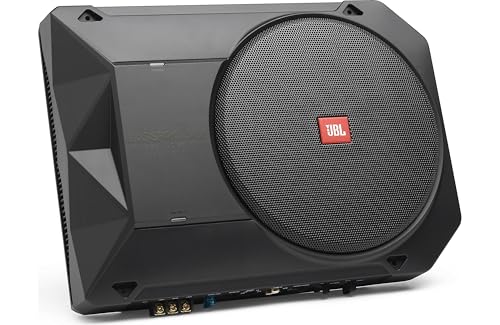
8. Best Under-Seat: JBL BassPro SL2 8" Powered Sealed Subwoofer
RMS power | Peak power | Type | Sealed Volume | Frequency Response | Enclosure Height |
|---|---|---|---|---|---|
125W | 250W | 8" powered sealed enclosure | Built-in, 13-9/16 x 9-7/8 in footprint | 35–120 Hz | 2-13/16 in |
The JBL BassPro SL2 is built for a very specific job, adding clean, sealed bass to vehicles that do not have room for a traditional enclosure. Its ultra-slim housing fits under front seats or in other tight locations, which makes it a practical choice for compact cars and stealth-focused installs. If you want an underseat powered subwoofer for trucks, or car that improves the low end without forcing you into a separate box-and-amp setup, this is the kind of product that makes sense.
Inside the enclosure, you get an 8-inch shallow driver and a built-in 125W RMS Class D amplifier with enough power to make a clear difference in low-end response without putting too much strain on a factory charging system. The sealed design helps the bass stay tight and controlled, which matters even more when the sub is mounted close to the listening position. At 2-13/16 inches tall it will slide under most bucket seats, though owners consistently say to measure around seat rails and motors before buying rather than after.
In real use, the BassPro SL2 fills in the lower frequencies that factory speakers usually struggle to reproduce. Kick drums gain more body, bass lines become easier to hear at normal listening levels, and the whole system feels more balanced. Because it is sealed, the bass stays cleaner and integrates more naturally with stock or lightly upgraded front speakers.
One pattern owners report again and again is that this unit is strongest through roughly 35 to 50 Hz and starts exciting panel rattles above that if you leave the bass boost up. The crossover and the boost control are there for a reason, and the SL2 sounds considerably better once both are set rather than left at default.
You should not expect it to compete with large, high-power sealed or ported systems. This is a compact powered sealed subwoofer made to improve everyday driving, not deliver competition-level output. Used that way, it does its job very well.
If you want the best powered sealed subwoofer enclosure for a compact daily-driver install, the BassPro SL2 is a very practical option. Just be realistic about its size. It works best as a clean, supportive bass upgrade, not as the only sub stage in a large cabin if your goal is big low-end output.
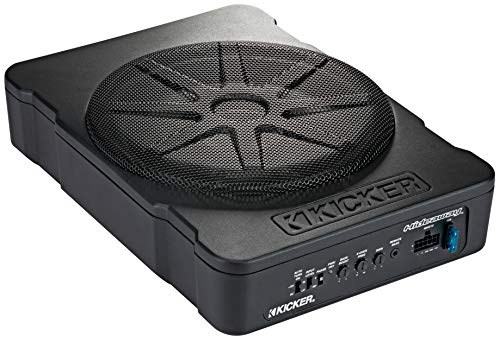
9. Best Quick-Install: KICKER 46HS10 Hideaway Powered Car Subwoofer
RMS power | Peak power | Type | Sensitivity | Frequency Response | Enclosure Height | Sealed Volume |
|---|---|---|---|---|---|---|
180W | 360W | 10" powered sealed enclosure | 82 dB | 25–120 Hz | 3-1/8 in | Built-in, 9-7/8 x 14 in footprint |
The KICKER 46HS10 Hideaway gives you a step up from the usual underseat 8-inch powered subs without pushing you into a large custom install. With a 10-inch driver and built-in amplifier inside a compact sealed enclosure, it works in the kind of tight spaces where a traditional subwoofer setup would be much harder to package.
With around 180W RMS on tap, the HS10 has enough power to be felt as well as heard in most normal-sized cabins when it is placed and tuned properly. The sealed design helps keep the bass response tight, which is one reason this kind of powered subwoofer tends to sound cleaner than a lot of compact ported setups.
Installation is one of its biggest strengths. It supports line-level and speaker-level input, includes a remote bass control, and does not ask you to plan a separate driver, box, and amplifier from scratch. Owner reports across retailer reviews point the same way, with first-time installers routinely finishing the job inside a couple of hours. For many owners, that makes it far more approachable than a full custom subwoofer build.
In terms of sound, the step up over the smaller Hideaway is real but worth sizing correctly. Kicker rates the HS10 at 180W RMS against 150W for the HS8, in an enclosure only two millimetres taller, so you gain cone area and some headroom rather than a different class of output. Music sounds fuller and more grounded, but the overall presentation still leans toward control rather than raw output.
If you want the best sealed enclosure subwoofer for your car that installs quickly, works with both factory and aftermarket systems, and gives you more presence than the usual small powered boxes, the KICKER 46HS10 is the one we recommend. It will not replace a large custom sealed box with a serious mono block, and the price is a bit higher than other powered subwoofer options, but you will find that drawback worth it for the extra output and convenience.
What To Consider to Choose the best car subwoofer for sealed boxes
After going through the reviews above, one thing should already be clear. Choosing the best car subwoofer for sealed enclosure is less about chasing a big number on the carton and more about matching the driver to your car, your space, and the way you actually listen. Sealed enclosures are easier to work with than ported ones, but the best results still come when a few key things line up.
Match the Box Volume to Your Available Space
Every sealed sub has a recommended box volume range, and staying close to that range is usually the easiest way to get tight, predictable bass. At the same time, you need to be realistic about how much space you can give up in your trunk, hatch, or cabin. Many higher-power 12-inch subs want around 0.5 to 1.0 ft³ sealed, while shallow and compact models are designed for much smaller spaces behind seats or in side panels.
Match RMS Power to Your Amplifier
Look at RMS power, not peak numbers. A sealed setup often needs a bit more clean power than a similar ported one, so the amp match matters. More moderate subs usually work well with 300–500W RMS, while heavier-duty sealed drivers can take 500–750W or more if your electrical system can support it.
Decide Between Tight and Heavy Before You Buy
Sealed boxes are known for control and accuracy. If you want bass that sounds tight, quick, and well blended with your front speakers, sealed is usually the better fit. If your main goal is maximum boom and cabin pressure, ported may make more sense. It helps to decide early whether you want clean, controlled bass or the most output possible.
Check Mounting Depth Against Your Vehicle
Mounting depth and enclosure size need to match your vehicle. Shallow subs make more sense in trucks, coupes, and OEM-style upgrades where space is limited. Full-depth 10-inch and 12-inch drivers work better when you have room for a proper enclosure. In most cases, it is smarter to choose a subwoofer built for compact sealed boxes than to force a larger woofer into a box that is too small.
Weigh Build Quality for Long-Term Use
Sealed boxes keep the driver in a small, controlled air space, so the cone and suspension are constantly working against that internal air spring. That makes build quality more important than many buyers expect. Pay attention to the surround, cone, and voice coil cooling. A better-built sub will usually stay more consistent, run cooler, and last longer in daily use.
Tune the Sub Into Your Front Stage
Even a good sealed sub can sound average if it is not integrated properly. Low-pass crossover, polarity, and gain setting still matter. Once the sub is level-matched and tuned properly with the front speakers, the sealed character you are paying for finally shows up.
FAQs
Are sealed boxes better for sound quality?
Often, yes. A well-designed sealed box controls cone movement more effectively, so the bass usually sounds cleaner and blends more naturally with the front speakers.
Do sealed subwoofers need more power than ported ones?
Usually, yes. Sealed setups are less efficient, so they often need a bit more clean power to reach the same loudness as a similar ported system.
Should you choose a driver-only sub or a powered sealed box?
Choose driver-only if you want to pick your own enclosure volume and amplifier, because that is where the best sealed results come from. Choose a powered sealed unit if you want one box, one harness, and a plug and play install, and you accept a lower ceiling on output in exchange.
Is a loaded sealed enclosure with an external amp worth considering?
It can be. A loaded passive sealed enclosure ships with the driver already mounted in a sealed box, so you supply the mono block and the wiring and skip the box build. None of the picks above are loaded passive enclosures, since this guide covers driver-only subs and fully powered sealed units, but the format sits neatly between the two if box building is the only part you want to avoid.
What is the best 12 inch subwoofer for sealed enclosure?
For most buyers, the KICKER CompVR 43CVR122 is the best 12-inch car subwoofer for a sealed enclosure because it is easy to match with a realistic daily-driver amplifier, works well in a sealed box, and delivers the kind of balanced bass that suits most systems.
What is the best 10 inch subwoofer for sealed box?
For most buyers, the Rockford Fosgate P3SD4-10 is the best 10-inch car subwoofer for a sealed enclosure because it combines sealed-box friendliness, compact shallow-mount packaging, and realistic daily-driver power handling in a way that fits a lot of vehicles.
Can shallow subs work well in sealed boxes?
Yes. Many shallow subwoofers are designed specifically for compact sealed enclosures, as long as you stay within the brand's recommended box volume and power range.
Are underseat powered sealed subs worth it?
They can be, especially if you want better bass without giving up trunk space. It is better to think of them as a clean, useful upgrade rather than a replacement for a large dedicated sub stage.
Final Verdict – Which One Should You Buy?
If you ask us, choosing the best car subwoofer for sealed box setups really comes down to space, power, and how simple you want the install to be. For a passive pick, we would start with the Rockford Fosgate P3SD4-10 because it gives you clean sealed-box bass in a compact package that is much easier to package than a full-depth setup.
If you want the easier powered route, we would point most daily drivers toward the KICKER 46HS10 Hideaway. It is compact, install-friendly, and gives you a real bass upgrade without the extra work of matching a separate driver, box, and amplifier.
If your situation is more specific, these are the runners-up we would point you to.
- High-power sealed build: Sundown Audio SA-12 Classic
- Everyday 12-inch sealed system: Kicker 43CVR122 CompVR
- Factory system upgrade: Pioneer TS-A3000LS4
- Doors and side panels: KICKER 48CWRT674 CompRT
- Depth-limited build that still needs headroom: Skar Audio VD-10 D4
- Sound quality above everything else: Dayton Audio RSS315HO-44
- Lowest under-seat profile: JBL BassPro SL2