
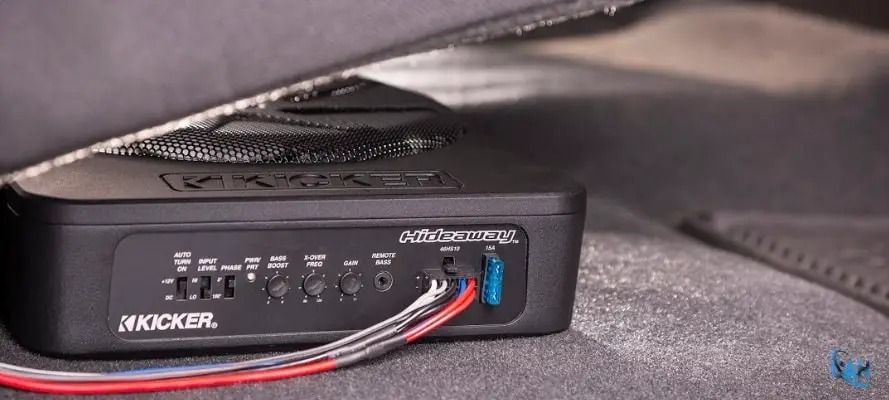
When you start looking for the best underseat car subwoofer, it does not take long to find out that a lot of “slim” boxes are either too tall to fit under real seats or too weak to make much difference in the car.
For this guide, we narrowed the field down through market research, spec checks, and long term owner feedback. Only powered, low profile subs that actually fit under or behind seats and offer a real bass upgrade made the cut. The KICKER 46HS10 Hideaway is our top pick for most daily drivers, and each of the other six covers a specific budget, vehicle, or listening style.
Here are our top Under Seat subwoofers for car at a glance before we dive into the detailed reviews.
Table of Contents
Quick Picks: 7 Best Under Seat Car Subs at a Glance
1. Best Overall - KICKER 46HS10 Hideaway
"10 inch sealed underseat sub with 180 watts RMS, KICKER's FIT+ factory integration, and a 3-1/8 inch aluminum chassis that fits cleanly under most front seats."
2. Best Budget - BOSS Audio BASS10
"Affordable 10 inch powered sub with high and low level inputs, a 50 to 150 Hz low pass filter, and a wired bass remote for simple factory system upgrades on a budget."
3. Best for Trucks - Kicker 51HS10 Hideaway
"The current KICKER HS10 with 180 watts RMS, a 17 foot power harness, and a 3-1/8 inch aluminum chassis that fits under or behind most truck cab seats."
4. Best for Tight Bass - Alpine PWE S8
"Compact 8 inch sub with 120 watts RMS, a sealed cast metal enclosure under 3 inches tall, and a 50 to 150 Hz low pass control for fast, tight bass in small cabins."
5. Best for Deep Bass - Rockville RW10CA
"The lowest box in this guide at 2.7 inches, with 200 watts RMS into a 10 inch woofer and up to 18 dB of bass boost at 45 Hz for heavier low end emphasis."
6. Best for Smooth Bass - JBL BassPro SL2
"8 inch powered sub with 125 watts RMS and a bass boost centred at 70 Hz for smooth, warm JBL voicing that blends with door speakers instead of dominating them."
7. Best for Hybrid or EV - Pioneer TS WX140DA
"Compact Class D active sub with 50 watts RMS, three digital bass modes, and a 4.3 amp maximum current draw tailored to hybrids, EVs, and efficiency focused builds."
Underseat Subwoofer Comparison Table
If you want to check height and power side by side before reading the reviews, this table puts the numbers that actually decide fit in one place.
Pick | RMS Power | Woofer Size | Height | Best Placement | Check Price |
|---|---|---|---|---|---|
1. KICKER 46HS10 Hideaway | 180W | 10" | 3-1/8" | Under front or rear seats | |
2. BOSS Audio BASS10 | 500 Watts | 10" | 3.3" | Under front seats | |
3. KICKER 51HS10 Hideaway | 180W | 10" | 3-1/8" | Under or behind truck cab seats | |
4.Alpine PWE-S8 | 120W | 8" | 2-13/16" | Under or behind a seat | |
5.Rockville RW10CA | 200W | 10" | 2.7" | Under low seats | |
6.JBL BassPro SL2 | 125W | 8" | 2-13/16" | Under front seats | |
7. Pioneer TS-WX140DA | 50W | 8" x 5-1/4" | 2.75" | Under seats or in storage cubbies |
In Depth Reviews of the 7 Best Underseat Car Subwoofers
Powered underseat subs bundle the woofer, amplifier, and enclosure into a single box, but they still differ a lot in output, tuning options, and how easily they fit real cars.
In the reviews below, I'll explore what each model does well, where it has limits, and which vehicle types and listening styles it suits best, so you can pick a sub that fits your space and the way you listen.
1. Best Overall: KICKER 46HS10 Hideaway Active Car Subwoofer
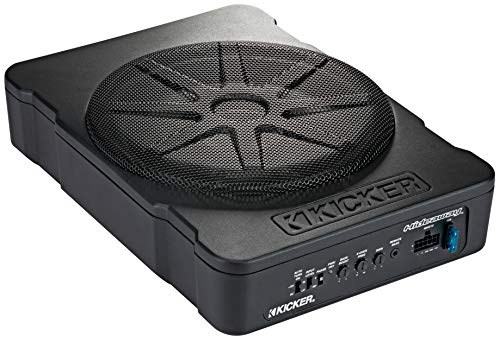
RMS Power | Peak Power | Subwoofer Size | Enclosure Type | Frequency Response | Dimensions |
|---|---|---|---|---|---|
180 Watts | 360 Watts | 10 inches | Sealed | 25 – 120 Hz | 9-7/8"W x 3-1/8"H x 14"D |
When we are shortlisting underseat subs for real world cars, the KICKER 46HS10 Hideaway is usually on the list for drivers who want more than a light bass fill but still need their cabin and trunk to stay usable. It packages a 10 inch driver, a 180W Class D amplifier and a sealed, low profile aluminum enclosure into a chassis that actually fits under a wide range of front and rear seats. That balance of real output and a 3-1/8 inch tall chassis is why it is our best overall pick.
The standout with this model is genuine under seat performance. With some slim subs, the box will technically fit but you do not get much more than a gentle rumble. Here, the larger 10 inch cone and real 180 watt RMS amp give the HS10 enough headroom to feel like a proper subwoofer rather than a token add on. In mid size SUVs, double cab trucks and many sedans, kick drums gain clear impact and bass lines stop sounding thin, even when the volume is up.
The enclosure design plays a big role in how it sounds. The sealed aluminum housing keeps the bass tight and controlled rather than loose or boomy. You get punch and definition in the common 35 to 60 hertz band instead of a one note thud. Kicker’s KickEQ bass boost (up to +6 dB at 40 hertz) lets you add extra weight if your vehicle naturally rolls off down low, but the system stays cleaner if you use it in moderation.
Day to day usability is helped by the integration features. The HS10 accepts both speaker level and RCA inputs, supports auto turn on and provides the core controls you actually use, including gain, low pass filter, phase and bass boost. KICKER’s FIT+ circuit accepts input signals from 0.25 to 40 volts and offers DC offset or signal sensing turn on, so most factory head units connect without a line output converter. The wired remote level knob is more than a spec sheet extra; it is what lets you trim bass quickly when road noise, passengers or tracks change without having to dig under the seat.
As an underseat solution, the physical format matters as much as the numbers. The Hideaway’s low profile aluminum chassis is tough enough for life under a seat and slim enough to stay out of the way of rear passengers’ feet. The all aluminum frame also gives the amplifier a metal path to shed heat, which matters in a spot with very little airflow.
There are a few downsides to weigh. The 46HS10 sits in a higher price bracket than many budget slim subs, so it is not the first choice if you are simply chasing the lowest possible cost. Deep sub bass is also constrained by the enclosure volume. It is not built to deliver home theatre style twenty hertz sweeps or match a large 12 inch ported box in sheer output, and it is not the right choice if your only goal is maximum SPL.
Placement and setup do matter. Underseat cavities vary from one vehicle to another, and small changes in location, phase setting and crossover point noticeably affect how even the bass sounds from the driver’s seat. When those basics are done correctly, the HS10 delivers strong, musical bass for its size, stays out of sight and does so with the kind of reliability record that has kept Kicker’s Hideaway line on a lot of shortlists, and Best Buy’s combined 46HS10/51HS10 listing averages 4.5 stars across 167 owner reviews.
If you want an all-in-one under seat subwoofer that feels like a real system upgrade rather than a compromise box, the 46HS10 is the best underseat car subwoofer we’d recommend for most daily drivers.
2. Best Budget: BOSS Audio BASS10 Under Seat Car Subwoofer
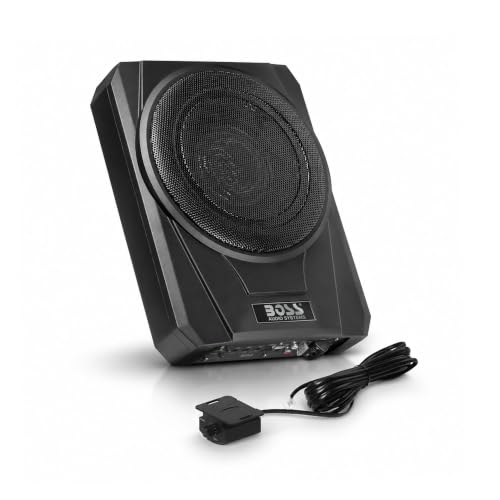
RMS Power | Peak Power | Subwoofer Size | Enclosure Type | Frequency Response | Dimensions |
|---|---|---|---|---|---|
500 Watts | 1000 Watts | 10 inches | Sealed | 30– 150 Hz | 14” x 12.3” x 3.3” |
If you are looking for the best budget under seat car subwoofer that still feels like a real upgrade, the BOSS Audio BASS10 is one we keep coming back to in low cost builds. It targets drivers who want more low end than their factory system can manage, but who are not ready to spend Kicker or Alpine money on their first powered sub.
The BASS10 pairs a 10 inch driver with a built in amplifier and a slim enclosure that is meant to live under front seats or in tight cargo spaces. BOSS rates it at 1000 watts max, and retail listings add a 500 watt RMS figure that BOSS itself does not publish. The BASS10 manual lists a maximum current draw of 12 amps, which at 14.4 volts is well short of what 500 watts of continuous output would need, so we treat those numbers as marketing rather than something to aim for. The usable power is lower, but it is still enough to give kick drums and modern pop bass lines a clear lift over stock.
For the price, the feature set is what stands out. You get RCA and speaker level inputs, a variable low pass filter (50 to 150 hertz), bass boost (0 to 12 dB), phase switch and a wired remote level control. That lets you hook it up to factory or aftermarket head units and then shape the response in the same basic way you would with a more expensive underseat subwoofer with built in amp. The remote knob does exactly what most people need day to day, since it lets you trim the bass from the driver’s seat when road noise or tracks change.
Sonically, the BASS10 leans toward a warm, punchy character rather than clinical detail. It will not match the tightness or low distortion of the premium units in this list, and expecting that at this price point is unrealistic. Its job is to make bass lines audible and enjoyable in cars that currently feel thin or flat, and in that role it does what it sets out to do, particularly in smaller cars and trucks running factory door speakers.
The downsides follow directly from the price. The amplifier ratings are optimistic compared with the conservative figures you see from brands like Kicker, JBL or Alpine, and the enclosure finish and hardware are more basic. If you run the gain and bass boost very hard, the sound can start to feel congested compared with the higher end underseat subwoofers here.
When you treat it as a budget under seat subwoofer for car owners on a tighter budget, the BASS10 is easy to understand. It is inexpensive, slim enough for most underseat locations, offers the core tuning controls you actually use, and produces a noticeable step up in bass weight over a stock system.
We would choose it for simple, low cost installs where the goal is a clear improvement in low end, not chasing maximum output or audiophile grade refinement.
3. Best for Trucks: Kicker 51HS10 Hideaway Powered Subwoofer

RMS Power | Peak Power | Subwoofer Size | Enclosure Type | Frequency Response | Dimensions |
|---|---|---|---|---|---|
180 Watts | 360 Watts | 10 inches | Sealed | 25 – 120 Hz | 14" x 9-7/8" x 3-1/8" |
When you are looking for an underseat sub that suits a truck cab, the KICKER 51HS10 Hideaway is usually near the top of the list. It is the current production number for the HS10, and KICKER publishes the same specs as the 46HS10, so you get the same compact 10 inch driver, sealed aluminum enclosure and 180 watt RMS Class D amp. If the 46HS10 is cheaper when you shop, you are buying the same sub. What makes it our pick for trucks is the install kit, since its 17 foot power harness reaches the battery from under a cab seat and the 3-1/8 inch chassis fits under or behind most truck seats.
The main appeal here is how controlled the low end feels for a slim powered box. Compared with cheaper under seat subs, the 51HS10 pairs its sealed box with a 24 dB per octave high pass filter at 25 hertz, which keeps the driver out of the lowest octave it cannot reproduce and helps kick drums and bass lines stay better separated. In a typical extended cab or crew cab truck, you get a solid sense of weight in the mid 30 to 60 hertz range, with the rated 25 hertz extension showing more as a gentle lift than a window rattling sweep. That behaviour is what you want from a shallow enclosure under the seat, giving you useful low end without the muddy smear that often appears when budget amps are pushed hard.
For a box this small, the 51HS10 hits harder than you expect. The enclosure is compact enough to live under the front seats in most compact and mid-size cars and small SUVs, but the combination of a well matched driver and 180 watt RMS amplifier gives it more headroom than a lot of slim under seat designs. If you are already running upgraded front speakers and a four channel amp, this sub has enough capacity to keep up without feeling like the weak link in the system.
Control and tuning tools are another reason we keep this model in mind for truck builds. You get a variable low pass crossover (50 to 120 hertz), phase adjustment, bass boost and a choice of DC offset or signal sensing turn on, along with a wired remote level control. That makes it much easier to integrate with both factory and aftermarket head units and to fine tune the response so it blends cleanly with front components instead of drawing attention to itself.
The all aluminum chassis is not just about looks. It is rigid, which helps the driver work cleanly, and it acts as a heat sink for the amplifier. That matters most in trucks parked in hot sun, where the cab heats up and there is little airflow under the seat. Backed by Kicker’s support network and track record with the Hideaway line, it is something you can count on in a daily driven car.
That still does not get around the normal constraints of an under seat subwoofer. The 51HS10 costs more than many rival slim subs, so it is not the right choice if you are trying to build the cheapest possible system. And while it reaches deeper and plays cleaner than most compact options, the limited enclosure volume still means it will not match a large ported twelve inch in the trunk for sheer low frequency extension and output, and we would look elsewhere if maximum shake-and-rattle output is the only goal.
If you want an under seat subwoofer with a built in amplifier for a truck cab, and you care more about control than chasing the highest spec numbers, the 51HS10 is a strong fit. It balances compact packaging, real output and clean, sealed box tuning in a way that makes sense for long term, everyday systems where you care as much about how the bass feels over time as how it sounds in a quick demo.
4. Best for Tight Bass: Alpine PWE S8 Amplified Car Subwoofer

RMS Power | Peak Power | Subwoofer Size | Enclosure Type | Frequency Response | Dimensions |
|---|---|---|---|---|---|
120 Watts | 240 Watts | 8 inches | Sealed | 25 – 152 Hz | 13-7/16" x 2-13/16" x 9-1/16" |
For smaller cabins where real bass is needed without changing how the car is used, the Alpine PWE-S8 is one of the first under seat subs we consider. It combines an 8 inch high excursion driver, a 120W RMS Class D amplifier and a very shallow sealed enclosure that sits under three inches tall. Its sealed 8 inch is tuned for speed and control rather than sheer volume, which is why it gets our pick for tight bass.
The compact footprint is one of its key strengths. The PWE-S8 can live under many front seats, behind seats in trucks, or in compact cargo areas without interfering with rear passengers’ feet or storage. In cars where a traditional box simply will not fit, this kind of cast metal, low profile enclosure turns a bass upgrade from “nice idea” into something that can actually be installed.
On the sound side, the PWE-S8 is built for tight, accurate bass rather than sheer volume. It is very good at reinforcing the 25 to 152 hertz region with speed and control, giving kick drums a defined hit and bass guitars a solid body without turning the low end into a blur. If your existing system sounds thin or a bit harsh at normal listening levels, this style of compact, fast sub can make it feel noticeably more complete and less fatiguing.
Integration with factory systems is another area where this Alpine makes sense. It accepts both RCA and speaker level inputs, has auto turn on, and provides the core controls you actually use; a variable low pass filter, gain, phase switch and a wired remote level control. That combination makes it straightforward to tie into stock head units and door speakers and then trim the bass from the driver’s seat as road noise and tracks change.
The limitations show up when you treat it like a big trunk box. This is not a heavy hitting SPL subwoofer. If you turn the gain up aggressively in search of maximum output, the PWE-S8 will start to sound strained and you lose some of the tightness that makes it appealing in the first place. Setting gains conservatively and letting it work in its comfort zone gives the best results.
For drivers who value clean, well controlled bass and need an under seat subwoofer for car that plays nicely with factory electronics, the PWE-S8 is a very strong candidate. It’s a great choice for smaller sedans and hatchbacks where an OEM plus, musical upgrade is the real goal.
5. Best for Deep Bass: Rockville RW10CA Underseat Subwoofer
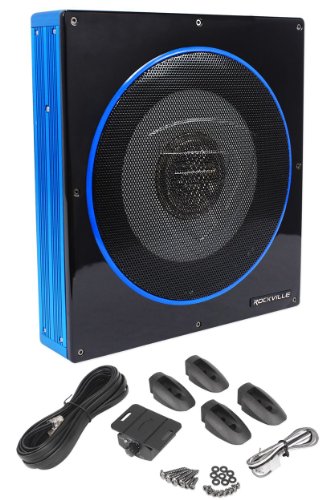
RMS Power | Peak Power | Subwoofer Size | Enclosure Type | Frequency Response | Dimensions |
|---|---|---|---|---|---|
200 Watts | 800 Watts | 10 inches | Sealed | 20 – 150 Hz | 12.4 x 13.4 x 2.7 inch |
If you are prioritizing deep bass from an underseat powered subwoofer on a tighter budget, the Rockville RW10CA is usually one of the first models you may consider. It combines a 10 inch woofer, a 200 watt RMS amplifier with a CEA-2006 power rating and a very slim enclosure only about 2.7 inches tall, with a rated response that reaches down to 20 hertz. What earns it our deep bass pick is the bass boost, which adds up to 18 dB at 45 hertz, more than any other sub in this guide.
You are not getting full strength 20 hertz output from a chassis this small, and Rockville also builds in a subsonic filter at 29 hertz, so the real low end starts closer to 30 hertz than the rated figure suggests. The deep bass case rests on that 45 hertz boost and the 200 watt RMS amp, which is the highest verified rating among these picks. That extra weight around 45 hertz is what makes hip hop, trap and modern EDM feel more substantial, with a clearer sense of sub bass weight than you typically hear from 8 inch under seat designs.
One of the standout features is the amount of control on the amplifier. You get a variable low pass filter, phase switch, high level and low level inputs, plus a bass boost control that can add up to plus eighteen decibels and a wired remote level knob. Set up with the crossover in roughly the seventy to ninety hertz band, bass boost used sparingly and gain matched carefully, the RW10CA behaves like a strong, deep leaning underseat sub that stays reasonably tidy.
The ultra low profile enclosure is another practical strength. At 2.7 inches, it is the lowest box in this guide. It fits under seats that simply will not accept taller boxes, which is useful in compact cars and smaller trucks where space is tight. That makes it a realistic subwoofer under seat option in vehicles where a more conventional powered box would sit too high.
Where the Rockville falls behind the Kicker, Alpine or JBL units in our picks is in refinement. The overall voicing is less polished, and if you lean hard on the bass boost or push the gain too far, the response can become boomy and one note in some cabins. The casing and hardware are functional rather than premium, which is expected at this price but still worth noting.
When you want a deep bass focused under seat solution, the value case is clear. You get more adjustable bass boost than most budget competitors, a very low profile chassis and enough tuning flexibility to adapt it to different vehicles, as long as you are prepared to spend a bit of time dialling it in.
If you want the best under seat car subwoofer for deep bass on a sensible budget and are willing to treat setup as part of the process rather than an afterthought, the RW10CA is well worth picking.
6. Best for Smooth Bass: JBL BassPro SL Underseat Active Car Sub

RMS Power | Peak Power | Subwoofer Size | Enclosure Type | Frequency Response | Dimensions |
|---|---|---|---|---|---|
125 Watts | 125 Watts | 8 inches | Sealed | 35 – 120 Hz | 13.6 x 9.9 x 2.8 inch |
If you want under seat bass that blends in rather than taking over, the JBL BassPro SL2 is the one we’d suggest first. At roughly 2.8 inches tall, it slides under seats that many other powered boxes simply cannot clear, yet it still packs an 8 inch driver and a 125 watt RMS Class D amplifier into a compact, sealed ABS housing. JBL centres its bass boost at 70 hertz rather than the 40 to 45 hertz the Kicker and Rockville boosts use, which is why it earns our pick for smooth bass.
Its low profile is the other big strength. In cars and crossovers where the seat rails sit close to the floor, the SL2’s 2 point 8 inch height often makes the difference between fitting a sub under the seat and having to give up on that location entirely. That is what makes it a realistic choice if you are trying to add an ultra-slim underseat car subwoofer in a cabin that simply will not take a taller box. Only the Rockville RW10CA and Pioneer TS-WX140DA sit a fraction lower in this guide.
The BassPro SL2 leans towards the classic JBL sound; smooth, slightly warm and controlled rather than sharp or aggressive. The frequency response starts around thirty five hertz and runs up to about one hundred twenty hertz, which in small and mid-size cabins is enough to restore weight and body to drums and bass instruments without stepping on the door speakers. If your current system sounds thin but you do not want the sub to dominate the mix, this voicing works in your favour.
Integration with factory systems is another strong point. The SL2 offers line level and speaker level inputs, auto turn on, a variable low pass crossover (50 to 120 hertz), bass boost of up to +9 dB at 70 hertz, a phase switch and JBL’s GTO-RBC wired remote level control in the box. That feature set makes it straightforward to tie into modern OEM head units and to fine tune the output so it blends with front speakers instead of calling attention to its location under the seat.
The ABS enclosure is designed for daily use. It is tough enough to handle the knocks and scuffs that come with life under a busy seat. Over time, that durability matters as much as the styling in commuter cars and family vehicles.
The drawbacks are mostly about output and character. With 125 watts RMS and a compact 8-inch driver, the BassPro SL2 is not built for very loud systems or for chasing maximum slam. Its emphasis on warmth and smoothness means kick drums have more body than bite compared with some sharper-voiced subs, and you won’t choose it if your only goal is the hardest possible attack.
It works best in small and mid-size cabins where the goal is a clean, full bottom end at sensible volumes rather than shaking mirrors at every stoplight. If you want smooth bass that fills out a factory system without dominating it, and you want a trustworthy, compact option from a major brand, the JBL BassPro SL2 fits that brief well.
7. Best for Hybrid or EV: Pioneer TS WX140DA Active Subwoofer

RMS Power | Peak Power | Subwoofer Size | Enclosure Type | Frequency Response | Dimensions |
|---|---|---|---|---|---|
50 Watts | 170 Watts | 8” x 5-1/4” | Sealed | 20 – 200 Hz (Deep), 40 – 160 Hz (Dynamic), 40 – 200 Hz (Natural) | 11.75" x 2.75" x 7.785" |
If you are using Hybrid or EV, the Pioneer TS-WX140DA is one of the compact active subs we recommend with confidence, because it is built around a small footprint, sensible current draw and tuning that works well in tight cabins.
At the core of the TS-WX140DA is a highly efficient Class D amplifier rated at 50 watts RMS and 170 watts max, paired with a rectangular 8 by 5.25-inch driver with an aluminum cone in a compact sealed enclosure. The priority here is not chasing big power ratings but keeping current draw reasonable and behaviour predictable on modern electrical systems. Pioneer rates its maximum current draw at just 4.3 amps, which is why it can run on lighter gauge power wire than most subs here. In hybrids and EVs, that lighter load on the 12 volt supply helps protect range and lowers the risk of stressing supporting components.
Pioneer’s Digital Bass Control gives you three preset response curves, Deep, Dynamic and Natural, that you select from the wired remote. Deep emphasises extended low end for bass heavy material, Dynamic adds a little extra punch, and Natural aims for a more even response that simply fills out the bottom end.
Pioneer rates Deep at 20 to 200 hertz, Dynamic at 40 to 160 hertz with the highest sensitivity, and Natural at 40 to 200 hertz. We find those modes useful when you are working with variable road noise and cabin acoustics, because you can adapt the sub’s character without climbing into the back of the car to adjust the amp.
Physical packaging is another clear strength. The TS-WX140DA can live under many front seats, against the front of a trunk, or in storage cubbies that would be off limits to a traditional box. That flexibility is important in hybrid sedans and compact crossovers where battery packs, charge hardware and bracing already occupy a lot of the easy locations.
Day to day control is part of the brief as well. The wired remote handles level, crossover, bass mode and phase, so you can retune it from the driver’s seat instead of reaching under the seat.
The TS-WX140DA mainly gives up ground when it comes to outright slam. With 50 watts RMS on tap and a compact driver, it will not match the impact of larger, higher powered underseat subs like the Kicker or Rockville models when you push things hard. In Deep mode it does a respectable job of filling in the lower octaves, but enclosure size still limits how much true sub bass you can get from this format.
If you are building an EV optimised system, care about preserving range and want the best underseat subwoofer for hybrid or electric cars in terms of efficiency and packaging, the TS-WX140DA is a sensible, well targeted option.
What To Consider To Choose the Best Underseat Subwoofer for Car
A powered underseat sub already matches the woofer, box, and amp for you. The real work is checking fit, output, and sound character against your own car and the way you listen. These are the points you should focus on before choosing your pick.
Measure the Space Under Your Seat
Measure height, width and depth under the seat before you fall in love with any specific option. Ultra slim models like the Rockville RW10CA at 2.7 inches, the Pioneer TS-WX140DA and the JBL BassPro SL2 are built for very low seat rails, while slightly taller units such as the Kicker Hideaway subs or the BOSS BASS10 often end up under rear seats in trucks or against the front of the trunk.
Match RMS Power to How Loud You Listen
RMS power tells you what the built in amp can deliver all day. For most underseat installs, 100–200 watts RMS is enough for normal to moderately loud listening. Higher powered options like the KICKER 46HS10 and Rockville RW10CA give more headroom, but only make sense if you actually listen at those levels.
Choose the Bass Character You Want
Decide whether you prefer fast, tight bass or deeper, more relaxed low end. Alpine’s PWE-S8 leans toward tight, controlled response, while JBL’s BassPro SL2 leans smooth and warm, and both suit mixed music and OEM plus upgrades. Rockville’s RW10CA and the larger Kicker units reach deeper and hit harder, which suits bass heavy tracks and bigger cabins if you have the space.
Check How It Ties Into Your Head Unit
If you are keeping the factory radio, make sure the sub has speaker level inputs and a reliable auto turn on circuit. That is how most of these models tie into OEM systems without extra processors. With aftermarket head units, RCA inputs and sub level control from the dash simplify tuning and daily use.
Look for the Controls You Will Actually Use
A variable low pass filter, proper gain control, phase switch and a wired remote bass knob are the tools you feel every time you drive. They help you avoid boomy, one note bass and let you trim the low end as road noise and tracks change. Fancy features matter less than getting these basics right.
Match the Sub to Your Electrical System and Vehicle
Most single underseat subwoofers are fine on a healthy stock charging system. Hybrids and EVs benefit from efficient designs like the Pioneer TS-WX140DA, which place less load on the twelve volt side and which Pioneer rates at 4.3 amps maximum current draw. Truck owners and those running amplified front stages often get better results from slightly stronger subs such as the
Kicker Hideaway models or the Rockville RW10CA that can keep up with upgraded door speakers.
If you work through those checks before you buy, you quickly narrow the field to a few underseat car subwoofers that do more than just look good in the specs. They fit, they integrate cleanly, and they behave like a natural extension of your system once installed.
FAQs
Is a single underseat subwoofer enough for my car system?
For most daily driven cars, yes. A decent powered underseat sub takes care of the lows so your door speakers can play cleaner mids and highs, even if they are still running from the head unit.
How much RMS power do I really need in an under seat car subwoofer?
For most drivers, 100–150 watts RMS is enough, and we treat it as a good everyday range. Stepping up to 180–200 watts RMS makes sense if you listen a bit louder or drive a larger cabin that needs more headroom.
Are 8 inch underseat subs worse than 10 inch models?
Not worse, just different. Most 8 inch underseat subs focus on tight, quick bass, while 10 inch units move more air and can dig a little deeper if you have the space.
Will an underseat sub drain my battery or reduce EV range?
In a healthy twelve volt system, a single powered underseat sub is rarely an issue. Efficient designs draw relatively little current, so the effect on EV range is small in normal use.
Do I still need a separate amp for my door speakers if I add an underseat sub?
Not always. In many cars, a powered underseat sub plus decent door speakers on head unit power feels well balanced. We only look at adding a separate four channel amp when someone wants higher overall volume and cleaner mids and highs at those levels.
Can I add a powered underseat subwoofer to my factory head unit?
Yes. Just choose a model with speaker level inputs and auto turn on. Every sub in this list can tie into factory speaker wiring without needing dedicated preamp outputs.
What is the best subwoofer for under a truck seat?
The KICKER 51HS10 Hideaway is our pick for truck cabs, since its 17 foot power harness and 3-1/8 inch chassis suit installs under or behind truck seats. If you need something lower, the Rockville RW10CA fits at 2.7 inches, and our under seat truck subwoofer guide covers more cab specific options.
What is the best compact under seat subwoofer?
The Pioneer TS-WX140DA is the most compact sub in this guide, with the smallest footprint and a 2.75 inch height. If height is the only limit, the Rockville RW10CA is the lowest box here at 2.7 inches and still carries a 10 inch driver, while the JBL BassPro SL2 and Alpine PWE-S8 sit at 2-13/16 inches with 8 inch drivers.
What is the best underseat subwoofer for a BMW?
For most BMWs, the best underseat subwoofer is a direct fit replacement driver rather than a powered box, because many models already carry 8 inch woofers in enclosures built into the floor under the front seats. Brands such as Rockford Fosgate and Audison sell 8 inch drivers made to drop into those factory locations, and BMW owner discussions point to that swap as the cleanest upgrade. The powered subs in this guide still work in a BMW if you have clearance under or behind a seat, but measure first, since the factory woofers already use much of that space.
Final Verdict: Which One Should You Buy?
If you want one clear winner, the KICKER 46HS10 Hideaway is our best underseat car subwoofer for most daily driven cars. It delivers genuinely useful under-seat bass with simple controls and a practical one-box design, so for many systems it is the most sensible upgrade.
After that, choose based on your priority. Pick the BOSS Audio BASS10 if you want a clean step up from factory sound for less money. Choose the KICKER 51HS10 Hideaway for a truck cab. Go with the Alpine PWE-S8 for tight bass in a small cabin, the JBL BassPro SL2 for smooth bass that blends in, or the Rockville RW10CA if you want heavier low end on modern tracks and the lowest box in this guide. Pick the Pioneer TS-WX140DA for hybrids and EVs.
Match enclosure size, realistic RMS output, and basic sound character to your vehicle and how you actually listen, then confirm fitment and current pricing before you buy. Do that, and any option on our list can be the final piece that makes your system feel complete.