
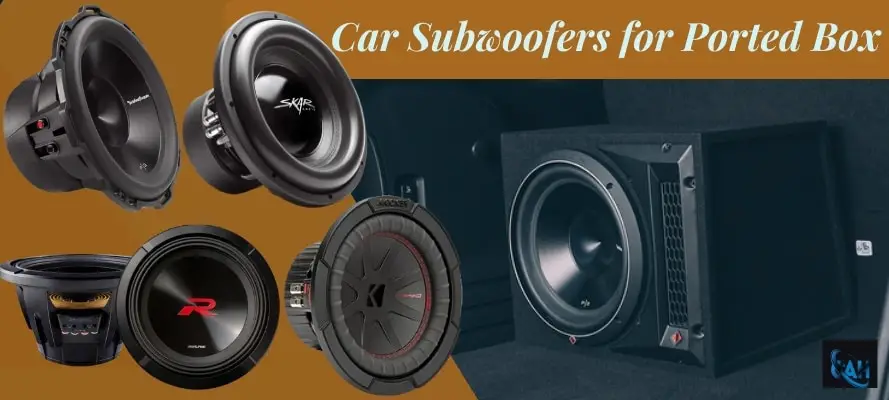
Dialing in the best car subwoofer for ported box setups can completely change how your system feels. When the driver and box are matched properly, you get deeper bass, more output per watt, and that effortless low-end response that makes music sound fuller and hit harder.
The opposite is true too. Put the wrong subwoofer in the wrong ported box, and you can end up with boomy bass, muddy output, extra stress on the driver, and a system that never sounds quite right. That is exactly the problem I focused on while selecting the picks in this guide.
In this article, I cover driver-only subwoofers, powered ported options, and preloaded ported enclosures that make sense for real vented setups, along with compact buying tips to help you match the right option to your car, amplifier, and listening style.
10 Best Car Subwoofers for Ported Box - My Top Picks
1. Best Overall Balance: Rockford Fosgate P3D4-12 Punch
"A true all-rounder with punchy daily bass, solid low-end control, and the reliability Rockford is known for."
2.Best for Deep Low Bass: Skar Audio EVL-12 D4
"Big-excursion bruiser rated 1250W RMS and 25Hz on the low end, built for the 2.0 cubic foot box tuned to 32Hz where deep bass lands hardest. It wants a real mono block."
3. Best for Aggressive Music: Alpine R-Series R2-W12D4
"Clean, fast and hard-hitting 750W RMS driver with HAMR suspension, so rock, metal and EDM stay tight in a 1.0 to 1.5 cubic foot vented box. Tuning runs 33 to 37Hz."
4. Best for OEM Upgrades: PIONEER TS-A2500LS4
"Space-saver with a 3-3/8 inch mounting depth and a 0.6 cubic foot ported box, so tight factory locations still get real low-end weight. Port size is published too."
5. Best for Wiring Flexibility: Skar Audio VD-10 D4
"Dual 4-ohm shallow sub rated 500W RMS that wires to 2 or 1 ohm, so it matches the amp you already own while keeping bass tight in compact builds. Depth is 4.41 inches."
6. Best Budget: KICKER 48CWR84 CompR
"Budget 8-inch punch machine that works in 0.8 to 1.2 cubic foot vented boxes and adds surprising kick on a modest 300W RMS mono amp. Kicker publishes the vented range."
7. Best Compact Trunk Solution: Rockford Fosgate Punch P300-8P
"Clean all-in-one powered ported system with 300W RMS in a 5.6 inch deep cabinet, so a small trunk gets satisfying punch and a simple install. Rated 30Hz to 200Hz."
8. Best 12-Inch Powered Option: JBL BassPro-12
"Powered 12-inch ported box with a 150W RMS amp, Slipstream port and remote level control, giving fuller cabin fill than compact powered subs. It needs trunk room."
9. Best Preloaded Performance Pick: Rockford Fosgate P3-1X12
"Preloaded 12-inch vented box rated 600W RMS and wired to a 1-ohm load, so you get strong output and factory tuning with zero enclosure guesswork. Wired at the factory."
10.Best for Tight Truck Spaces: KICKER 50TCWC104 CompC
"Thin-profile loaded box tuned to 35Hz with a 4-3/8 inch top depth, so it slides behind truck seats and still brings punch on 125 to 250W RMS. Rated 91 dB."
Ported Picks Compared at a Glance
The picks below split into three install formats, so check the format column first and the depth or dimensions second.
Pick | Format | RMS Power | Size and Impedance | Mounting Depth | Ported Box | Check Price |
|---|---|---|---|---|---|---|
1. Rockford Fosgate P3D4-12 | Driver only | 600W | 12" dual 4-ohm | 6.66" | 1.79 ft³ | |
2. Skar Audio EVL-12 D4 | Driver only | 1250W | 12" dual 4-ohm | 7.75" | 2.00 ft³ at 32Hz | |
3. Alpine R2-W12D4 | Driver only | 750W | 12" dual 4-ohm | 6.5" | 1.0 to 1.5 ft³ at 33 to 37Hz | |
4. Pioneer TS-A2500LS4 | Driver only | 300W | 10" single 4-ohmonly | 3-3/8" | 0.6 ft³ | |
5. Skar Audio VD-10 D4 | Driver only | 500W | 10" dual 4-ohm | 4.41" | 1.25 ft³ at 39Hz | |
6. Kicker 48CWR84 | Driver only | 300W | 8" dual 4-ohm | 4-1/8" | 0.8 to 1.2 ft³ | |
7. Rockford Fosgate P300-8P | Powered enclosure | 300W | 8" powered | 17.6" W x 5.6" D x 11.4" H | Factory ported, tuning not published | |
8. JBL BassPro-12 | Powered enclosure | 150W | 12" powered | 22-1/2" W x 12-1/6" D x 14-5/8" H | Factory Slipstream port, tuning not published | |
9. Rockford Fosgate P3-1X12 | Preloaded enclosure | 600W | 12" wired to 1 ohm | 19-1/8" W x 15-3/4" D x 15-1/8" H | Factory vented, tuning not published | |
10. Kicker 50TCWC104 | Preloaded enclosure | 125 to 250W | 10" single 4-ohm | 21-1/2" W x 7-7/8" base D x 15" H | Factory ported at 35Hz |
6 Best Driver-Only Subs for Ported Boxes (Reviews)
We will now review the six driver-only subwoofers that, in our research, work particularly well in ported boxes. These are ideal if you want to build or buy a separate vented enclosure and tune the system around your car and amplifier. Let's jump into the first pick.
1. Best Overall: Rockford Fosgate P3D4-12 Punch Car Subwoofer

RMS Power | Peak Power | Type | Impedance | Sensitivity | Frequency Response | Mounting Depth | Ported Volume (Net) |
|---|---|---|---|---|---|---|---|
600W | 1200W | 12" Sub | Dual 4-Ohm | 85 dB | 28–250Hz | 6.66" (169.3 mm) | 1.79 ft³ |
The Rockford Fosgate P3D4-12 continues the Punch series legacy and is a strong contender for the best car subwoofer for ported enclosure builds if you want clean output without a complicated setup. We like that it offers a practical mix of power handling, box compatibility, and sound quality for everyday systems, and that balance is what earns it the top spot here.
At 600W RMS and 1200W peak, the P3D4-12 is built to be driven by a serious but realistic mono amplifier. In a ported enclosure around 1.7–1.9 cubic feet, it takes that power and turns it into clean, confident bass that works well for mixed music libraries. Rockford publishes 1.79 cubic feet as the vented volume for this driver, so you are not guessing at the box. You do not have to chase huge numbers or extreme amps to get it moving; a solid 500–700W mono block is enough to wake it up properly.
Rockford's choice of an anodized aluminum cone paired with a Santoprene surround is more than cosmetic. This combination, along with VAST surround technology, allows the cone to act like a slightly larger driver in terms of effective area. In a ported box, that extra cone area works in your favor by moving more air at the same excursion level, which translates into better efficiency and stronger output around tuning.
Cooling and durability are handled through a vented back plate, an extended pole piece, and a robust motor structure. Ported enclosures can be demanding on subs because excursion tends to peak around the tuning frequency. With 15.9mm of listed excursion, the P3D4-12 is designed to cope with that environment, making it a strong choice if you like to listen at higher volumes for extended periods.
In terms of tuning, this sub leans more toward balanced, musical bass rather than pure competition-style output. In the right vented box, it offers a tight mid-bass punch that makes kick drums feel alive, while still reaching down low enough to give hip-hop and modern pop the depth they deserve. It does not chase extreme lows at the expense of everything else, which suits daily setups very well.
By the way, we found some downsides worth noting. The P3D4-12 is not a burp box monster, so if your only goal is maximum SPL scores, you might gravitate to more aggressive competition drivers. It also expects a reasonably clean supply of power; trying to run it off a small, clipping amplifier will only hold it back and potentially hurt it over time. In addition, the protective grille is usually sold separately, so you may want to add that if your trunk sees a lot of cargo.
If you want a sub that feels like a safe, smart foundation for a ported car subwoofer build, this Rockford Punch model is a very easy recommendation for you. It makes sense as a single daily 12" in a trunk build and scales nicely into dual-sub systems when you decide to go bigger later.
2. Best Value: Skar Audio EVL-12 D4 Car Subwoofer
RMS Power | Peak Power | Type | Impedance | Sensitivity | Frequency Response | Mounting Depth | Ported Volume (Net) |
|---|---|---|---|---|---|---|---|
1250W | 2500W | 12" Sub | Dual 4-Ohm | 85.3 dB | 25–250Hz | 7.75" | 2.00 ft³ tuned to 32Hz |
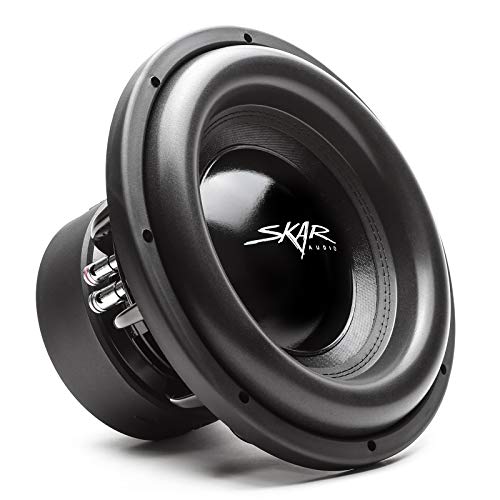
We picked the Skar Audio EVL-12 D4 as our deep low bass choice because it is rated from 25Hz and built for a 32Hz box, which is lower than anything else in this guide. It has earned a solid reputation among budget-focused bass lovers, and in a properly tuned ported enclosure, it performs well above its price point.
With a 3-inch four-layer CCAW voice coil and a large motor structure, the EVL-12 is comfortable in the 1000–1250W RMS range. That already sets it apart from many entry-level drivers that only claim high power on paper. In a 2.0 cubic foot box tuned to around 32Hz, which is exactly what Skar recommends along with 24 square inches of port area, it converts that power into serious cabin pressure.
The cone is made from competition-grade pressed paper with a high-roll foam surround. This combination gives the sub the excursion capability it needs to make real use of ported-box gains, without immediately falling apart at higher volumes. When the port is tuned correctly, the EVL-12 leans into that tuning and delivers thick, heavy bass notes that suit hip-hop, trap, and modern EDM particularly well.
Where this sub really separates itself in our view is the sense of physical impact it brings. The low 30Hz region feels strong and convincing, and with the right cabin gain, you can get very satisfying response down towards the high 20Hz range. Skar rates the EVL-12 from 25Hz with 23.5mm of one-way excursion, which is what makes that bottom octave possible rather than just loud. It is the kind of output that makes long drives feel like rolling listening sessions instead of just background music.
Of course, there is a cost to that performance. The EVL-12 is a deep, heavy driver at 7.75 inches of mounting depth, so it demands a sturdy baffle and a well-braced enclosure. It also expects a healthy amplifier and electrical system. Trying to get by with a small, underpowered amp at clipped gains is a recipe for disappointment or premature failure. This is not a woofer you casually throw in a random prefab box and hope for the best.
This is not a subtle-sounding subwoofer. Its character is decidedly bold and bass-forward. If you prefer a more relaxed, ultra-tight sound for jazz or acoustic tracks, the EVL may feel a bit too aggressive. But if you enjoy hard-hitting bass lines and want your system to make a strong impression, it does that job very well.
In short, if you are looking for one of the best ported car subwoofers for deep low bass rather than the lowest price, the Skar EVL-12 D4 is the one we would recommend. Give it the recommended 2.0 ft³ vented box, match it with a capable mono block, and it will reward you with a remarkably powerful low end.
3. Best for Aggressive Music: Alpine R-Series R2-W12D4 Dual Subwoofer

RMS Power | Peak Power | Type | Impedance | Sensitivity | Frequency Response | Mounting Depth | Ported Volume (Net) |
|---|---|---|---|---|---|---|---|
750W | 2250W | 12" Sub | Dual 4-Ohm | 84.6 dB | 24–200Hz | 6.5" | 1.0–1.5 ft³ tuned 33 to 37Hz |
The Alpine R-Series R2-W12D4 is a subwoofer that feels purpose-built for listeners who want their bass to hit hard and stop cleanly. If your playlists are full of fast kick drums, double-bass patterns, and dense electronic productions, this driver makes a compelling case for itself in a ported enclosure.
Alpine rates the R2-W12D4 at 750W RMS and pairs that with a Kevlar-reinforced pulp cone and the well-known HAMR (High Amplitude Multi-Roll) surround. That surround is more than a visual signature; it is designed to allow significant excursion while keeping the cone's motion linear. In a properly tuned ported box, this helps the woofer maintain control when the music gets busy.
Alpine's ported range is 1.0 to 1.5 cubic feet of net volume with tuning between 33 and 37Hz, which is quite manageable in most trunks. In Alpine's own recommended box, a 1.45 cubic foot net design tuned to 36Hz, the R2-W12D4 delivers a very satisfying mix of speed and weight. Drums hit with authority, bass guitars stay articulate, and electronic basslines feel punchy without becoming a blur.
One thing we appreciate about this sub is how it behaves across genres. It clearly has the grip and attack that aggressive music demands, but it does not fall apart when you switch to vocal-heavy tracks or softer content. The mid-bass region stays controlled, and the sub-bass does not overpower the rest of the mix when gains and crossovers are set correctly.
The drawbacks are in line with what you would expect at this level. The R2-W12D4 wants a genuinely capable amplifier and decent electrical support. At 84.6 dB it is the least sensitive 12-inch driver in this guide, so you may need to turn the gains a touch higher compared to some budget subs, but it rewards that effort with clean, composed output. It also sits in a price band above entry-level offerings, which matches its real-world performance.
If we had to summarize its appeal in a ported setup, we would say the Alpine R2-W12D4 is for the listener who wants tight control with enough aggression to stay exciting. It gives you the benefits of a vented box, more output and more depth, without losing the detail and timing that make a system enjoyable long-term.
4. Best for OEM Upgrades: PIONEER TS-A2500LS4 Shallow Mount Subwoofer

RMS Power | Peak Power | Type | Impedance | Sensitivity | Frequency Response | Mounting Depth | Ported Volume (Net) |
|---|---|---|---|---|---|---|---|
300W | 1200W | 10" Shallow Sub | Single 4-Ohm | 85 dB | 20–900Hz | 3.375" | 0.6 ft³ with a 3" port 7-1/2" long |
The PIONEER TS-A2500LS4 is a good reminder that not every ported build has to be huge to be worthwhile. Designed as a shallow-mount 10" solution, it fits into spaces where traditional drivers simply cannot go, yet still supports both sealed and ported alignments when the box is designed correctly.
With a mounting depth just over 3", this sub is particularly attractive for trucks, coupes, and compact cars where the challenge is always, "Will it even fit?" Pioneer's glass fiber and mica reinforced IMPP cone strikes a balance between stiffness and lightness, helping the driver maintain control without needing an overly stiff suspension.
In the 0.6 cubic foot ported enclosure Pioneer publishes for this driver, built around a 3-inch port 7-1/2 inches long, the TS-A2500LS4 adds a very welcome sense of warmth and depth to factory or lightly upgraded systems. Pioneer does not publish a tuning frequency for that box, so the port dimensions are what you build to. It will not compete in sheer output with the larger 12" monsters in our list, but that is not its job. Its role is to slot into tight spaces and quietly raise the overall quality of your low end.
The 300W RMS rating means it matches nicely with compact mono amplifiers, including many models that are friendly to stock charging systems. This makes it a realistic step up for drivers who want better bass but are not yet ready to overhaul the entire electrical side of the vehicle.
Where you do need to be a little more deliberate is in setup. Shallow subs, including this one at 8.3mm of linear excursion, have less mechanical headroom than full-depth drivers. That means the enclosure volume, tuning, and subsonic filter all matter a bit more, especially if you like to turn things up. Get that right, though, and the TS-A2500LS4 rewards you with a clean, rounded low end that integrates well with upgraded door speakers.
If your priority is an OEM-friendly upgrade that still benefits from a ported box, this Pioneer shallow-mount sub is a very sensible choice. It works well as a stepping stone from a factory system into a more serious audio setup, and the grille is sold separately as the UD-10GL if the sub sits somewhere exposed.
5. Best for Wiring Flexibility: Skar Audio VD-10 D4 Car Audio Subwoofer
RMS Power | Peak Power | Type | Impedance | Sensitivity | Frequency Response | Mounting Depth | Ported Volume (Net) |
|---|---|---|---|---|---|---|---|
500W | 800W | 10" Shallow Sub | Dual 4-Ohm | 85.1 dB | 35.2 - 200 Hz | 4.41" | 1.25 ft³ tuned to 39Hz |
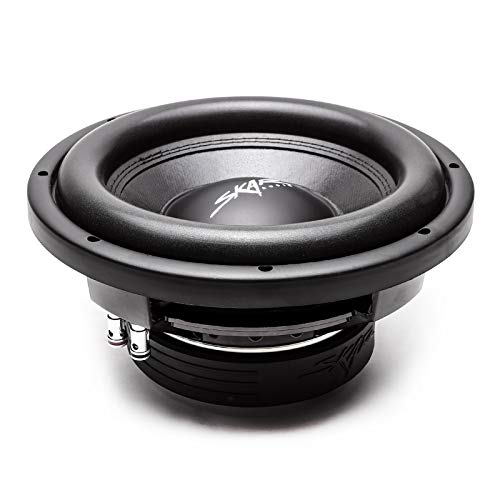
The Skar Audio VD-10 D4 is designed for those tricky installs where you want real bass, a ported character, and the ability to match impedance to a variety of amplifiers, all without needing a deep enclosure. It lives in that middle ground between ultra-slim shallow subs and full-depth drivers.
As a dual 4-ohm coil sub rated at 500W RMS, it gives you plenty of wiring options. A single VD-10 D4 can be wired to 2 ohms to suit most mono blocks, while a pair opens up 1-ohm or 4-ohm configurations depending on how you arrange the coils. This flexibility is very useful if you already own an amplifier and want a driver that can adapt to it rather than starting from scratch.
Skar publishes 1.25 cubic feet with 17 square inches of port area and a 39Hz tuning for this driver, so the guesswork is already done. Boxes in that size range are still manageable in compact trunks and hatchbacks, yet they give the cone enough room to breathe and benefit from ported efficiency. Paired with a clean 400–500W, it delivers a satisfying mix of punchy mid-bass and respectable low-end extension.
As with most shallow-oriented designs, there are some limitations. This is not the driver you choose for extreme low-tuned builds in the 20Hz zone, since the D4 version is rated at 7mm of one-way excursion and Skar's own tuning recommendation sits at 39Hz. Its design is more comfortable with everyday music and realistic listening levels. That is where it does its best work, particularly in builds where you also care about keeping cargo space usable.
The foam surround and pressed paper cone should be treated with the same respect you would give any quality subwoofer. Avoid clipping, set gains carefully, and use a sensible subsonic filter, especially in a vented box. Owners fitting these in prefab boxes also report having to open up the cutout, since the frame is wide for a 10, so check the 9.3 inch cutout before you build. Set it up right, and the VD-10 D4 holds up well as a daily-use sub.
If you need the best ported box subwoofer that keeps mounting depth under control while still giving you room to grow with your amplifier, this Skar model is a very practical option to consider.
6. Best Budget: KICKER 48CWR84 CompR Car Subwoofer

RMS Power | Peak Power | Type | Impedance | Sensitivity | Frequency Response | Mounting Depth | Ported Volume (Net) |
|---|---|---|---|---|---|---|---|
300W | 600W | 8" Sub | Dual 4-Ohm | 82.1 dB | 30–500Hz | 4.125" | 0.8–1.2 ft³ |
The KICKER 48CWR84 CompR is a compact 8" driver that makes ported bass practical in cars where space is at a premium. It may not look imposing next to a large 12" sub, but in the right vented enclosure it delivers a very enjoyable low-end lift.
With a 300W RMS rating and a recommended ported volume between 0.8 and 1.2 cubic feet, the CompR 8" fits naturally into smaller trunks, hatchbacks, and even some rear-side cavities. That size range also keeps material cost and construction complexity down if you are building your own box.
In terms of tuning, this driver is more capable than its dimensions might suggest. In a well-tuned vented box around 1.0 ft³, it can play down to the 30Hz region with a convincing sense of weight, especially once cabin gain in a smaller car is factored in. At the same time, it has the speed and control to render mid-bass details cleanly, which helps music feel lively instead of dull. Kicker's Forced-Air Cooling design pulls air through the motor as the cone moves, which is the part that keeps it composed on long drives at volume.
You do need to keep your expectations realistic here, and that is one reason we recommend this sub for the right setup rather than every setup. An 8-inch subwoofer moves less air than a 10-inch or 12-inch subwoofer, so it will not deliver the same output in a large SUV. At 82.1 dB it is also the least sensitive driver in this guide, so it wants the full 300W RMS rather than whatever an old four-channel has spare.
If you want very high bass output in a larger vehicle, we would look at multiple CompR 8-inch subs or a single larger subwoofer. For small and mid-sized vehicles, if sound quality matters more to you than maximum volume, the Kicker 48CWR84 can be an excellent right-size solution.
Because KICKER provides clear guidance on ported volumes, it is easier to avoid the common mistakes that plague generic prefab boxes. Aim for the recommended range, pay attention to port dimensions, and you will end up with a system that feels far from "budget" in everyday listening.
If you want to experience what a ported car subwoofer enclosure can do in a compact package without stretching your amplifier or budget, this CompR 8" is a great choice indeed.
2 Best Ported Powered Subwoofers for Car (Reviews)
The first six picks in this guide were driver-only options for custom ported enclosures. These next two are different: both are ported powered subwoofers for car, which means the driver, amp, and ported box are already combined.
We picked these for buyers who want the sound and punch of a ported setup without building a full custom sub stage from scratch. They are easier to buy, easier to install, and a better fit for daily drivers who want solid bass without having to match separate components.
7. Best Compact Trunk Solution: Rockford Fosgate P300-8P Powered Sub
RMS Power | Peak Power | Type | Impedance | Sensitivity | Frequency Response | Dimensions (W×D×H) | Enclosure |
|---|---|---|---|---|---|---|---|
300W | 600W | 8" Powered Sub | Not published | 8" | 30 – 200 Hz | 17.6" x 5.6" x 11.4" | Ported |
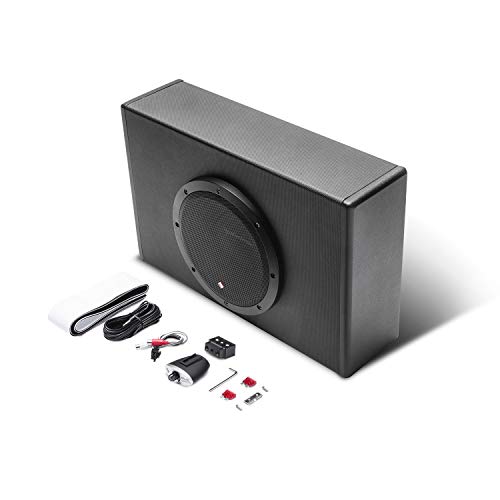
Want the best powered ported subwoofer enclosure? The Rockford Fosgate Punch P300-8P is a strong all-in-one option for buyers who want compact size, reliable output, and ported-style punch without building a custom setup or dealing with enclosure math.
The P300-8P wraps a Punch sub, a ported enclosure, and a 300W RMS Class D amplifier into one tidy package. You supply power, ground, remote turn-on, and signal, and the system takes care of the rest. At 5.6 inches deep it is the slimmest cabinet in this guide, which is the whole reason it works in a small trunk.
In everyday use, the P300-8P behaves like a well-implemented compact ported system should. Bass has good punch and energy, and it adds satisfying low-end weight to factory or mild aftermarket systems without taking up much trunk space. Rockford rates the system from 30Hz to 200Hz and gives you a variable 50Hz to 200Hz low-pass, adjustable bass EQ, a phase switch, and thermal plus over and under voltage protection, so the only tuning left to you is on the knobs. While it does not have the additional output and extension that a larger ported setup can provide, it also avoids the complexity and space demands that come with custom vented builds.
If your goal is to shake panels on 1500W of power, this is not the right product. However, if you are stepping up from factory audio and want a clean, reliable way to add serious low end in a small footprint, the P300-8P fits the bill nicely. It works particularly well when paired with improved coaxial or component speakers up front, so the whole system lifts together.
Think of it as a smart option for drivers who like the idea of "bass done right" more than they like the idea of measuring, cutting, gluing, and tuning. For that audience, the Punch P300-8P is one of the easiest ways to get into amplified ported bass without regret.
8. Best Stealth: JBL BassPro-12 Active Car Subwoofer

RMS Power | Peak Power | Type | Impedance | Sensitivity | Frequency Response | Dimensions (W×D×H) | Enclosure |
|---|---|---|---|---|---|---|---|
150W | 450W | 12" Powered Sub | Not published | 12" | 30 – 200 30–200 Hz (JBL), 35–120 Hz on retail listings | 22-1/2" × 12-1/6" × 14-5/8" | Ported |
The JBL BassPro-12 is the pick here for drivers who want a full 12-inch powered box rather than a compact unit, without moving into a custom subwoofer build. It combines a 12" subwoofer, built-in amplifier, and ported enclosure in one package, which makes it a practical option for users who want straightforward installation and predictable results.
Like the Rockford Fosgate P300-8P, the BassPro-12 removes a lot of the guesswork. You do not need to match amplifier power, calculate enclosure volume, or worry about port tuning. JBL has already done that work, which is exactly why products like this appeal to daily drivers and first-time installers. The Slipstream port is JBL's own design claim for keeping airflow turbulence free, which is the part of a ported box most likely to add noise at high levels.
In everyday use, the BassPro-12 delivers the kind of bass many people want from a factory-system upgrade: more depth, more presence, and a stronger sense of low-end impact without becoming difficult to manage. Compared with smaller compact powered subs, the 12" woofer helps produce a fuller sound and better overall cabin fill. That extra cone area is the reason to choose it over the compact P300-8P, and the reason it needs more room. At the same time, it still stays far simpler than running a separate mono amp and a custom vented enclosure.
At the same time, this is not the right pick if your priority is maximum output or competition-style loudness. The built-in amp and fixed enclosure are designed for convenience and balanced daily bass, not raw SPL. At 22-1/2 inches wide and 34 pounds it is a proper trunk box rather than a hideaway unit, so measure before you buy. Like most powered subs, the cons are less upgrade flexibility and less tuning freedom.
If you want a powered ported subwoofer that keeps installation simple while giving you a bigger, fuller sound than most compact units, the JBL BassPro-12 is the 12-inch option we would recommend. It works well for users who have the trunk space for it and want a noticeable bass upgrade without turning the system into a full custom project.
2 Best Preloaded Ported Car Subwoofer Enclosures (Reviews)
After the powered options, we are moving to preloaded ported car subwoofer enclosures for buyers who want ported-box performance without building a custom enclosure from scratch. In these setups, the subwoofer and ported box are already matched from the factory, so you do not have to calculate box volume, tuning frequency, or port area yourself. These two picks are strong options if you want a simpler setup with more predictable results.
9. Best Preloaded Performance Pick: Rockford Fosgate P3-1X12 Punch Ported Sub

RMS Power | Peak Power | Type | Impedance | Sensitivity | Frequency Response | Dimensions (W×D×H) | Enclosure |
|---|---|---|---|---|---|---|---|
600W | 1200W | 12" P3D2-12 in Vented Box | 1 Ohm (internally wired) | 85dB (driver) | 26.5–250 Hz (driver) | 19-1/8" × 15-3/4" × 15-1/8" | Vented, 5/8" MDF |
The Rockford Fosgate P3-1X12 Punch ported enclosure is the Punch P3 packaged for those who want everything done for them on the box side. It combines a single P3D2-12 dual 2-ohm driver with a vented 5/8 inch MDF enclosure that Rockford has already tuned for everyday performance, so it is the box-side twin of the P3D4-12 rather than the same driver.
Rated at 600W RMS and wired to a 1-ohm load internally, this setup is ready to pair with a mono amplifier that can deliver its full rated power at that impedance. Rockford's own recommended power range for it is 300 to 700 watts RMS at 1 ohm. The port is designed to offer strong low-bass reinforcement without turning the system into a one-note boom machine.
The installation is straightforward. You set the box in the trunk or cargo area, secure it, connect speaker wire from your amplifier, and you are ready to start fine-tuning gains and crossovers. There is no need to calculate net volume or port length, and no risk of accidentally building a box that works against the sub's design.
In the car, this enclosure delivers the same kind of balanced, confident bass we described earlier for the bare P3 driver, but with less setup complexity. You get a nice blend of mid-bass punch and low-end extension, making it suitable for a wide range of music and daily listening. It has more than enough output for most listeners when paired with an appropriate amplifier.
The drawbacks revolve mostly around flexibility. Because the internal wiring is fixed at 1 ohm, it may not pair perfectly with every existing amplifier. The enclosure also takes up a noticeable footprint at 19-1/8 inches wide, 15-3/4 inches deep and 15-1/8 inches high, so it is wise to measure your available space ahead of time. And, of course, advanced tuners may still prefer to design a custom box that is optimized for a specific car.
If you want one of the best car subwoofers for ported enclosures in a ready-made format, the P3-1X12 is a strong, low-risk choice that brings serious performance without asking you to build anything yourself.
10. Best for Tight Truck Spaces: KICKER 50TCWC104 CompC Subwoofer

RMS Power | Peak Power | Type | Impedance | Sensitivity | Frequency Response | Dimensions (W×D×H) | Enclosure |
|---|---|---|---|---|---|---|---|
125–250W recommended | 500W | 10" CompC in Thin Ported Box | 4 Ohms | 91 dB | 30–500Hz | 21-1/2" × 7-7/8" base × 15" | Ported, tuned to 35Hz |
The KICKER 50TCWC104 is designed around a clear use case: drivers who need a budget-friendly ported subwoofer and box package that fits in cramped spaces, especially behind seats in trucks. It uses a 10" CompC sub loaded into a thin-profile ported enclosure, which makes it much easier to place than a conventional rectangular box. Kicker keeps the top depth at 4-3/8 inches and the base at 7-7/8 inches, which is what lets it sit where a square box will not go.
With a recommended 125 to 250W RMS and a 91 dB sensitivity rating, the 50TCWC104 reaches enjoyable levels on amplifiers that are reasonable in size and price. In single-cab and extended cab trucks, where cabin volumes are smaller, it can deliver a very satisfying amount of bass without overwhelming the rest of the system.
The sound profile leans toward strong punch and mid-bass, which is ideal for rock, country, and everyday playlists. Kicker tunes the enclosure to 35Hz, so it also offers respectable low-end extension, particularly once vehicle gain is factored in. For a single 10" in a compact ported enclosure, it manages to feel bigger than it looks.
Because it is a preloaded box, you do surrender the ability to adjust volume and tuning to a specific vehicle. The truck-style wedge shape is also a better visual and physical fit in some cars than others, so checking dimensions against your space is important. At 21-1/2 inches wide and 15 inches tall, it is sized for a cab wall rather than a sedan trunk floor.
Even with those considerations, the 50TCWC104 does what it sets out to do very well. It gives you a best ported box subwoofer experience in a thin-profile format, which is exactly what a tight truck cab needs, at a price point that is approachable for most first-time bass upgrades.
What To Consider to Choose the Best Car Subwoofer for Ported Box
Ported enclosures can deliver deeper bass and more output than sealed boxes, but they are less forgiving when the box design or setup is off. Most disappointing results usually come from the same problems: the wrong box volume, poor tuning decisions, or an amp that cannot supply clean RMS power. Whether you are buying a driver-only sub, a powered subwoofer, or a preloaded enclosure, keep these factors in mind before choosing a sub for a ported box.
Match the Box Volume and Tuning First
Ported boxes are less forgiving than sealed boxes, so box size and tuning matter a lot. The safest approach is to stay close to the manufacturer's recommended vented box range, because that usually gives you better results with less boominess and less trial and error. In general, a slightly larger box with lower tuning can play deeper, while a smaller box with slightly higher tuning usually sounds punchier but gives up some low-end extension.
That is one reason we like drivers with clear ported-box guidance, such as the Rockford Fosgate P3D4-12 at 1.79 cubic feet and the Skar EVL-12 D4 at 2.0 cubic feet tuned to 32Hz, because they are easier to match with the right enclosure. With a driver like the Skar VD-10 D4, where the published tuning sits at 39Hz, you need to be more careful if you were hoping to tune lower for deep bass.
Match Amplifier Power to the RMS Rating
Always use RMS ratings, not peak numbers, when matching an amp to a subwoofer. We usually recommend an amplifier that can deliver about 60% to 100% of the sub's RMS power at the final impedance, because clean power matters more than inflated peak claims. Clean power helps keep bass controlled and reduces clipping-related problems.
High-RMS subs perform much better with proper power, and they can sound disappointing if the amp is undersized. More moderate subs are easier to run on typical daily-driver amps, especially if you are not upgrading the whole electrical system. If you want the easiest route, powered models remove most of the amp-matching guesswork because the amplifier and enclosure are already matched to the driver.
Check Impedance and Wiring Flexibility
Impedance is more than a spec on paper. It affects how much power your amplifier can deliver and how easily you can match the subwoofer to the amp you already own. Dual voice coil subwoofers give you more wiring flexibility, which makes it easier to hit the final load your amp is designed to handle.
That matters most when you are trying to get safe, efficient power from a monoblock amplifier. Preloaded enclosures are usually simpler because the wiring is already fixed, which is great for beginner-friendly installs, but it also gives you less flexibility if you want to change amplifiers later. The Rockford P3-1X12 is the clearest example here, since it arrives wired to 1 ohm and needs an amp that is stable at that load.
Measure Trunk Space and Mounting Depth
Even the best car subwoofer for a ported box is the wrong choice if it does not fit your vehicle. Ported enclosures usually take more space than sealed boxes, so trunk space is often the first limit in sedans and smaller cars. You also need enough mounting depth for the driver and enough internal space for the enclosure design to work properly.
That is why shallow or compact subwoofer options make more sense in space-limited installs, particularly if you still want a clean setup and usable cargo space. The depth spread in this guide runs from 3-3/8 inches for the Pioneer TS-A2500LS4 to 7.75 inches for the Skar EVL-12 D4, so the driver you pick decides how deep the box has to be. If space is very tight and you want a simple upgrade, a compact powered subwoofer can also be a smarter choice than forcing a large ported box into the trunk.
Match the Sub to Your Music and Listening Style
Your music taste and how loud you normally listen should guide this decision more than specs alone. Some subs are more satisfying with bass-heavy playlists because they deliver more low-end weight in a properly tuned ported box, while others feel better for fast, aggressive tracks where you want bass impact without losing control.
In our picks, the Skar EVL-12 D4 makes more sense for buyers chasing deep low bass, while the Alpine R2-W12D4 is the kind of option we recommend when clean, hard-hitting bass matters just as much as output. For daily driving and mixed playlists, the Rockford Fosgate P3D4-12 is the safer all-around pick. If you care more about convenience than customization, a powered option like the JBL BassPro-12 is a smart shortcut to strong bass without building a custom box.
FAQs - Car Subwoofers for Ported Enclosure
Are all subwoofers suitable for ported enclosures?
No, not all subwoofers are ideal for ported boxes. Some drivers are specifically designed and tested for vented alignments, with clear recommendations for volume and tuning. Others are better suited to sealed boxes. Always check the manufacturer's enclosure guidance before planning a ported build.
What is the best 12 inch subwoofer for ported box from this list?
For most users, the Rockford Fosgate P3D4-12 offers the best overall balance of power handling, sound quality, and ease of box design in a ported setup. If you want more extreme output and have the power and space, the Skar EVL-12 D4 is the more aggressive alternative.
How big does a ported box need to be for a 12 inch subwoofer?
Most 12 inch subwoofers want somewhere between 1.0 and 2.0 cubic feet of net volume in a ported box, tuned in the low to mid 30Hz range. Rockford publishes 1.79 cubic feet for the P3D4-12, Alpine asks for 1.0 to 1.5 cubic feet tuned between 33 and 37Hz, and Skar recommends 2.0 cubic feet at 32Hz for the EVL-12 D4. Those figures exclude driver, port and bracing displacement, so build slightly larger than the number.
Can shallow-mount subwoofers work in ported enclosures?
Yes, shallow-mount subs can work in ported enclosures when the manufacturer supports that use. The Pioneer TS-A2500LS4 is a good example, as it is rated for both sealed and vented boxes. You should still be careful with tuning and volume to avoid over-stressing the driver.
Do ported boxes always hit harder than sealed ones?
Ported boxes usually provide more output around their tuning frequency compared to sealed boxes with the same sub and amp. That is why they often feel louder and deeper. However, sealed boxes can sound tighter and more controlled, which some listeners prefer, for lower-volume or more critical listening.
Is a powered ported subwoofer like the JBL BassPro-12 enough on its own?
For many factory or lightly upgraded systems, a powered ported subwoofer such as the JBL BassPro-12 is more than enough to transform the low end. It will not rival a high-power competition setup, but it offers a strong improvement over stock audio with relatively little installation effort.
Should I choose a preloaded ported box or build a custom one?
If you value simplicity and predictability, a preloaded ported enclosure is an excellent starting point. If you are comfortable with design tools, woodworking, and tuning, a custom box can squeeze a bit more performance customized to your specific vehicle.
Final Verdict - Which Ported Subwoofer Should You Buy?
As we wrap up this look at the best car subwoofer for ported box builds, one thing becomes clear: the driver and box need to be treated as a team. When they are matched well, you get the depth, impact, and efficiency that make ported bass so satisfying. When they are mismatched, even a strong sub can sound underwhelming.
The Rockford Fosgate P3D4-12 is our top pick overall, because 600W RMS and a published 1.79 cubic foot vented volume make it the easiest driver here to build a good box around. For deep low bass, the Skar EVL-12 D4 is the runner-up worth the extra depth and power. For aggressive music, the Alpine R2-W12D4 keeps control at volume. For a shallow factory-location upgrade, the Pioneer TS-A2500LS4 fits in 3-3/8 inches. If you want fewer setup decisions, the Rockford P300-8P suits a compact trunk, the JBL BassPro-12 suits buyers with room for a 12, and the Rockford P3-1X12 packages the hard parts into a ready-made vented box. Measure your available space first, be realistic about RMS power, and then choose the option that best fits your music and how simple you want the install to be.