
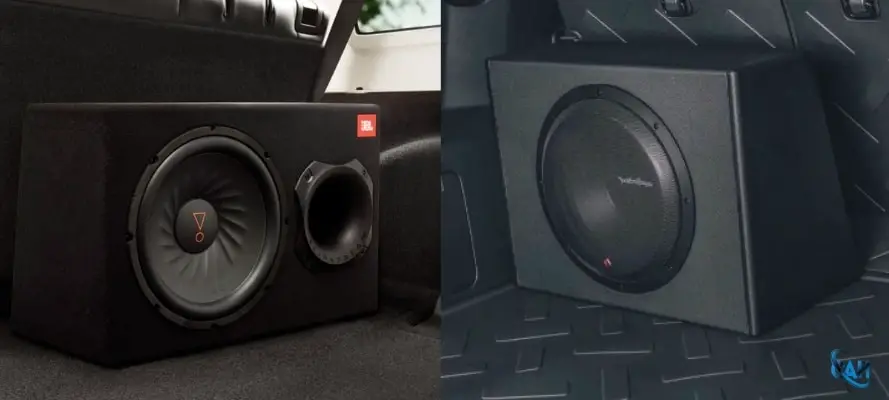
When you start looking for the best powered subwoofer for car audio, it quickly becomes clear that not every “all in one” box is created equal. Some look powerful on paper but fall short in real cars, while others quietly deliver far better bass than their numbers suggest.
For this guide, we approached powered subs the same way we do component speakers, by focusing on what actually matters in daily use. We considered real RMS output, enclosure design (sealed, ported, or slim), feature set, brand track record, and long term owner feedback from places like Amazon and specialist retailers. Only models that combine the subwoofer, built in amplifier, and enclosure in a well matched, ready to install package made the final list.
Our aim here is to keep things objective and practical. Our best overall pick is the Rockford Fosgate Punch P300, and every other model here earns its place for a specific space, budget, or listening style. We will walk you through 9 of the best powered car subwoofers available right now, explain what each one does well, where it has drawbacks, and which listening style and vehicle type it suits best. That way, you can align your choice with your car, your space, and how you actually enjoy your music.
Now, let’s start with a quick at a glance overview of the top picks before moving into the in depth reviews and buying guide.
Table of Contents
9 Best Active/Powered Car Subwoofers at a Glance
1. Best Overall: Rockford Fosgate Punch P300
"300W RMS sealed 10" and 12" with tight, controlled bass, simple wiring, and proven Rockford reliability, the one box we'd start most daily car audio systems with."
2. Best for Deep Bass: JBL BassPro 12
"150W RMS ported 12" with a Slipstream port and rich JBL voicing that delivers deep, warm bass impact for hip-hop, EDM, trap, and other low-end-heavy tracks."
3. Best for Tight Bass: Alpine PWE-S8
"120W RMS 8" powered sub just 2-13/16" tall that slides under or behind seats and focuses on fast, tight bass to add real weight without overwhelming the cabin."
4. Best High-Output: Rockford Fosgate P500-12P
"The highest RMS rating in this guide, 500W into a ported 12", with serious slam and near full-system bass performance from a single, quick-disconnect box."
5. Best Compact: Pioneer TS-WX130DA
"Slim 8" x 5-1/4" powered sub, 2-3/4" tall, with Deep and Dynamic bass modes, designed to fit tight spaces while giving factory systems a fuller low end."
6. Best Value Trunk Box: Pioneer TS-WX1010A
"The same 300W RMS as the Punch P300 in a sealed 10" box that usually costs less, hitting hard and clean when you have trunk space and like to listen louder."
7. Best Budget: Rockville SS10P
"Affordable 10" slim sub with 200W RMS in a 3" cast-aluminum case, full tuning controls, and a real bass upgrade for first-time buyers on a tighter budget."
8. Best Under-Seat: KICKER 46HS10 Hideaway
"Low-profile 10" powered sub with 180W RMS that tucks under most seats, delivering surprisingly full, musical bass while keeping your trunk completely free."
9. Best for Trucks: JBL BassPro SL2
"Slim 8" under-seat enclosure with 125W RMS, tuned for smooth, controlled bass in extended and crew cab trucks and tight cabins where every inch of space matters."
Powered Subwoofer Comparison Table
If you want to compare the picks side by side before reading the reviews, this table puts RMS power, woofer size, enclosure type, and the most practical mounting spot in one place.
Pick | RMS Power | Woofer Size | Enclosure | Best Placement | Check Price |
|---|---|---|---|---|---|
1. Rockford Fosgate Punch P300 | 300W | 10" or 12" | Sealed | Trunk or cargo area | |
2. JBL BassPro 12 | 150W | 12" | Ported | Trunk or cargo area | |
3.Alpine PWE-S8 | 120W | 8" | Sealed | Under or behind a seat | |
4. Rockford Fosgate P500-12P | 500W | 12" | Ported | Trunk or hatch | |
5. Pioneer TS-WX130DA | 50W | 8" x 5-1/4" | Sealed | Under a seat | |
6. Pioneer TS-WX1010A | 300W | 10" | Sealed | Trunk or cargo area | |
7. Rockville SS10P | 200W | 10" | Sealed | Under a seat | |
8. KICKER 46HS10 Hideaway | 180W | 10" | Sealed | Under a seat | |
9. JBL BassPro SL2 | 125W | 8" | Sealed | Under or behind a truck seat |
In-Depth Reviews - Best Powered Car Subwoofers
In this section, we will go through each powered subwoofer that made our shortlist and explain why it earned its place here. For every model, we will highlight its key strengths, weakness, and ideal use cases so you can match the right active subwoofer to your car, space, and listening style.
1. Best Overall: Rockford Fosgate Punch P300 Powered Car Subwoofer
RMS Power (Amp) | Peak Power | Subwoofer Size | Enclosure Type | Frequency Response | Dimensions |
|---|---|---|---|---|---|
300 Watts | 600 Watts | 10 & 12 inches | Sealed | 20 – 200 Hz | 19-13/16" x 15" x 11" x 7" |
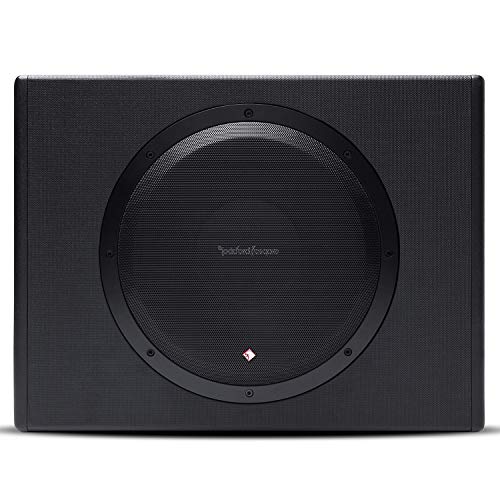
When enthusiasts start looking for the best powered subwoofer for car use, Rockford Fosgate’s Punch P300 series almost always appears on the shortlist. It combines a 12" woofer, a matched Class D amplifier, and a sealed enclosure into a single system that is engineered to work together. As a result, you get bass that feels controlled and authoritative, rather than just loud. That balance is the main reason it sits at the top of our list.
This powered enclosure is built around a sealed box design, which is a key reason why the P300-12 is so popular as an everyday upgrade. Sealed enclosures naturally lean toward tight and accurate bass, and here that translates into kick drums that start and stop cleanly and bass lines that stay well defined at normal and higher volumes.
If you listen to a mix of rock, pop, metal, or modern music and want your low end to sound musical instead of boomy, this character works in your favor. Rockford builds the box from 5/8" MDF covered in heat-activated vinyl, which it says is meant to resist scrapes and bumps in a trunk or cargo area.
From everything we found, the P300 is designed to make adding real bass as clean as possible. You only need to run power, ground, and a signal connection from your head unit or factory speakers.
The built-in high-level inputs mean you can integrate it with a factory stereo without extra converters, while RCA inputs are ready for aftermarket head units. For many car audio owners who just want an active car subwoofer that simply works, this removes a lot of friction from the upgrade.
The onboard controls cover everything you need to blend the P300 smoothly with the rest of your system. A variable low-pass filter (50–200 Hz at 12 dB per octave) lets you choose where the sub hands off to the door speakers, the phase switch helps correct timing issues in the cabin, and the adjustable bass boost can add a little extra weight if your vehicle naturally rolls off some low end.
The included remote bass knob is very useful in real-world driving, as road noise and recordings vary; being able to trim bass level from the driver’s seat becomes something you quickly rely on.
There are, however, some drawbacks that are worth keeping in mind. The P300-12 is a full-size trunk enclosure, so it will take a noticeable portion of your cargo space. It is also tuned for balanced, everyday performance rather than extreme sound pressure levels.
If your goal is to compete with multi-sub, competition-style builds, this is not the right tool; a separate amplifier and larger ported enclosures will still go further.
However, for most drivers who want a car subwoofer with built-in amplifier that delivers a substantial upgrade over factory sound without the complexity of separate components, the Punch P300 fits the brief exceptionally well. It offers confident output, a controlled sound signature, and user-friendly integration features that make it easy for us to recommend as an overall top pick.
2. Best for Deep Bass: JBL BassPro-12 Active Car Subwoofer

RMS Power (Amp) | Peak Power | Subwoofer Size | Enclosure Type | Frequency Response | Dimensions |
|---|---|---|---|---|---|
150 Watts | 450 Watts | 12 inches | Ported | 30 – 200 Hz | 22-3/8" x 14-5/8" x 11-7/8" x 9-1/8" |
If you are mainly chasing deep, immersive bass rather than just a light low‑end fill, the JBL BassPro 12 stands out as one of the best options among powered subwoofer for car audio systems. It is built around a 12" subwoofer in a ported enclosure that uses JBL’s patented Slipstream port. This design is engineered to move a lot of air while keeping turbulence and port noise under control, which is a common weakness in cheaper ported boxes.
On paper, 150W RMS may not sound dramatic compared to some bigger numbers you see on boxes at a glance. In practice, the combination of JBL’s amplifier tuning, the ported alignment, and the 12" cone area gives this system a low end that feels fuller and more extended than its rating suggests.
The owner feedback we reviewed often describes it as a noticeable step up in depth and weight compared to sealed powered subs in the same general power range, especially in sedans and SUVs.
The BassPro 12 is particularly at home with bass‑heavy genres. Hip‑hop, trap, EDM, and modern pop with strong sub‑bass lines benefit from the way this enclosure emphasizes the lower registers without losing the basic musicality JBL is known for. If you want one that makes kick drums hit hard and 808s roll through the cabin, this tuning works in your favor.
JBL also checks the important integration boxes. The built‑in amplifier accepts both RCA low‑level and high‑level speaker inputs, so it works cleanly with factory or aftermarket head units. You get a variable low‑pass crossover (40–200 Hz), phase switch, and a variable bass boost centered around 45 Hz, along with a remote level control. That remote knob is very useful in real‑world driving, as it lets you trim the sub level from the front seat without touching the amplifier.
As with any ported design, there are some cons to be aware of. If you set the low‑pass filter too high and add heavy bass boost, the response can become boomy or one‑note in certain vehicles.
The fix we suggest is very easy. Cross the sub over in the 70–90 Hz range, use bass boost sparingly, and let your door speakers handle the upper bass and midrange. When tuned with that mindset, the BassPro 12 settles into a much more controlled and powerful character.
Physical size and weight are the other considerations. This is a full‑size trunk enclosure, and its footprint and height will be a factor in smaller cars or hatchbacks where every inch of cargo space matters. It’s not the right choice if you were hoping for a compact powered subwoofer that hides under a seat.
However, if your priority is the best car subwoofer with built in amp that focuses on deep, authoritative bass from a single box, the JBL BassPro 12 is an easy model to keep on your shortlist. It offers the kind of low‑end presence many people expect from a separate amp and sub setup, while still giving you the simplicity of a powered enclosure.
3. Best for Tight Bass: Alpine PWE-S8 Amplified Car Subwoofer

RMS Power (Amp) | Peak Power | Subwoofer Size | Enclosure Type | Frequency Response | Dimensions |
|---|---|---|---|---|---|
120 Watts | 240 Watts | 8 inches | Sealed | 25 – 152 Hz | 13-7/16" x 2-13/16" x 9-1/16" |
If you’re driving a smaller car, share cargo space with family, or simply refuse to give up your trunk, a compact powered subwoofer is usually the smartest path, and the Alpine PWE-S8 is one of the most proven options in that category. Its sealed 8" is tuned for speed and definition rather than boom, which is why we give it our pick for tight bass.
This unit combines an 8" high-excursion driver, a 120W RMS Class D amplifier, and a very shallow sealed enclosure that’s just under 3" tall and built from cast metal. That form factor is a big part of its appeal.
It allows the PWE-S8 to live under many front seats, behind seats in trucks, or in other tight spaces where a traditional box simply will not fit. In practice, that makes it feel less like an add-on and more like part of the car.
What stands out to us about the PWE-S8 is its tight, controlled bass character. Instead of chasing maximum boom, Alpine tuned this system to focus on speed and definition. Kick drums hit with a clean attack, bass guitar lines gain real body, and overall the system fills in the lower octaves your factory speakers can’t handle.
If your current setup sounds thin or flat, this type of compact powered sub can make it feel far more complete without overpowering the front stage.
Integration is another option to start with. The PWE-S8 accepts both RCA and speaker-level inputs, and it includes an auto turn-on mode for factory stereos that don’t provide a dedicated remote output.
On the control panel, you get a variable low-pass filter (50–150 Hz), gain, and a phase switch, along with a wired remote level control. In real-world daily use, that remote knob is something we found owners usually praise, as it lets you trim bass quickly as road noise, passengers, or music changes.
There are, however, limitations that come with this design. Despite a frequency response that reaches down into the mid-20 Hz range on paper, in most cars the usable deep bass is more about giving you a solid foundation in the 35–50 Hz region than delivering window-rattling 25 Hz sweeps.
If you try to run the gain very high to mimic a large 12" ported box, the PWE-S8 will start to sound strained and lose some of that tightness that makes it appealing in the first place.
From an expectations standpoint, it’s good to think of this Alpine as the best active car subwoofer for listeners who want tight bass and refinement over raw SPL. It is ideal if your priority is improving clarity and punch at normal listening levels, and you value a clean install that doesn’t compromise space.
Overall, if you’re looking for a powered subwoofer for car audio upgrade that delivers fast, musical bass in an extremely compact form, the PWE-S8 deserves serious consideration. It fits where many enclosures can’t, integrates smoothly with factory and aftermarket systems, and adds the kind of low-end control that makes daily listening more enjoyable.
4. Best High-Output: Rockford Fosgate P500-12P All in One Car Subwoofer

RMS Power (Amp) | Peak Power | Subwoofer Size | Enclosure Type | Frequency Response | Dimensions |
|---|---|---|---|---|---|
500 Watts | 1000 Watts | 12 inches | Ported | 20 – 200 Hz | 15.00” x 24.76” x 10.91 x 7.71” |
For drivers who want to go beyond the typical 150–300W powered subwoofers without diving into a full separate-amp build, the Rockford Fosgate P500-12P is a standout option. It earns our high-output pick because it combines a serious 500W RMS Class D amplifier, the highest rating in this guide, with a proprietary 12" driver and a tuned ported enclosure in one cohesive system.
The heart of this model is its high-output, ported design. Compared to sealed powered subs like the P300-12, the P500-12P moves more air and does so with more efficiency in the lowest octaves. That translates into bass that feels bigger, more forceful, and more present at higher listening levels. In a hatchback, sedan, or SUV, you can feel kick drums and bass drops in your chest, not just hear them in the background.
Rockford’s tuning here leans toward strong, authoritative bass while still maintaining enough control to avoid a one-note sound when you set it up correctly. The built-in amplifier is designed specifically around this enclosure and woofer, which is what Rockford means by its closed-loop design, since the 12" woofer is impedance optimized for the amplifier that drives it. If you need a subwoofer that gets close to what a separate mono amp and 12" ported box can do, this system fits that description.
From an integration standpoint, the P500-12P offers pretty much everything you’d expect from a premium powered enclosure. It accepts both speaker-level and RCA low-level inputs, so it works cleanly with factory and aftermarket head units.
You get a variable low-pass crossover (50–200 Hz), adjustable bass boost (0 to 12 dB), a variable phase control, and a gain knob to match levels. The included remote bass level control is the piece we would lean on most in day-to-day use, as it gives you quick, practical control over output right from the driver’s seat.
One of the practical touches that deserves mention is the quick-disconnect power and signal harness. Rockford designed the P500-12P so you can remove it relatively quickly when you need maximum cargo space. For many owners, that flexibility makes living with a larger enclosure much more realistic.
The drawbacks come in predictable areas. This is a large, heavy enclosure, and its footprint will be a serious consideration in smaller trunks. It is not aimed at someone who occasionally listens at low volume and just wants a subtle fill; for that listener, a smaller option is likely a better fit. The P500-12P is built for enthusiasts who will actually use the extra output and headroom it provides.
For car audio fans who want the most output a powered subwoofer for car can deliver from a single box, we find the P500-12P very easy to justify. It delivers the kind of impact and low-end authority that normally requires carefully matching a separate amplifier and subwoofer enclosure, yet it keeps the wiring, tuning, and overall system design much simpler.
5. Best Compact: Pioneer TS-WX130DA Active Car Subwoofer
RMS Power (Amp) | Peak Power | Subwoofer Size | Enclosure Type | Frequency Response | Dimensions |
|---|---|---|---|---|---|
50 Watts | 160 Watts | 8 x 5-1/4 inches | Sealed | 20 – 200 Hz (Deep), 40 – 160 Hz (Dynamic) | 11" x 8" x 2-3/4" |
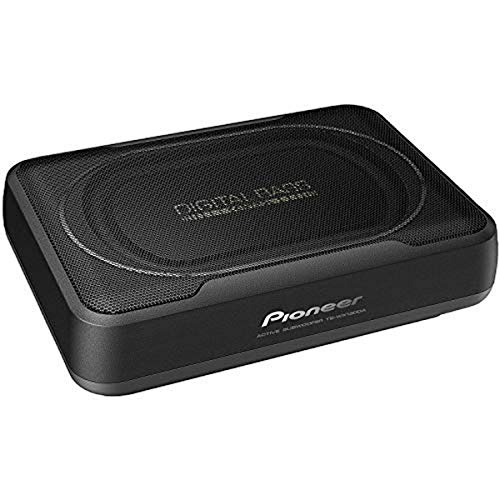
The Pioneer TS-WX130DA is a textbook example of how a compact powered car subwoofer should be done. Pioneer makes the enclosure as small and flexible as possible, then relies on smart amplification and tuning to extract the most out of that footprint. At 2-3/4" tall and 11" wide, it is the smallest enclosure in this guide, which is why it earns our compact pick.
This powered unit uses an 8" x 5-1/4" oval driver with an aluminum cone and a 50W RMS Class D amplifier inside an ultra-slim sealed housing that stands under 3" tall. That form factor is its biggest advantage. You can mount it under many front seats, against the rear of a hatch, in the cargo area of small SUVs, or even in storage cavities where a conventional box would never fit. For many car owners who cannot give up trunk space, this style is the most realistic upgrade path indeed.
On the sound side, the TS-WX130DA focuses on adding depth and fullness to factory or mild aftermarket systems rather than chasing maximum SPL. Pioneer’s DIGITAL BASS CONTROL gives you two primary response modes, Deep and Dynamic. Deep mode emphasizes low-end extension to make music sound richer and more substantial, while Dynamic mode tightens the response and brings out more punch in the mid-bass region.
Pioneer’s own figures show the trade-off, with Deep mode rated down to 20 Hz at 95 dB sensitivity and Dynamic mode narrowing to 40–160 Hz in exchange for 100 dB. This flexibility helps you customize the system to both your taste and your cabin’s acoustics.
Although the raw power rating of 50W RMS looks modest compared to larger trunk boxes, in a compact enclosure like this, it is well matched to the driver and use case. When set up correctly, the TS-WX130DA fills in the missing low frequencies so that vocals, instruments, and effects feel better grounded. If your current system sounds thin or harsh at normal volumes, this compact subwoofer can make it sound much more balanced and enjoyable.
Integration is straightforward. The TS-WX130DA accepts both RCA and high-level inputs, so it can work with factory head units or aftermarket stereos. The supplied wired remote lets you adjust gain, low-pass filter, phase, and bass mode from the driver’s seat, which is invaluable as recordings and road noise change. This ease of use is a consistent advantage of compact powered subs over pieced-together amp and box combinations.
The trade-offs are mostly about output and expectations. This is not the right choice if you are looking for high-output powered car subwoofer setup or want to rattle panels with heavy hip-hop or EDM at high volume.
If you push the gain too far in pursuit of that, the system will start to compress and lose its composure. It is better viewed as an OEM-plus solution for daily driving, where subtle but clearly noticeable bass improvement is the goal.
All things considered, we see the Pioneer TS-WX130DA as a very strong compact powered car subwoofer choice if you’re working with limited space but still want a meaningful upgrade. It adds real low-end presence, keeps installation simple, and fits into places where traditional enclosures simply can’t go.
6. Best Value Trunk Box: Pioneer TS-WX1010A Active Car Subwoofer

RMS Power (Amp) | Peak Power | Subwoofer Size | Enclosure Type | Frequency Response | Dimensions |
|---|---|---|---|---|---|
300 Watts | 1100 Watts | 10 inches | Sealed | 20 – 125 Hz | 20.5" x 16.0" x 11.5" |
If you want noticeably more impact than a compact under-seat sub can deliver, but you’re not ready to build a full custom amp-and-box system, the Pioneer TS-WX1010A is a very sensible middle ground.
It earns our value trunk box pick because it carries the same 300W RMS rating as the Rockford Fosgate Punch P300 in a sealed 10" enclosure that typically sells for less. It’s one of the better choices if your idea is a high-output sealed 10" sub that plays loud, stays clean, and still fits in a practical enclosure.
Pioneer builds the TS-WX1010A around a 10" woofer in a sealed, pre-loaded cabinet with a dedicated 300W RMS Class D amplifier. That combination gives you more cone area and power than the 8" and ultra-slim options we covered earlier in this guide, and Pioneer rates the woofer at 112 dB sensitivity, which helps it play loud from that 300W.
With a published response of 20 to 125 Hz, the sub covers the 30–60 Hz range where a lot of modern music’s bass energy lives, and it adds a solid physical punch that smaller enclosures simply can’t match.
Because it’s a sealed design, the character of the bass remains tight and controlled rather than loose or boomy. That makes the TS-WX1010A a good fit if you listen to a wide mix of genres like rock, metal, pop, electronic, even some acoustic material and want your low end to stay articulate. Compared with some ported options, it gives up a little sheer low-frequency efficiency in exchange for a more even, predictable response.
The built-in amplifier and controls give you everything you need to integrate this powered box into either a factory or aftermarket system. You get both RCA and speaker-level inputs, so hooking it up to an OEM head unit is straightforward, and the control panel includes gain, a variable low-pass filter, bass boost that you can center anywhere from 40 to 100 Hz, and a phase switch.
With basic gain matching and a crossover setting in the 70–90 Hz region, it’s not difficult to blend this sub smoothly with upgraded or even stock door speakers.
What stands out to us is the headroom. Pairing 300W RMS with a 112 dB sensitive woofer means the amplifier has room to spare at normal to moderately loud listening levels, so the sub should stay relaxed and in control rather than strained. That is exactly the kind of behavior many car audio enthusiasts look for in a subwoofer with a built-in amplifier.
The main compromises are predictable for a full-size trunk enclosure. The TS-WX1010A takes up a meaningful chunk of cargo room, so it’s less appealing if you drive a very small car or rely heavily on trunk space. And while it hits hard, listeners chasing maximum shake-and-rattle output will still get more sheer SPL from larger 12" ported systems like our high-output pick, the Rockford Fosgate P500-12P, or similar builds.
However, if you’re after a full-size trunk subwoofer that delivers strong, clean bass for less than the Punch P300, works well across different music styles, and keeps installation simpler than a separate amp-and-sub combo, we find the Pioneer TS-WX1010A very easy to recommend.
It slots neatly between compact under-seat units and full-blown competition-style systems, making it a very practical value choice for real-world daily driving.
7. Best Budget: Rockville SS10P Car Sub with Built-in Amp

RMS Power (Amp) | Peak Power | Subwoofer Size | Enclosure Type | Frequency Response | Dimensions |
|---|---|---|---|---|---|
200 Watts | 800 Watts | 10 inches | Sealed | 20 – 180 Hz | 13.6" x 9.65" x 3.0" |
For many drivers, the first real step beyond factory sound is simply finding a budget powered car subwoofer that doesn’t feel like a compromise. In that role, we see the Rockville SS10P as a strong fit. It is a slim powered sub with a 200W RMS built-in amp in a cast-aluminum, under-seat-ready enclosure, giving you a clear bass upgrade without a big bill or a big box.
The main appeal of the SS10P, in our view, is its value-versus-output equation. At this price point you are not paying for high-end cosmetics or ultra refined voicing; you are paying for a real jump in low-end presence over nearly any stock system.
The built-in amplifier gives it noticeably more physical impact than many compact powered units in small to mid-size cabins. Kick drums, bass guitar and modern pop low-end all gain real weight, which is exactly what most first-time upgraders are really looking for in an entry-level powered sub.
Its slim, roughly 3"-tall form factor is another strong point. The SS10P is built to live under a front seat, in the rear footwell, or against the back wall of a truck cab. That makes it a practical choice if you can’t spare trunk space for a larger enclosure but still want a noticeable bass improvement. In that sense, it behaves well without the premium price tag that usually comes with big-name brands.
Rockville also includes a surprisingly complete feature set for the money. You get both RCA and high-level inputs with auto turn-on, so integration with factory or aftermarket head units is very easy.
On the control side, there is an adjustable low-pass filter (50–180 Hz), phase switch, bass boost, and gain, plus a built-in 20 Hz subsonic filter, along with a wired remote bass knob. In day-to-day driving, that remote control is very useful, since you can trim bass quickly as road noise, passengers, or tracks change, just as you would with more expensive powered subwoofer for car audio options.
The compromises show up when you compare it directly with higher-tier brands in our list. Build quality is serviceable but not as polished as what you’ll see from Rockford, JBL, Alpine, or KICKER. The enclosure and hardware feel more utilitarian, and while the sub absolutely delivers more bass than stock, it doesn’t have the same level of tightness and low-end nuance as the premium under-seat units.
Pushed very hard, it can start to sound a bit congested, which is typical in this budget class. Some users describe the same pattern, with clear bass that fills out a stock system at moderate volume but no mirror-rattling output and sound quality that tapers off as the volume climbs.
Low-frequency extension is also more about filling in the everyday bass range than digging deep into sub-30 Hz territory.
In other words, it’s a solid choice if you want your music to feel fuller and more enjoyable on the commute, but it isn’t built to chase competition-level output or glass-rattling lows. If that’s your goal, stepping up to a larger trunk enclosure like the Punch P300 or JBL BassPro 12 will make more sense.
As an entry point into powered subs, the SS10P makes a lot of practical sense. It is affordable, compact, easy to install, and delivers the kind of improvement that makes you wonder why you waited so long to add bass. If your budget is tight and you just want a simple upgrade that pulls you out of stock sound territory without getting too technical or expensive, the Rockville SS10P is a very sensible place to start.
8. Best Under-Seat: KICKER 46HS10 Hideaway Car Subwoofer
RMS Power (Amp) | Peak Power | Subwoofer Size | Enclosure Type | Frequency Response | Dimensions |
|---|---|---|---|---|---|
180 Watts | 360 Watts | 10 inches | Sealed | 25 – 120 Hz | 9-7/8"W x 3-1/8"H x 14"D |
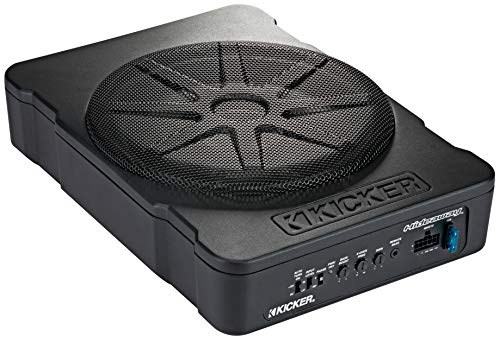
When we look at slim powered subs that can hide under a seat, the KICKER 46HS10 Hideaway is one of the first models that comes to mind. It combines a 10" driver, a 180W RMS Class D amplifier and a very shallow sealed enclosure to deliver real low-end authority in spaces where a traditional box simply will not fit.
What earns it our under-seat pick is KICKER’s FIT+ integration, which accepts input signals from 0.25 to 40 volts and works with start/stop vehicles, so it can tie into almost any factory system without a line output converter.
What stands out to us is how much usable bass the HS10 is built to produce for its size. A lot of under-seat designs rely on smaller 8" drivers and modest power, and they work for light bass fill but run out of headroom quickly.
With the HS10, the larger 10" cone and extra power give the sub a more confident punch in trucks, double cabs, and mid-size SUVs where the listening position is very close to the sub.
In terms of sound, KICKER keeps the focus on tight, musical bass rather than loose boom. The sealed enclosure helps kick drums and bass lines stay distinct, and the built-in KickEQ circuit lets you add a controlled lift (up to +6 dB) around the 40 Hz region if your vehicle naturally rolls off there. Used moderately, that extra boost makes the system sound fuller without turning muddy or one note.
From an integration standpoint, the HS10 behaves exactly the way a best self powered car subwoofer should. It offers both high-level and RCA inputs, auto turn-on, and a full set of onboard controls, including gain, a low-pass filter (50–120 Hz), phase, and KickEQ. The included remote bass knob is very useful in day-to-day driving, as it lets you trim bass level quickly as songs, road noise, and passengers change, instead of reaching back to the amp.
There are, however, predictable drawbacks. The HS10 sits at the premium end of the compact powered market, so it does cost more than budget-friendly units like the Rockville SS10P.
In return, you get more refinement and brand-backed reliability, but that price gap can be a deciding factor if your budget is tight. And while it plays impressively strong for a slim enclosure, it still won’t compete with larger 12" ported systems like the Rockford P500-12P if your goal is pure SPL.
Physics also limit the very lowest frequencies. The HS10 focuses on delivering solid impact in the everyday 35–60 Hz band rather than chasing ultra-deep 25 Hz sweeps. Placement matters, too. Under-seat installs can vary a lot between vehicles, so taking time to experiment with which seat, phase setting, and crossover point works best will directly affect how clean and cohesive the bass feels.
If you are trying to keep your trunk completely free and still want a serious under-seat powered car subwoofer, we find the KICKER Hideaway HS10 easy to justify. It feels less like a token add-on and more like a compact, well engineered solution that fits daily driving realities very well.
9. Best for Trucks: JBL BassPro SL2 Subwoofer with Built-In Amp
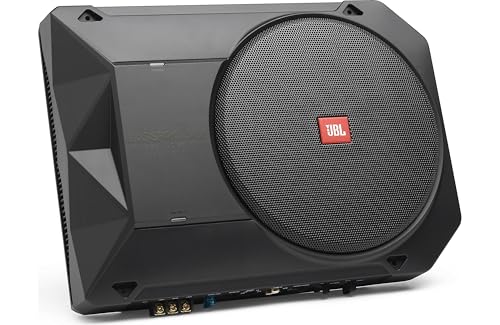
RMS Power (Amp) | Peak Power | Subwoofer Size | Enclosure Type | Frequency Response | Dimensions |
|---|---|---|---|---|---|
125 Watts | 250 Watts | 8 inches | Sealed | 35 – 120 Hz | 13.6" x 9.9" x 2.8" |
For truck owners and drivers of tighter cabins, the JBL BassPro SL2 stands out as one of the most practical powered car subs. It uses a slim 8" driver in a rugged, low-profile ABS enclosure that can slide under many front seats or tuck behind the seats in extended-cab and crew-cab trucks.
On the spec sheet, 125W RMS doesn’t look dramatic next to some of the larger powered subs in this guide. In real use, though, that power level is well matched to the driver and the kind of small to mid-size cabins this sub is designed for. When positioned close to the listening area, it delivers smooth, musical bass that fills in the bottom end without overpowering vocals or high frequencies. For a lot of factory systems, that is exactly the missing piece.
The tuning is classic JBL. The sub leans slightly warm and controlled rather than overly sharp or boomy, which makes it friendly with a wide mix of genres, including rock, pop, country, R&B, even talk-heavy content.
You won’t get the kind of ultra-deep rumble a big 12" ported box can generate, but you do get bass that makes drums and bass lines feel present and natural instead of thin. That is why we keep this model on our short list for powered subs for trucks and compact SUVs.
Integration is another strong point. The BassPro SL2 offers both RCA and high-level inputs with auto turn-on, so it can tie cleanly into modern OEM head units as well as aftermarket units. The onboard controls (a 50–120 Hz low-pass crossover, bass boost of up to 9 dB at 70 Hz, and a phase switch) give you the tools to blend it properly with stock or upgraded door speakers. JBL lists its GTO-RBC wired remote as included, so you also get quick level tweaks from the driver’s seat.
Its limitations are mostly about expectations and physics. This slim 8" design is not aimed at extreme SPL or panel-rattling bass. If your goal is to shake mirrors at every stoplight, a larger 10" or 12" powered box in the trunk will be a better fit.
The enclosure’s compact volume also means the very lowest sub-bass notes are more hinted at than fully reproduced; the BassPro SL2 focuses on solid, everyday 40–80 Hz impact rather than chasing the lowest octave.
Placement plays a role as well. The BassPro SL2 really shines when mounted close to the seating position, under a truck seat or directly behind the seats, where the distance between driver and sub is short.
In that context, it behaves like a well-sorted subwoofer with a built-in amplifier that makes a stock system feel more complete without demanding extra space or complicated wiring, which is exactly what we look for in a daily-driver upgrade.
If you are working with a truck, compact SUV or small car and care more about space-efficient, high-quality bass than outright volume, the JBL BassPro SL2 is a choice we are happy to recommend.
It delivers what many people really want from a powered subwoofer upgrade, which is a cleaner, fuller low end, OEM-friendly installation and a form factor that disappears into the vehicle while the bass quietly does its job.
Buying Guide: How to Choose the Best Powered Subwoofer for Car
A powered sub already takes care of matching the sub, box, and amplifier. What really matters now is whether it fits your car, your music, and the way you drive. In this section we walk through the key checks you should use when choosing the best powered sub for car use in a real system. Let's figure them out.
Decide Where the Subwoofer Will Go
Space is the first decision. If you have usable room in the trunk or cargo area and want stronger output, full enclosures such as the Rockford Fosgate P300-12, P500-12P or JBL BassPro 12 usually make the most sense. You trade some storage for deeper and louder bass.
If you drive a small car or do not want to use trunk space, typical locations are under the front seats or along the back wall. That is where compact boxes like the Alpine PWE-S8, Pioneer TS-WX130DA, and JBL BassPro SL2 come in. They are built to disappear, add weight to the sound and keep the cabin usable.
In trucks, the space behind or under the rear seats is usually the best starting point. A low profile sub close to the listeners often feels stronger than a larger box sitting farther away in the bed or behind a divider.
Match Output to Your Listening Style
Once the location is clear, the next step is matching output to how the car is actually used. Many daily drivers just need the bass to sound present and clean; for that kind of setup, something in the 100 to 200 watt RMS range is usually enough, and most under seat models sit in this bracket.
If you like to turn it up and feel kick drums and bass lines but still want the system to stay controlled in everyday use, 200 to 300 watts RMS in a sealed 10 or 12 inch box is a sensible target. This is a middle ground where the bass feels serious without being excessive.
If bass is the first thing you notice in any track, especially with hip hop, trap or EDM, powered subs above 300 watts RMS in a larger enclosure start to make more sense. Below that level, most bass heavy listeners eventually end up wanting more.
Focus on the Specs That Actually Matter
Spec sheets can look impressive, but only a few numbers really decide how a powered sub will behave.
RMS power is the first one. It tells you what the built in amplifier can deliver all day. Peak or “MAX” ratings are short bursts and are mostly there for marketing.
Frequency response is the next check. On paper many powered subs list something like 35 to 120 hertz. In practice, the box should play with confidence down into at least the mid 30 hertz range inside the car. If it only feels alive above 45 or 50 hertz, the bass leans more toward punch than true low end.
Sensitivity and box design also play a role, but in this category they are better treated as part of the overall tuning rather than numbers to chase on their own.
One practical advantage of a subwoofer with an inbuilt amplifier is that you do not have to think about impedance at all. The amplifier and driver are already matched inside the enclosure, so there is no risk of wiring yourself into a bad load as there can be with loose subs and separate mono amps.
Choose Between Sealed, Ported, and Slim Enclosures
Enclosure type sets the basic character of the bass.
Sealed powered boxes give tighter, more controlled bass that works with almost any genre. That is why sealed designs appear on so many models in our list, from larger enclosures like the P300-12 and TS-WX1010A to compact units such as the PWE-S8 and BassPro SL2.
Ported powered boxes lean more toward output and low frequency weight. For listeners who mainly play bass heavy music and have the space, options like the BassPro 12 or P500-12P are usually the more suitable choice.
Slim and under seat boxes are also usually sealed, with space and stealth as the main priorities. They are best treated as a way to make the system sound complete rather than chase maximum SPL, and they suit daily driven cars that need to carry people and gear first and entertain them second.
Make Sure It Works With Your Head Unit
Compatibility with the existing head unit is a basic check before shortlisting any powered sub.
If the car still runs a factory radio, it should offer high level (speaker) inputs and a reliable auto turn on circuit. That allows the powered sub to read the signal from the existing speaker wiring and wake up automatically when the radio turns on, without hunting for a separate remote wire.
If the car already has an aftermarket head unit with subwoofer or preamp outputs, RCA inputs on the powered sub are what we'd strongly prefer. The signal is cleaner, tuning is easier and you often gain direct sub level control on the head unit itself.
Match the Power Wiring to the Sub
Powered subs are simpler than full amp setups, but basic power work still matters.
Match power wire gauge to realistic RMS power. For compact under seat subs, a good 8 gauge kit is usually enough. For higher power trunk boxes such as the P300-12 or P500-12P, Rockford specifies 8 gauge power and ground wiring, and a heavier 4 gauge kit is optional rather than required.
Fuse the power line as close to the battery as practical, and keep the ground short, clean and bolted to bare metal on the chassis. That simple groundwork does more for noise control and long term reliability than most add ons.
For a single powered sub in the 100 to 300 watt RMS range, a healthy stock electrical system is usually fine. If headlights dip hard at higher volume, battery condition and a basic wiring refresh should be checked before jumping to a new alternator.
Look for Features That Actually Help You Use It
There are a few controls and protections that make a powered sub much easier to live with day to day.
If you follow these same steps in your own system, you quickly narrow the field to a handful of powered subs that do more than just look good online. They fit your space, line up with your listening habits and behave like a natural part of the system once installed.
FAQs: Powered Subwoofers for Cars
Is a powered subwoofer alone enough for my system?
For many cars, yes. A good powered sub takes over the low frequencies so the door speakers can play mids and highs more cleanly, even if they are still factory units. You can always come back later and add an amp for the doors if you decide you want more overall output.
How much RMS power do I really need in an active subwoofer?
100 to 200 watts RMS is enough for most daily drivers, and we treat it as a solid everyday range for filling in missing bass. Around 200 to 300 watts RMS suits most people who like a bit more punch and headroom. Above 300 watts RMS starts to make sense if you listen loud and lean heavily on bass driven music such as hip hop or EDM.
What size powered subwoofer is best for a car?
For most cars, a 10 inch sub is the best all-round size. An 8 inch powered sub is compact and tight, ideal for small cabins and under seat locations. A 10 inch sub balances speed and depth and works well for mixed music if you have a little more space. A 12 inch sub moves more air and reaches deeper, so it suits trunk or cargo installs where strong low bass is the priority.
Can I add a powered subwoofer to my factory head unit?
Yes, as long as you choose a powered sub with speaker level inputs and some form of auto turn on. It will tap into your existing speaker wiring and turn on with the factory radio without needing special outputs. This is exactly how many powered subwoofers for car audio are used in modern vehicles.
Do I need to upgrade my battery or alternator for a powered subwoofer?
For a single powered sub in roughly the 100 to 300 watt RMS range, a healthy stock battery and charging system is normally enough. We only start thinking about electrical upgrades when someone runs higher power boxes hard for long periods or the car already shows signs of a weak battery. If headlights dim badly at volume, a fresh battery and basic wiring improvements usually come before a new alternator.
Can I install a powered subwoofer myself?
Yes, in most cases. If you are comfortable pulling trim panels, routing cable, and making solid electrical connections, a powered sub is one of the more realistic DIY upgrades. The core tasks are running a fused power wire, finding a clean ground, feeding a signal, and setting gain and crossover. If any of that feels uncertain, paying an installer for a clean, safe job is usually money well spent.
How do I tune a powered subwoofer so it doesn’t sound boomy?
Set the head unit to the loudest volume you normally use, then raise the sub gain only until the bass blends with the front speakers. Start with the low-pass crossover around 70–90 Hz, keep bass boost off or very low, and test phase at 0° and 180°, choosing the setting that sounds tighter and less boomy from the driver’s seat.
Will a powered subwoofer make a big difference with stock door speakers?
Adding a powered sub usually makes a big difference even if the door speakers are stock. Once the sub takes over the heavy work in the low end, the doors no longer have to strain to produce bass, so mids and highs sound clearer. The overall result is a system that feels fuller and less harsh at normal volumes.
Do I still need an amp for my door speakers if I add a powered subwoofer?
You do not have to amp your door speakers just because you add a powered sub. Many systems feel balanced with a powered sub and the doors still running from the head unit, especially if those speakers have been upgraded. A separate door amp becomes the next step only if you want higher overall volume and cleaner mids and highs at those levels.
Is a subwoofer with a built-in amp as good as a separate sub and amp?
For most daily drivers, yes, because a subwoofer with a built-in amp arrives with the woofer, amplifier, and enclosure already matched. A separate sub and mono amp still go further on raw output and tuning freedom, which is why competition-style builds use them, but they also ask you to choose an enclosure, match impedance, and wire more components. If your goal is a clean bass upgrade rather than maximum SPL, the powered route is the simpler and more predictable one.
What is the best compact powered subwoofer for a car?
The Pioneer TS-WX130DA is our pick if you need the smallest box, since its enclosure is only 2-3/4" tall and 11" wide. If you can fit a slightly larger slim unit and want more output, the KICKER 46HS10 Hideaway puts 180W RMS into a 10" driver while still sliding under most seats, and the Rockville SS10P gets you a similar 10" format for less money.
Final Verdict: Which Powered Subwoofer Should You Buy?
If you want a single starting point for the best powered subwoofer for car audio, the Rockford Fosgate Punch P300 is our clear best overall pick for most daily driven cars. It hits a very useful balance of output, control and practicality, giving you real low-end authority without forcing you into complex wiring or a full custom install. For a lot of systems, it feels like the most sensible “one-box” solution that can genuinely change how your music sounds day to day.
The right runner-up depends on the job you need the sub to do. For deep bass from one trunk box, the JBL BassPro 12 is the pick, and the Rockford Fosgate P500-12P takes over when you want the most output in this guide.
The Pioneer TS-WX1010A is our value trunk box, giving you 300W RMS in a sealed 10" for less than the P300. If you need to keep the trunk free, the KICKER 46HS10 Hideaway is our under-seat pick, the Alpine PWE-S8 suits listeners who want tight bass from a slim 8", the Pioneer TS-WX130DA fits the tightest spaces, and the Rockville SS10P is the budget way in. Truck owners should start with the JBL BassPro SL2.
Beyond that, if you want real, reliable bass without juggling separate amps and boxes, a powered sub is still the most practical route for most vehicles. There is no single best powered car subwoofer for every situation, because the right choice always depends on your space, budget and how much low end you actually enjoy.
As a simple rule of thumb, choose a compact under-seat model if cabin space is tight and you mainly want to fill out the bottom end, and look at larger enclosures if you have more room and prefer stronger output. If you match the enclosure style and realistic RMS power to your vehicle and listening habits, any of the models in this guide can quietly become the missing piece that makes your whole system feel finished.