

We’ve compared manufacturer specs and cross-checked retail listings to help you find the best secondary battery for car audio. The XS Power D3400 is our top pick for overall performance, with a published secondary-system wattage guide and more capacity than the compact backups.
Whether you play music with the engine off or need more reserve for bass hits, a secondary battery provides added power support. Just keep in mind, it still needs a charging system that can handle the load.
In this guide, we’ll break down 7 dual or secondary battery options from high-power beasts to compact backups and budget-friendly performers. So, you can find the one that fits your system like a glove.
Let’s explore.
Table of Contents
Quick Look: Our Top 7 Secondary Batteries at a glance
1. XS Power D3400 is our top pick for overall performance
with more reserve than the compact backups and a published secondary-system guide.
2. Odyssey PC680 earns its compact setup tag
with a narrow footprint for tight custom installs, while its lower Ah limits engine-off runtime.
3. Kinetik HC2400-BLU brings the largest capacity
in this set for high power systems, while its Group 31 case needs a proper mounting space.
4. Optima Batteries 8014-045 YellowTop balances engine starting and deep cycling
for drivers who need one battery to handle both uses properly.
5. Kinetik HC600 is our budget option for small audio upgrades
with a compact AGM case that needs less space than the full-size power cells.
6. Renogy Deep Cycle AGM Battery suits versatile use in van-life builds
with capacity for audio and added accessories in a larger AGM case.
7. Skar Audio SK-BATT20AH suits short audio sessions
with published discharge-rate figures that show why a compact backup has runtime limits.
Compare our Best Car Audio Secondary Batteries
Product | Best Tag | Capacity | Other current rating | Weight | Check Price |
|---|---|---|---|---|---|
Best Overall Performance | 80 Ah | 3300A max | 49.97 lbs | ||
Best for Compact Setups | 16 Ah at 20 hours | 520A PHCA for 5 seconds | 15.4 lbs | ||
Best for High Power Systems | 110 Ah | 1700A CA retail rating | 62.7 lbs | ||
Best Dual-Purpose | 55 Ah at 20 hours | 750A CCA | 43.5 lbs | ||
Best Budget Option | 18 Ah at 20 hours | not published | 11.9 lbs | ||
Best for Versatile Use | 100 Ah at 10 hours | 1100A for 5 seconds | 63.9 lbs | ||
Best for Short Audio Sessions | 20 Ah nominal | 300A maximum continuous discharge | 13.6 lbs |
Comprehensive Reviews of 7 Best Car Audio Secondary Batteries
1. XS Power D3400 XS Series - Best Overall Performance
When it comes to choosing the best secondary battery for car audio, the XS Power D3400 XS Series is our pick for overall performance as XS Power publishes both a secondary-system wattage guide and a substantial energy reserve.
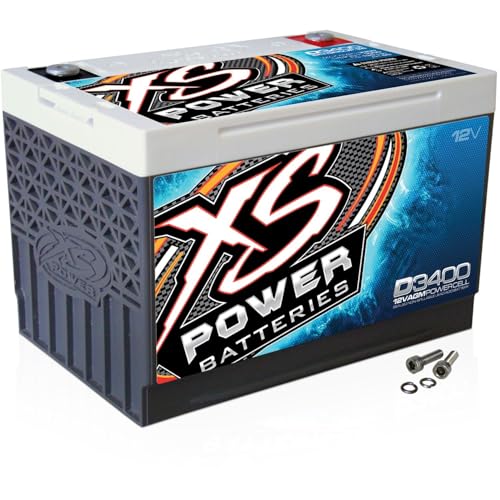
- Voltage: 12V
- Capacity: 80 Ah
- Cold Cranking Amps (CCA): 1012A
- Other current rating: 3300A max; 1150A CA
- Reserve Capacity: 160 minutes
- Weight: 49.97 lbs
- Dimensions: 10.24 x 6.89 x 7.16 in
- Battery chemistry: AGM
- Connections: M6 terminal hardware included
See More Specs on XS Power's Site
What Makes It Stand Out?
- Published secondary-system wattage guide
- Low internal resistance for quick power delivery
- Sealed AGM design
What Could Be Better?
- Premium price may be overkill for mild systems
- Heavier than the compact backups
With XS Power’s secondary-system guide of up to 4000W, we consider the D3400 for a powerful audio system with the right electrical support. That figure is the manufacturer’s system guide, with its RMS basis not published.
The low internal resistance supports quick current delivery during musical peaks. Its sealed AGM design also makes it a practical power reserve for daily drivers with heavy subwoofers.
In verified buyer feedback on Sonic Electronix, added power support appears across multiple builds. The wider owner discussions on that page also include reduced headlight dimming alongside some reports of remaining flicker. But we don’t promise rock-solid voltage from the battery alone.
Just keep in mind, the premium price may be overkill for mild systems. Its weight also needs more support than the compact backups, which makes mounting space part of the decision.
For serious builds, we recommend the D3400 as our overall pick when the charging system and available space can handle it. Just be sure that your system is designed to use all that it offers.
2. Odyssey PC680 Battery - Best for Compact Setups
When space is limited and power requirements are modest, we recommend the Odyssey PC680 Battery for compact setups, with its narrow footprint for tight custom installs.
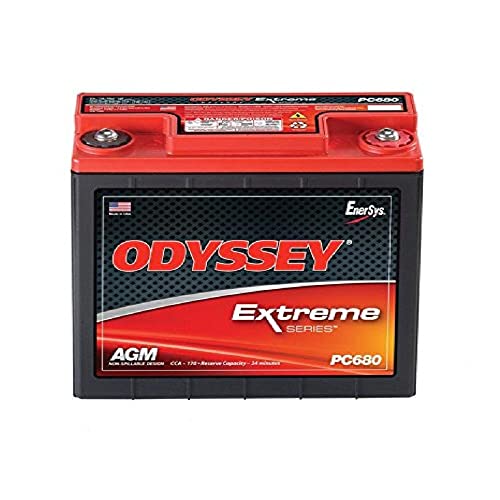
- Voltage: 12V
- Capacity: 16 Ah at the 20-hour rate
- Cold Cranking Amps (CCA): 170A
- Other current rating: 520A PHCA for 5 seconds; 350A HCA
- Reserve Capacity: 24 minutes
- Weight: 15.4 lbs
- Dimensions: 7.2 x 3 x 6.4 in with terminals as listed by Odyssey
- Battery chemistry: AGM
- Connections: M6 receptacle
What Makes It Stand Out?
- Compact size perfect for tight installations
- Non-spillable and vibration resistant
- Deep cycle capabilities
What Could Be Better?
- Not suitable for large or high-wattage systems
- Lower Ah limits runtime
It’s purpose-built for small vehicles or tight custom installs where every inch matters.
Odyssey now lists the PC680 as ODS-AGM16L. Check that model number when purchasing the same battery. Its narrow case is a practical fit for compact sport builds with modest power requirements.
Odyssey lists 520A as five-second Pulse Hot Cranking Amps, while its CCA rating is 170A. That distinction matters if the battery will help start the vehicle, and neither figure gives you an audio-system RMS rating.
One of the key strengths in Odyssey’s published specs is its cycling durability. Odyssey claims up to 400 cycles at 80% depth of discharge, which gives it a published cycling basis for repeated supplemental use. Its non-spillable AGM construction also supports installs where shock and vibration matter.
Across multiple verified buyers on eBay, small-vehicle starting and compact fit appear more often than car audio runtime. That owner feedback is separate from the manufacturer’s cycle claim and doesn’t establish an audio-system wattage limit.
If you’re upgrading your audio setup but don’t have space for a beefy cell, we recommend the PC680 for compact supplemental use. Lower Ah limits runtime. For large systems or long engine-off sessions, you’ll need more reserve.
3. Kinetik HC2400-BLU - Best for High Power Systems
For serious car audio setups with the space for a larger power cell, we recommend the Kinetik HC2400-BLU for high power systems as it has the largest published capacity in this set.
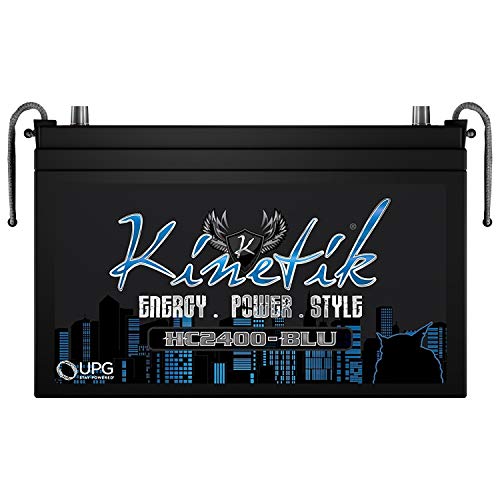
- Voltage: 12V
- Capacity: 110 Ah
- Other current rating: 1700A CA as listed by two retailers
- Weight: 62.7 lbs
- Dimensions: 12.91 x 6.77 x 8.58 in
- Battery chemistry: AGM
- Connections: 3/8 in threaded terminals
What Makes It Stand Out?
- Largest published capacity in this set
- High current rating listed by two retailers
What Could Be Better?
- Heavy and bulky
- Expensive for casual users
Sonic Electronix and OnlineCarStereo list a 2400W system guide, but its RMS basis is not published.
The same retailers list 1700A as cranking amps, and that figure should stay separate from the D3400’s max amp rating. Its higher capacity gives more nominal reserve than the D3400, while the different ratings don’t establish which one holds voltage better.
Multiple verified buyers on eBay report less headlight dimming or fewer voltage-related amp problems. We treat that as owner feedback across different systems, with no published conditions that support a promise of zero voltage drop.
It’s not something you casually toss into a lightweight build. The larger Group 31 case is heavy and bulky. We recommend it only when your mounting space can support a full-size power cell. The price is also hard to justify for casual users with modest power needs.
If you have the space and the right charging support, the HC2400-BLU remains our pick for high power systems that need a larger reserve.
4. Optima Batteries 8014-045 YellowTop - Best Dual-Purpose
For those who need both engine starting and deep cycling, the Optima Batteries 8014-045 YellowTop earns its dual-purpose tag through OPTIMA’s published starting and cycling design.

- Voltage: 12V
- Capacity: 55 Ah at the 20-hour rate
- Cold Cranking Amps (CCA): 750A
- Other current rating: 870A CA
- Reserve Capacity: 120 minutes at 25A
- Weight: 43.5 lbs
- Dimensions: 10.06 x 6.94 x 7.88 in
- Battery chemistry: AGM SpiralCell technology
- Connections: Dual SAE & GM posts
What Makes It Stand Out?
- True dual-purpose for starting and deep cycling
- Dual SAE & GM posts
What Could Be Better?
- Pricier than some single-use alternatives
- Bulky for ultra-compact installs
OPTIMA lists the D34/78 for engine start and cyclic applications, and we recommend it when one battery needs to handle both uses. The dual SAE and GM posts also give you a connection option that the M6-only PC680 doesn’t offer.
For those running a single-battery system, the YellowTop is a smart solution. We consider it particularly valuable when adding a second unit isn’t feasible, provided the vehicle’s battery requirements match this model.
Just keep in mind, its reserve capacity is a published discharge rating. It doesn’t mean your amp draw can’t outpace the charging system. OPTIMA also warns that a deeply discharged YellowTop may fail to start the engine.
The price is higher than some single-use alternatives, and the full-size case is bulky for ultra-compact installs. If you’re looking for the best dual battery for car audio, our recommendation here is for starting and cycling in one model, with proper fitment and charging support.
5. Kinetik HC600 Cell Battery - Best Budget Option
Enter your text here...

- Voltage: 12V
- Capacity: 18 Ah at the 20-hour rate
- Cold Cranking Amps (CCA): not published
- Weight: 11.9 lbs
- Dimensions: 7.13 x 3.01 x 6.57 in
- Battery chemistry: AGM
- Connections: 6 mm threaded terminals
What Makes It Stand Out?
- Small form factor for flexible mounting
- Great entry-level secondary battery
What Could Be Better?
- Retail system-wattage guide has no published RMS basis
- Limited reserve capacity
It’s a great fit for hatchbacks, sedans, and compact SUVs where space is limited and power needs are modest.
The HC600 appears as HC600-BLU in Kinetik’s catalogue and the cross-checked retail listings. Check the label before purchasing. We consider it an affordable secondary battery for car audio when your build needs a small backup close to the amp.
DWG and CARiD list a 600W system guide, which keeps this recommendation in the entry-level category. Its RMS basis is not published, and that guide doesn’t support systems pushing 800 to 1000 watts.
Across multiple verified buyers on eBay, compact mounting and added audio power support are recurring strengths. Those older owner reports don’t establish current-model performance under a fixed load. We don’t promise an end to headlight dimming.
Now, to be clear, this isn’t the battery you want for a multi-amp or SPL competition build. We recommend it for small audio upgrades, with limited reserve capacity for long engine-off listening.
6. Renogy Deep Cycle AGM Battery - Best for Versatile Use
For van-life conversions or custom mobile installs, the Renogy Deep Cycle AGM Battery (RNG-BATT-AGM12-100) earns its versatile use tag through its published capacity and support for added 12V electronics.

- Voltage: 12V
- Capacity: 100 Ah at the 10-hour rate
- Other current rating: 1100A for 5 seconds
- Weight: 63.9 lbs
- Dimensions: 13.1 x 6.9 x 8.6 in
- Battery chemistry: AGM
- Connections: M8 bolts included
What Makes It Stand Out?
- High capacity for extended usage
- Suitable for off-grid and hybrid car audio setups
- Slow self-discharge when stored correctly
What Could Be Better?
- Bulkier than traditional car audio batteries
- No published CCA rating for engine-start selection
We recommend it to car owners who treat their vehicles like rolling entertainment systems or mini-RVs.
With Renogy’s capacity rated at a 10-hour rate, we consider it for added accessories and engine-off listening, while actual runtime depends on the load. But the HC2400-BLU has a higher nominal capacity, and this Renogy doesn’t store more energy than every audio AGM in the set.
What makes it stand out for us is its versatility. Renogy’s published uses include off-grid power, which makes audio with lighting or an inverter the use case behind this pick.
Renogy lists self-discharge below 3% per month at 77°F, which supports storage between trips. The manufacturer still recommends a full charge before storage and recharging after three months.
Just keep in mind, the larger case is bulky for tight custom installs. We keep it as a secondary deep cycle battery for car audio upgrade plans, with the primary battery handling ignition as a CCA rating is not published.
Renogy’s current page lists a 30A maximum charging current, and your charging setup must stay within that limit. It also recommends staying above 50% discharge for longer cycle life, which limits the capacity you should plan to use regularly.
7. Skar Audio SK-BATT20AH - Best for Short Audio Sessions
For short audio sessions with the engine off, we recommend the Skar Audio SK-BATT20AH with Skar’s published capacity at different discharge rates to help you choose a compact backup.

- Voltage: 12V
- Capacity: 20 Ah nominal
- Cold Cranking Amps (CCA): 326A
- Other current rating: 300A maximum continuous discharge
- Reserve Capacity: 25 minutes at 25A
- Weight: 13.6 lbs
- Dimensions: 7.125 x 3.00 x 6.625 in
- Battery chemistry: AGM
- Connections: Top post terminal hardware included
What Makes It Stand Out?
- Published capacity at different discharge rates
- Terminal hardware included
What Could Be Better?
- Lower capacity at higher discharge rates
- No published RMS system rating
Skar’s manufacturer manual lists 11.45Ah at the one-hour rate, which means its nominal capacity doesn’t give you 20A for a full hour. That published limit helps you plan engine-off listening.
The manual keeps maximum continuous discharge current separate from CCA. We keep those figures separate when comparing the compact backups. Amazon and Singh Electronics list the weight at 13.6 pounds, which matters when planning a lightweight build.
Terminal hardware is included in the cross-checked retail listings, which helps with connections close to the amp. Just keep in mind, the listed discharge capacity falls as the load increases.
We recommend checking your system’s current draw before choosing this battery, as an RMS system rating is not published. For short audio sessions, the SK-BATT20AH gives you published discharge-rate figures to work from, while long engine-off sessions need more reserve.
Buying Guide for the Best Secondary Battery for Car Audio
Match the battery to your system’s power demands and available space before making your final decision.
There’s no one-size-fits-all solution. The right battery depends on your system’s power demands, available space, and how you use your vehicle. Here’s a quick breakdown of the key factors to keep in mind.
1. Know Your Power Needs
The first thing you need to look at when choosing a second battery is the system’s total wattage. Use your amps’ RMS figures for system planning, and check the battery’s published system guide and charging requirements. We don’t treat a retailer’s wattage guide as a verified RMS rating.
For secondary battery options for powerful car audio setups, we consider the D3400 or HC2400-BLU when the charging system can handle the load. Renogy’s charging guidance makes the alternator’s available current part of that decision.
2. Consider the Amp Hour Rating
Always consider the Amp Hour rating (Ah) when evaluating a secondary battery. The published discharge rate matters, as capacity falls as the load increases. Skar’s rate figures show that a compact battery’s nominal Ah won’t all be available during a heavy draw. For anyone who plays music with the engine off, we recommend planning around usable capacity and the manufacturer’s discharge limits.
3. Check the Current Rating
Cold Cranking Amps (CCA) is relevant only if the secondary battery is expected to help start the vehicle. For audio-specific use, compare current ratings only when their conditions match. Odyssey’s five-second PHCA and Skar’s maximum continuous discharge current describe different demands, and the larger number doesn’t establish the better audio battery.
4. Match the Battery Chemistry and Charging System
Battery chemistry plays a crucial role in safety, charging behavior, and overall suitability for car audio. All seven picks use AGM technology. But we recommend checking the charging requirements for the exact model. Renogy publishes a maximum charging current, while Skar’s manual gives its own charging limits. A shared battery type doesn’t mean every model needs the same charging setup.
For a full comparison, see AGM vs Lithium Battery for Car Audio – Which Should You Choose?
5. Measure the Install Area First
No matter how powerful or feature-rich a battery is, it won’t help if it doesn’t physically fit the available space. Every vehicle has unique space constraints, particularly in under-seat installs, custom builds, or stealth setups. That’s why it's essential to measure the install area before purchasing a secondary battery.
For under-seat installs, we recommend checking terminal clearance as well as the case. The PC680 manufacturer page lists a terminal height below its container height. Confirm the install drawing before purchasing. For a trunk or van-life build, allow a secure mounting space for the heavier HC2400-BLU or Renogy.
Renogy recommends upright mounting and says not to install its battery upside down. A sealed AGM design doesn’t mean every mounting position is suitable. Skar’s manual also warns that charging can cause gas to escape. Keep the install area ventilated and protect the terminals.
6. Check the Budget and Brand Support
From our perspective, budget will always influence the decision and that’s completely understandable. We recommend checking the exact model’s warranty and the seller’s support before purchasing. OPTIMA publishes different terms for car audio and commercial use, but a brand name alone doesn’t establish long-term reliability.
If you’re looking for the best secondary battery brands for car audio reliability, compare the model’s published limits with owner feedback for that same model. We keep the HC600 as the budget option for modest upgrades, rather than treating a low price as a reason to push it beyond its retail system guide.
Want a deeper breakdown of these factors? Check out our full guide on How to Choose a Second Battery for Car Audio.
Match the Second Battery Connections
Use charging support that matches the secondary battery and protects your primary battery during engine-off listening. Renogy’s dual-battery guidance separates an isolator from a DC to DC charger. We recommend checking which setup your vehicle needs before connecting both batteries.
A battery isolator doesn’t add alternator output. Follow the charging equipment’s wiring instructions and fit the specified fuses, as both batteries can supply current to the wiring.
People Also Ask While Buying A Second Battery
When should I add a second battery for car audio?
Add a second battery when you need more stored power, especially for engine-off listening. If you notice dimming headlights or voltage drops with the engine running, check the wiring and charging system before choosing a larger battery.
Check out our in-depth guide on: Do You Need a Second Battery for Car Audio?
Can I install a secondary battery without upgrading my alternator?
Yes, but only if your alternator can handle the load of both batteries and the audio system. For moderate setups, the factory alternator may suffice. However, a battery isolator can’t make up for an alternator that doesn’t supply enough current.
Want to see how to wire everything properly? Check out our step-by-step guide to installing a second battery for car audio.
What is the difference between a car audio capacitor and a second battery?
A capacitor is designed to smooth out short bursts of voltage demand (think of it as a quick recharge buffer), while a secondary battery provides sustained power for longer periods.
Still deciding which one you need? Here’s our comparison guide of car audio capacitors vs. second batteries to help you choose wisely.
Do I need a battery isolator with a second car audio battery?
Use an isolator or a suitable DC to DC charging setup when you need to protect your starting battery during engine-off listening. Renogy’s guidance makes the choice depend on the vehicle’s charging system. But an isolator alone doesn’t guarantee the engine will always start.
Can I use any deep-cycle battery as a secondary car audio battery?
No, you need a deep-cycle battery that fits the vehicle and the charging setup. Renogy’s published charging and mounting limits show why a secondary deep cycle battery for car audio upgrade plans still needs model-specific checks.
What is the best secondary battery for car audio under $200?
We recommend checking the Kinetik HC600 first for a modest budget build. Compare the current delivered price with your budget, as the battery still needs suitable wiring and charging support.
What is the best car audio dual battery setup for engine-off listening?
Use a starting battery with a separate audio reserve and charging support that protects the starting battery. For longer listening sessions, we consider Renogy’s deep-cycle design when its mounting and charging limits fit the vehicle.
Final Verdict – Which Secondary Battery Is Right for You?
The best secondary battery for car audio in this set is the XS Power D3400 for overall performance. We recommend it for serious builds as XS Power publishes a secondary-system guide and a larger reserve than the compact backups.
Tight on space? Go for the Odyssey PC680. For high power systems with room for a larger reserve, we recommend the Kinetik HC2400-BLU. Need starting and deep cycling in one battery? The Optima Batteries 8014-045 YellowTop fits that use case.
For budget-conscious builders with small audio upgrades, the Kinetik HC600 remains our pick. Renogy Deep Cycle AGM Battery suits versatile off-grid use, while Skar Audio SK-BATT20AH is our pick for short audio sessions where its published discharge-rate limits fit the load.
Need extra power smoothing? Check out the Best Car Audio Capacitors to fine-tune voltage during peak bass hits.
Got questions about our picks? Drop a comment below.
Explore More
- Best Car Audio Alternators
- How to Choose a Second Battery for Car Audio
- Car Audio Capacitor vs 2nd Battery